Firearm Industry: The Makers, Sellers, Schools and Ranges Behind American Gun Ownership
The firearm industry is much more than the companies that make guns. It includes ammunition and suppressor makers, distributors, retailers, auction houses, gun shows, ranges, shooting schools, gunsmiths, publishers and the online forums and apps where owners trade information. This section of Minuteman University.com maps that whole ecosystem, along with the history of how firearms and ammunition developed and the hunters and adaptive shooters who keep the shooting sports growing.
The industry is a significant part of the economy. The National Shooting Sports Foundation’s 2025 economic impact report, covering 2024, put the total economic impact of the firearm and ammunition industry at about $91.65 billion, supporting 382,995 full-time-equivalent jobs and about $26.17 billion in wages. Manufacturers and importers also pay a federal excise tax under the Pittman-Robertson Act of 1937 (10% on handguns, 11% on long guns and ammunition), which funds state wildlife conservation and hunter education; firearms and ammunition accounted for about $886.5 million of those taxes in 2024.
The industry also works within a specific legal framework. Manufacturers, importers and dealers are licensed under the Gun Control Act of 1968, and the Protection of Lawful Commerce in Arms Act of 2005 (PLCAA) generally bars lawsuits that seek to hold the industry liable for the criminal misuse of lawfully sold products, with exceptions for defective products, negligent entrustment and knowing violations of law. Supporters say PLCAA keeps lawful businesses from being sued out of existence; critics argue it limits accountability. Several states have since passed laws aimed at creating new grounds for suits, and those laws are being tested in court.
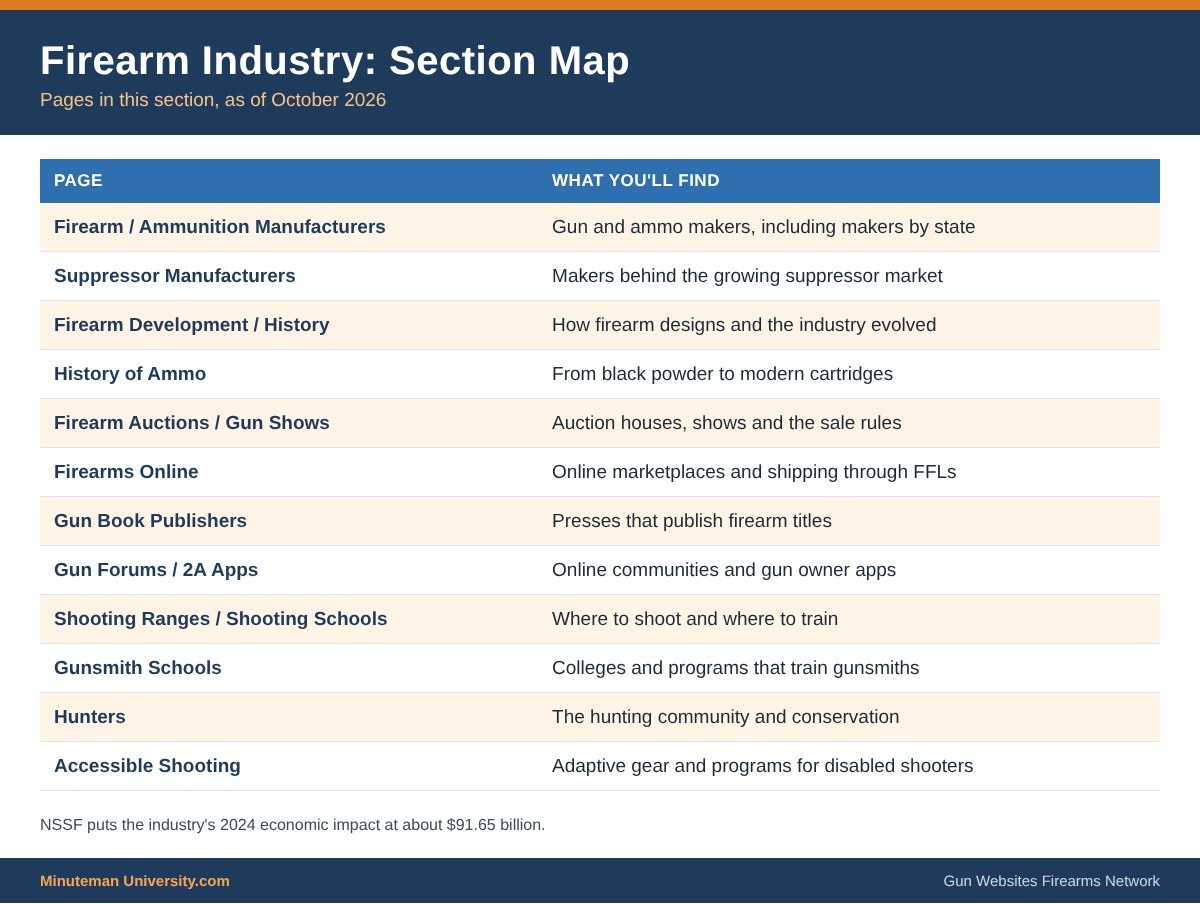
Pages in This Section
- Firearm Manufacturers: American and foreign gun makers, including makers by state.
- Ammunition Manufacturers: the companies that load ammunition and components.
- Suppressor Manufacturers: the makers behind the fast-growing suppressor market.
- Firearm Development: an A-to-Z of how firearm designs evolved.
- Firearm History: key moments in the history of firearms.
- History of Ammo: from black powder to modern cartridges.
- Firearm Auctions: auction houses and how auction purchases are transferred.
- Gun Shows: how gun shows work and the rules that apply to sales.
- Firearms Online: buying, selling and shipping through online marketplaces.
- Gun Book Publishers: publishers of firearm books and manuals.
- Gun Forums: online communities where owners share knowledge.
- 2A Apps: apps for carry laws, range time and gun owner tools.
- Shooting Ranges: indoor and outdoor ranges and how to find one.
- Shooting Schools: training academies and instructor events.
- Gunsmith Schools: colleges and programs that train gunsmiths.
- Hunters: the hunting community and its role in conservation.
- Accessible Shooting: adaptive equipment and programs for shooters with disabilities.
Key Facts
- 1937: Pittman-Robertson Act creates the federal excise tax that funds wildlife restoration.
- 1968: Gun Control Act establishes the modern licensing system for makers, importers and dealers.
- October 26, 2005: PLCAA signed into law.
- 2024: Industry economic impact of about $91.65 billion and 382,995 jobs (NSSF 2025 report).
- 2026: The $0 NFA tax on suppressors, SBRs, SBSs and AOWs takes effect January 1; see Suppressor Buyers Guide.com.
Sources
- NSSF: Firearm and Ammunition Industry Economic Impact
- Pittman-Robertson Federal Aid in Wildlife Restoration Act (Wikipedia)
- 15 U.S.C. Chapter 105, Protection of Lawful Commerce in Arms (Cornell LII)
- 18 U.S.C. 923, Licensing (Cornell LII)
- Firearm Instructors
- Shooting Schools
- Shooting Ranges
- Gunsmith Schools
- Firearm Inventors
- Firearm Industry Timeline
- Firearm Development (a-z)
- History of Ammo
- History of Shooting Sports
- Olympic Shooting & Hall of Fames
- Competition Shooters
- Shooting Sports
- Shooting Sport Calendar
- Accessible Shooting
- Hunting Organizations
- Hunters
- Firearm Collectors
- Firearm Museums
- Firearm Auctions

http://gunshopguide.com/firearm-museums/












- November 5, 1818
- January 1, 1841
- July 10, 1926
- January 2, 1935
- July 10, 1936
- January 1, 1946
- January 1, 1947
- May 10, 1948
- January 1, 1950
- January 1, 1952
- January 1, 1953
- January 1, 1954
- January 1, 1954
- January 1, 1961
- July 10, 1961
- January 1, 1962
- May 1, 1964
- January 1, 1965
- July 20, 1966
- February 1, 1967
- January 1, 1969
- January 1, 1970
- January 1, 1977
- January 1, 1981
- January 1, 1981
- January 1, 1984
- January 1, 1986
- January 1, 1989
- January 1, 1992
- January 1, 1993
- January 1, 1995
- January 1, 1997
- January 1, 1998
- January 1, 1999
- February 19, 1999
- January 1, 2001
- January 1, 2001
- November 30, 2002
- January 1, 2004
- March 5, 2005
- January 1, 2008
- January 4, 2008
- January 1, 2009
- December 18, 2009
- January 1, 2010
- January 1, 2010
- December 18, 2010
- January 1, 2011
- September 8, 2011
- November 26, 2012
- December 1, 2012
- October 3, 2013
- December 1, 2013
- December 15, 2014
- December 1, 2017
- January 1, 2018
- June 15, 2018
- December 1, 2018
- December 1, 2018
- July 11, 2019