Last reviewed October 31, 2026
Antique Firearms: Where It Stands in 2026
Federal law draws a bright line at 1899. Any firearm manufactured in or before 1898, along with certain replicas and black powder muzzleloaders, is an “antique firearm” under the Gun Control Act (18 U.S.C. 921(a)(16)) and is not a “firearm” for most federal purposes. That means no federal Form 4473, no NICS check on a dealer sale and no FFL needed to ship one across state lines. These are the guns that settled the frontier and armed Americans at the time the Fourteenth Amendment was ratified, and collectors preserve that history.
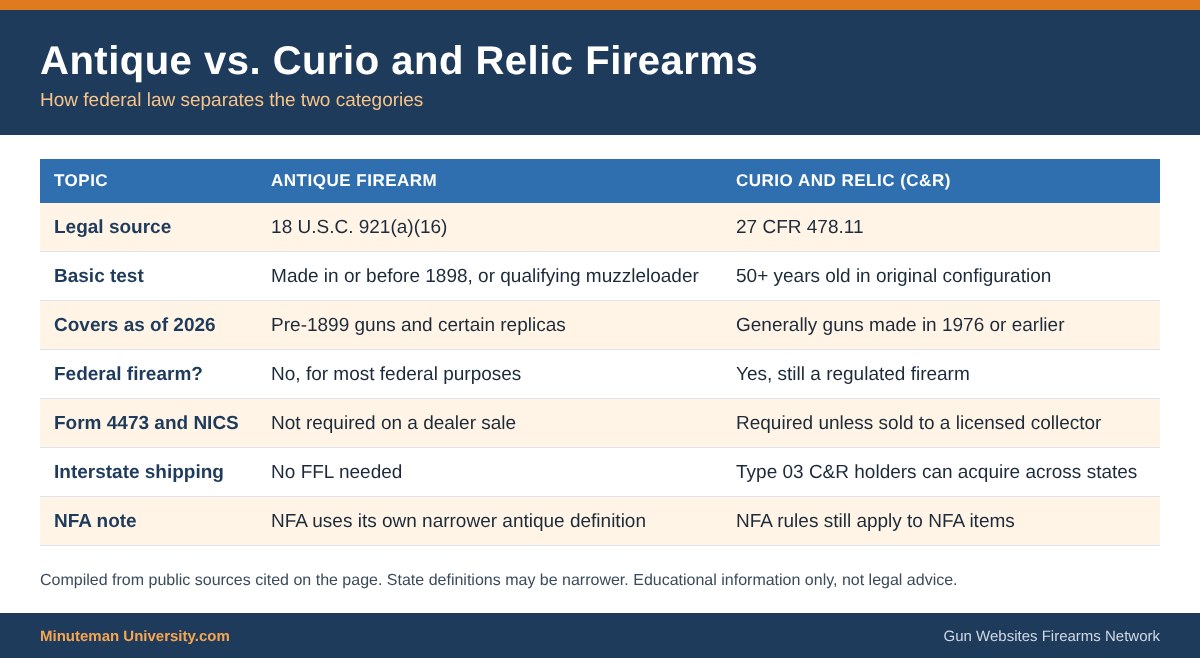
Antiques are different from Curios and Relics (C&R). Under 27 CFR 478.11, a firearm becomes a C&R automatically once it is at least 50 years old and in original configuration, so as of 2026 that generally covers guns made in 1976 or earlier. C&R guns are still regulated firearms, but holders of a Type 03 Collector of Curios and Relics license can acquire them across state lines for their collections. ATF posts a downloadable C&R list (updated July 2025) for items classified by other criteria.
State law is where antique owners can get tripped up. Some states define “antique” more narrowly than federal law, and many still apply carry, transport or prohibited-person rules to antiques. Newer state bans often exempt antiques; Virginia’s 2026 law banning sales of many semi-automatic firearms expressly exempts antique firearms.
Key Facts
- 18 U.S.C. 921(a)(16): antique firearm = manufactured in or before 1898, certain replicas not using conventional fixed ammunition, and qualifying black powder muzzleloaders.
- 26 U.S.C. 5845(g): the NFA has its own narrower antique definition; a pre-1899 short-barreled gun that uses commonly available fixed ammunition can still be an NFA item.
- 27 CFR 478.11: C&R status at 50 years old in original configuration (1976 and earlier as of 2026), or by museum certification or ATF classification.
- Type 03 C&R license: $30 for three years (27 CFR 478.42).
- Virginia SB 749 (effective July 1, 2026) exempts antique firearms from its semi-automatic firearm sales ban.
What Gun Owners Should Know
- Document manufacture dates with serial number records, factory letters or reference books; the burden of proving antique status falls on the owner.
- A modern reproduction of an 1873 revolver chambered in a common cartridge is not an antique, even if the design is.
- Check your state’s definitions before buying, carrying or shipping an antique, especially if you live in a restrictive state.
- Collectors interested in C&R guns can review the Federal Firearms License page for the Type 03 license.
- Related pages: Primitive Weapons and the National Firearms Act. Firearms history dates are on Gun Calendars.com.