Last reviewed October 31, 2026
Ammunition Bans: Where It Stands in 2026
Ammunition laws rarely ban ammunition outright. Instead they restrict who may buy it, how it is sold, or which specific types may be made and sold. For gun owners the practical effect can be the same as a ban: a firearm without ammunition cannot be used for self-defense, hunting or practice. Courts have long recognized this link, and post-Bruen challenges increasingly argue that the right to keep and bear arms includes the right to acquire the ammunition needed to use them.
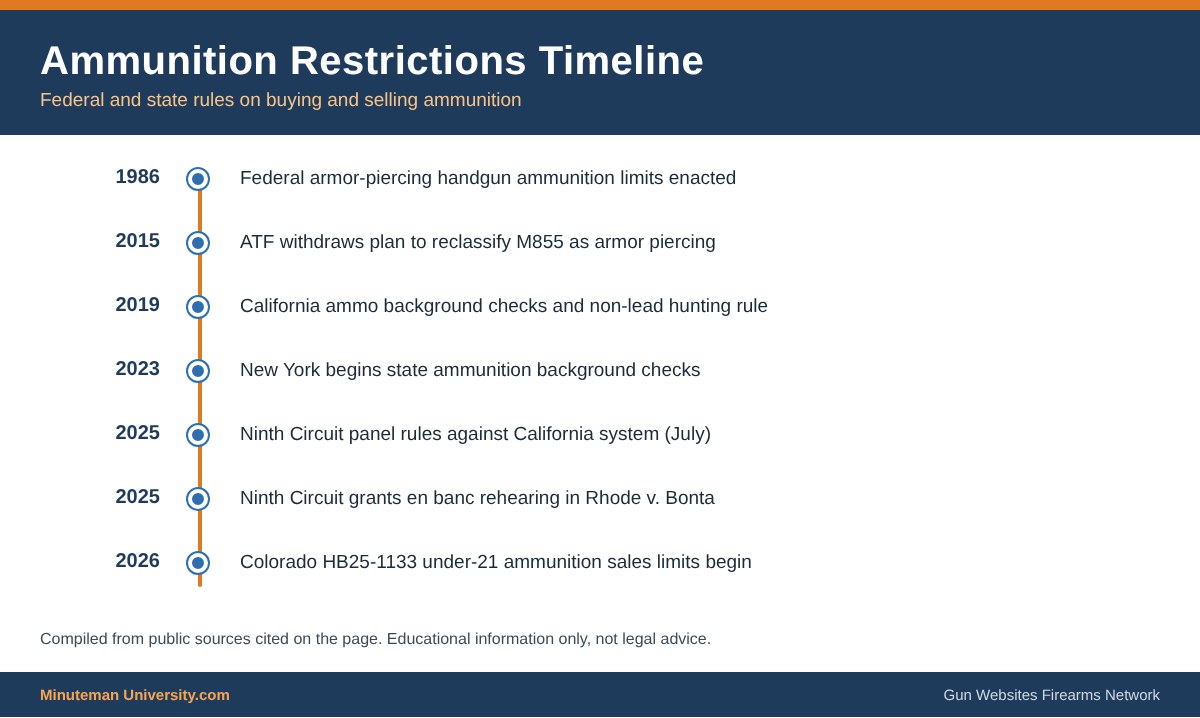
At the federal level, restrictions are narrow. Since 1986, federal law has barred the manufacture, import and dealer sale of “armor piercing ammunition,” defined in 18 U.S.C. 921(a)(17)(B) as handgun-capable projectiles made of certain hard metals or with jacket weights above a set limit. Licensed dealers may not sell handgun ammunition to buyers under 21 or rifle and shotgun ammunition to buyers under 18 (18 U.S.C. 922(b)(1)), and anyone prohibited from possessing firearms under 18 U.S.C. 922(g) is also prohibited from possessing ammunition. In 2015, ATF proposed treating common M855 5.56mm rifle ammunition as armor piercing, then shelved the proposal after public opposition.
Most restrictions are at the state level and fall into three groups. First, point-of-sale checks: California has required a background check for every ammunition purchase since July 1, 2019, and New York added a state ammunition background check in September 2023. Second, license requirements: Illinois (FOID card), Massachusetts (FID or LTC), New Jersey (firearms ID card or permit) and Connecticut (ammunition certificate or permit) require a state credential to buy ammunition. Third, type or age limits: California has required non-lead ammunition for all hunting since July 1, 2019, and Colorado’s HB25-1133, effective July 1, 2026, bars most retail centerfire ammunition sales to buyers under 21 and requires ammunition to be kept behind the counter or in locked cases. Supporters say these laws keep ammunition from prohibited persons; opponents say they burden lawful buyers with fees, delays and erroneous rejections while providing little benefit.
The leading court test is Rhode v. Bonta, a challenge to California’s background-check and out-of-state import rules. A Ninth Circuit panel ruled the system unconstitutional on July 24, 2025, but the full court granted rehearing en banc on December 1, 2025, vacating that decision, and heard argument in March 2026. California’s system stays in effect while the en banc court decides. Ammunition history is covered under the site’s Firearm History section; the Background Checks page covers firearm purchase checks.
Key Facts
- 1986: The Law Enforcement Officers Protection Act created the federal armor-piercing handgun ammunition restrictions now in 18 U.S.C. 921(a)(17)(B) and 922(a)(7)-(8).
- March 2015: ATF withdrew its proposed framework that would have reclassified M855 rifle ammunition as armor piercing.
- July 1, 2019: California’s point-of-sale ammunition background checks and statewide non-lead hunting ammunition requirement both took full effect.
- September 2023: New York began state-run background checks on ammunition sales.
- July 1, 2024: California’s 11 percent state excise tax on firearms, parts and ammunition took effect.
- December 1, 2025: The Ninth Circuit granted en banc rehearing in Rhode v. Bonta; argument followed in March 2026 and a decision is pending.
- July 1, 2026: Colorado’s HB25-1133 under-21 ammunition sales limits and display rules took effect; rimfire ammunition is exempt.
What Gun Owners Should Know
- Know your state’s purchase rules before ordering online. Several states require shipment to a licensed vendor for a check or require proof of a state license, and out-of-state retailers may refuse to ship.
- Bringing ammunition home from another state can be a crime in states that restrict imports. California, for example, generally requires ammunition brought in by residents to go through a licensed vendor, with limited exceptions.
- Prohibited persons may not possess ammunition under federal law, even a single round. A family member’s ammunition in a shared home can create legal risk for a prohibited household member.
- Hunters in California must use non-lead ammunition for all hunting; other states and some federal lands have their own rules for waterfowl and specific areas.
- Keep receipts and records of lawful purchases and denials. If a background check rejects a lawful buyer, state appeal procedures and the federal background check process are the path to correction.
- Ammunition and safety questions can be submitted at Ask Gun Questions.com; legal timelines are tracked at Gun Calendars.com.
Across the Gun Websites Network
- Bullet Types Ammo Buyers Guide.com
- Ammo F.A.Q. Ammo Buyers Guide.com
- Is lead ammunition really a health problem? Ask Gun Questions.com