Setting up an IndieGoGo Campaign: Crowdfunding a 2A Project
Crowdfunding lets a 2A project raise money from its audience before a book, documentary, app, event or training program is finished. There are three basic models. Rewards-based campaigns give backers a product or perk. Donation campaigns offer nothing in return. Equity campaigns offer a share of the business and fall under securities law. Indiegogo and Kickstarter are rewards-based platforms. Indiegogo was founded in 2008, and Gamefound announced in July 2025 that it had acquired the company.
Platform rules come first. Indiegogo’s Community Guidelines list “Weapons, Ammunition and Related Accessories” among prohibited campaigns and perks. Kickstarter’s rules prohibit “weapons, replicas of weapons, and weapon accessories.” The rules are enforced: in October 2017 Indiegogo suspended firearm-related campaigns, including one that had already raised money. Projects about firearms, such as education, history, legal-rights content, media or events, are not weapon products, but the platform’s reviewers make the final call. Plan for the possibility of rejection, and contact support before launch if the project is close to the line.
Alternatives used by the gun community. Many 2A creators skip the big platforms and take pre-orders or donations on their own site through a processor that accepts the business (see Building an Online Store). Others raise money through a nonprofit or build recurring support with affiliate and membership income. Gun-focused crowdfunding sites such as Gun Dynamics and FireFunder were announced around 2018. Confirm that any such platform is still operating, and review its terms and payment handling, before planning around it.
Legal cautions. Firearms, ammunition and regulated parts cannot be offered as perks on mainstream platforms. Any firearm transfer must also follow federal and state law, including FFL transfers and background checks. Raffles and sweepstakes are governed by state gambling laws. Offering equity, profit shares or revenue shares makes the campaign a securities offering. Under Regulation Crowdfunding, a company can raise up to $5 million in 12 months, and only through an SEC-registered broker-dealer or funding portal.
Key Facts
- Indiegogo policy: Its Community Guidelines prohibit “Weapons, Ammunition and Related Accessories” in campaigns and perks.
- Kickstarter policy: Its rules prohibit weapons, replicas of weapons and weapon accessories.
- October 2017: Indiegogo suspended firearm-related campaigns, including the AF Loader campaign.
- July 2025: Gamefound announced its acquisition of Indiegogo.
- Regulation Crowdfunding: Up to $5 million per 12 months, through an SEC-registered intermediary, with disclosures filed with the SEC on Form C.
- Taxes: Gifts to 501(c)(3) charities can be tax-deductible. Gifts to 501(c)(4) advocacy groups and to personal or for-profit campaigns generally are not.
Steps
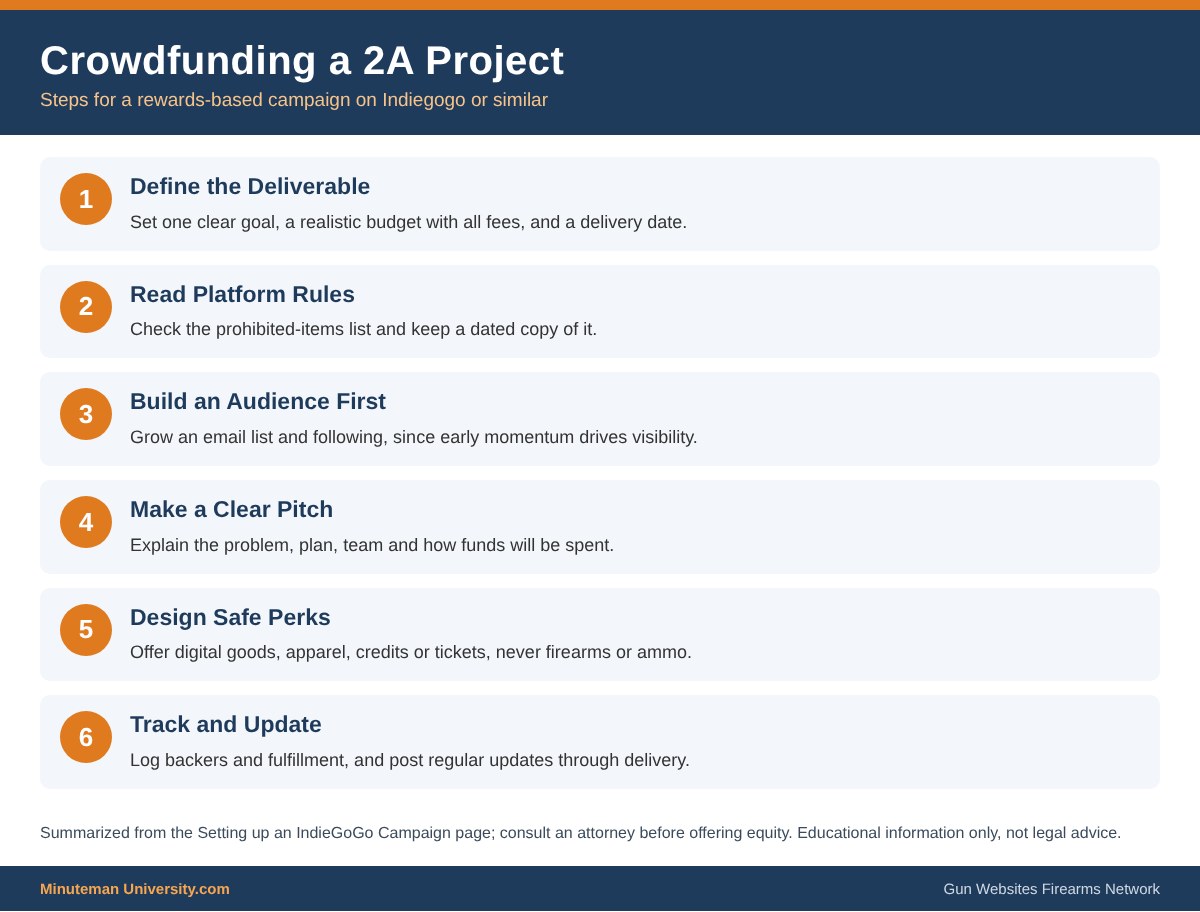
- Define one clear deliverable, a realistic budget and a delivery date. Include platform fees, payment processing, taxes and shipping in the budget.
- Read the platform’s prohibited-items list and keep a dated copy. Avoid images or perks that could be read as weapon products.
- Build an email list and social following before launch. Early momentum in the first days drives visibility.
- Write a short pitch video and page that explain the problem, the plan, the team and how funds will be spent.
- Design perk tiers around digital goods, apparel, name credits, event tickets or signed copies, never firearms or ammunition.
- Track backers, perks and fulfillment in a shared spreadsheet (see Using Google Sheets), and post regular updates through delivery.
- Consult an attorney before offering equity or revenue shares, or before running any giveaway that involves firearms.