Last reviewed November 1, 2026
Stand Your Ground: Where It Stands in 2026
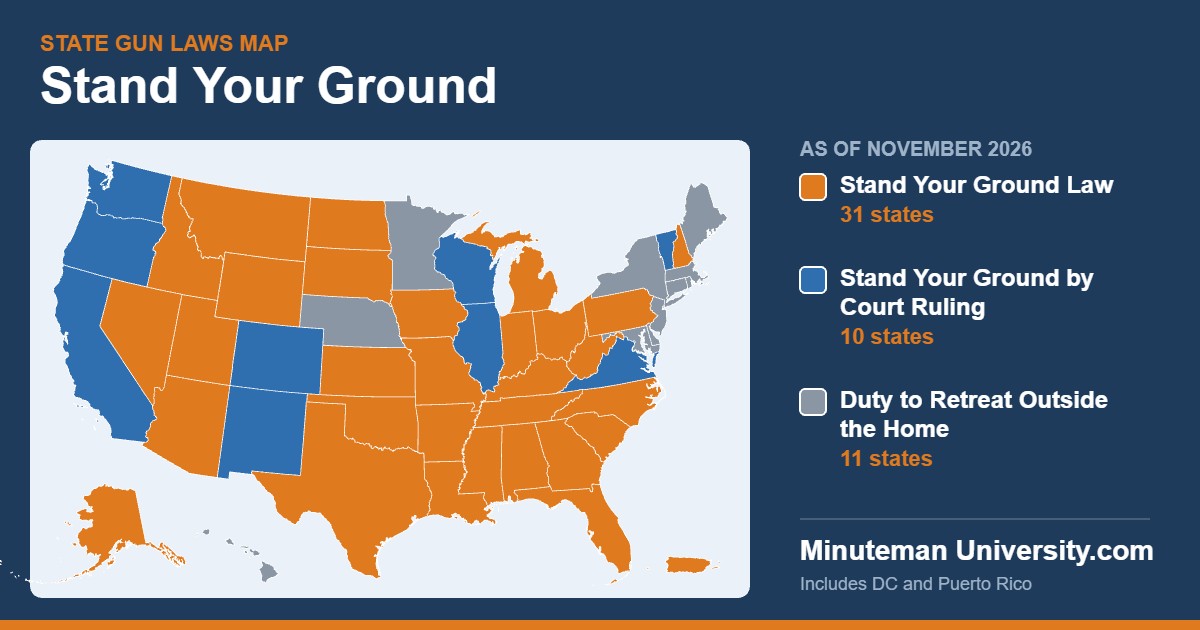
Stand Your Ground is now the majority rule in America. A law-abiding person who is attacked in a place where they have a lawful right to be is not required to turn their back on an attacker before using force in self-defense. According to the National Conference of State Legislatures (NCSL), at least 31 states have no-duty-to-retreat rules in statute or case law, and several more, including California, Colorado, Illinois, Virginia and Washington, recognize the principle through court decisions or jury instructions.
Warning: maps are habit forming. Next stop, 2A Maps
Stand Your Ground Law (31): Alabama, Alaska, Arizona, Arkansas, Florida, Georgia, Idaho, Indiana, Iowa, Kansas, Kentucky, Louisiana, Michigan, Mississippi, Missouri, Montana, Nevada, New Hampshire, North Carolina, North Dakota, Ohio, Oklahoma, Pennsylvania, Puerto Rico, South Carolina, South Dakota, Tennessee, Texas, Utah, West Virginia, Wyoming
Stand Your Ground by Court Ruling (10): California, Colorado, District of Columbia, Illinois, New Mexico, Oregon, Vermont, Virginia, Washington, Wisconsin
Duty to Retreat Outside the Home (11): Connecticut, Delaware, Hawaii, Maine, Maryland, Massachusetts, Minnesota, Nebraska, New Jersey, New York, Rhode Island
How this map is researched, from statute to state note: How We Research.
The modern movement began with Florida in 2005 and grew steadily, most recently with Ohio and Arkansas in 2021. Gun-rights advocates see these laws as restoring a common-sense rule: the burden belongs on the aggressor, not on the victim forced to decide in a split second whether a safe escape exists. Several states, led by Florida, also provide immunity from prosecution and civil suits for justified self-defense, which protects defenders from years of costly litigation.
Stand Your Ground does not make any use of force legal. Every state still requires that the defender not be the aggressor, be in a place they are lawfully allowed to be, and reasonably believe force is necessary to prevent imminent death, great bodily harm or a forcible felony. A small number of states, such as New Jersey and Rhode Island, still impose a duty to retreat outside the home when it can be done in complete safety. Inside the home, the related Castle Doctrine applies.
Key Facts
- 2005: Florida enacted the first modern Stand Your Ground statute (Fla. Stat. 776.012 and 776.013), effective October 1, 2005, with immunity under Fla. Stat. 776.032.
- 2017: Florida amended its law to require prosecutors, not defendants, to overcome a self-defense immunity claim at a pretrial hearing by clear and convincing evidence.
- 2021: Ohio removed its duty to retreat in public places (SB 175, signed January 4, 2021, effective April 6, 2021). Arkansas did the same in 2021 (Act 250).
- As of 2026: NCSL counts at least 31 states with Stand Your Ground in statute or case law, with about eight more recognizing it through case law or jury instructions; exact counts vary by source because of how case-law states are classified.
- Pennsylvania’s 2011 law limits no-retreat protection outside the home to situations where the attacker displays or uses a lethal weapon.
What Gun Owners Should Know
- Read your own state’s self-defense statute and know whether it has a duty to retreat, an immunity provision, or only case-law protection.
- Stand Your Ground never protects the initial aggressor or someone engaged in criminal activity at the time.
- Laws differ sharply across state lines. Check the destination state before traveling armed; see Concealed Carry Reciprocity.
- De-escalation and avoidance remain the best outcome. Quality training from sources like After Action.net builds judgment as well as skill.
- Know the legal-defense options available before an incident; see CCW Insurance.
- Have specific questions? Submit them at Ask Gun Questions.com, and consult a licensed attorney in your state.
Sources
- NCSL: Self-Defense and Stand Your Ground
- Florida Statutes Chapter 776: Justifiable Use of Force
- Ohio General Assembly: Senate Bill 175 (133rd GA)
Background and Resources
Stand Your Ground is the right to use reasonable force, when threatened with bodily harm or death, without having to first attempt to retreat
- 2005 Florida passed the first stand your ground law
Stand Your Ground is the opposite of “Duty to Retreat”
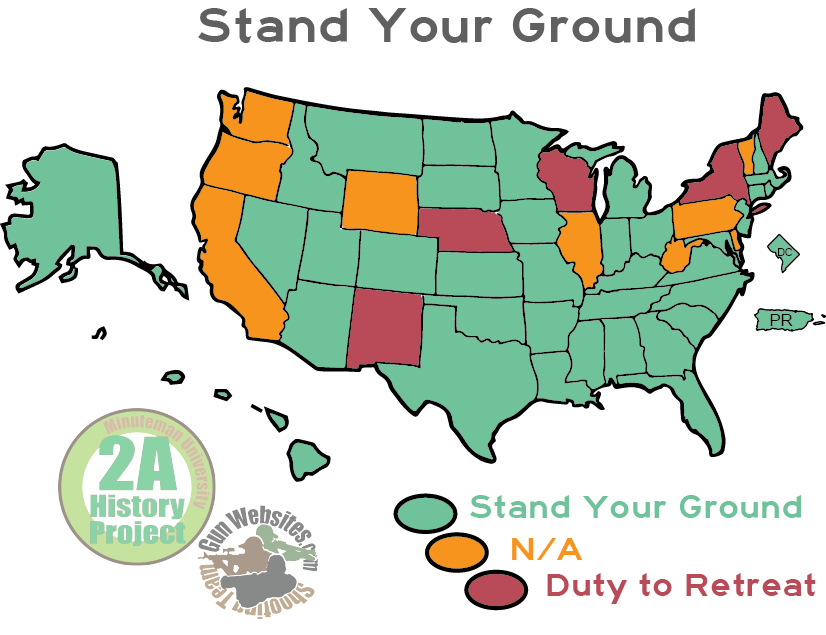 Hand-built in 2021. This map stood its ground for years before the robots showed up with their fancy clickable states.
When you “Stand your Ground” on your own property it involves Castle Doctrine