Last reviewed October 31, 2026
Gun Free Zones: Where They Stand in 2026
A “gun free zone” is any place where the law, or a property owner, forbids lawful carry. Gun-rights advocates have long argued that these zones disarm only the law-abiding: a person willing to commit murder is not stopped by a sign, while the permit holder who obeys it is left defenseless. Federal law creates several such zones, including K-12 school zones (18 U.S.C. 922(q)), federal facilities (18 U.S.C. 930) and post office property (by regulation), and many states add their own lists of “sensitive places.”
Since NYSRPA v. Bruen (2022), every gun free zone must be justified by the nation’s historical tradition of firearm regulation. Bruen accepted a short list of historically recognized sensitive places, such as legislative assemblies, polling places and courthouses, but warned that a state may not declare an entire city a sensitive place. Several states responded with long new lists of off-limits locations, and the lawsuits that followed are still working through the courts. The Supreme Court declined to hear New York’s case, Antonyuk v. James, in April 2025, leaving most of that state’s list in place for now.
The biggest recent win came on June 25, 2026, when the Supreme Court decided Wolford v. Lopez (6-3). The Court struck down Hawaii’s rule that made all private property open to the public a no-carry zone unless the owner gave express permission, the so-called “vampire rule.” Property owners still decide for themselves, but the state may not flip the default against permit holders. On the legislative side, Wyoming repealed most of its gun-free zones effective July 1, 2025, opening government meetings and most University of Wyoming buildings, among other places, to permit holders.
Key Facts
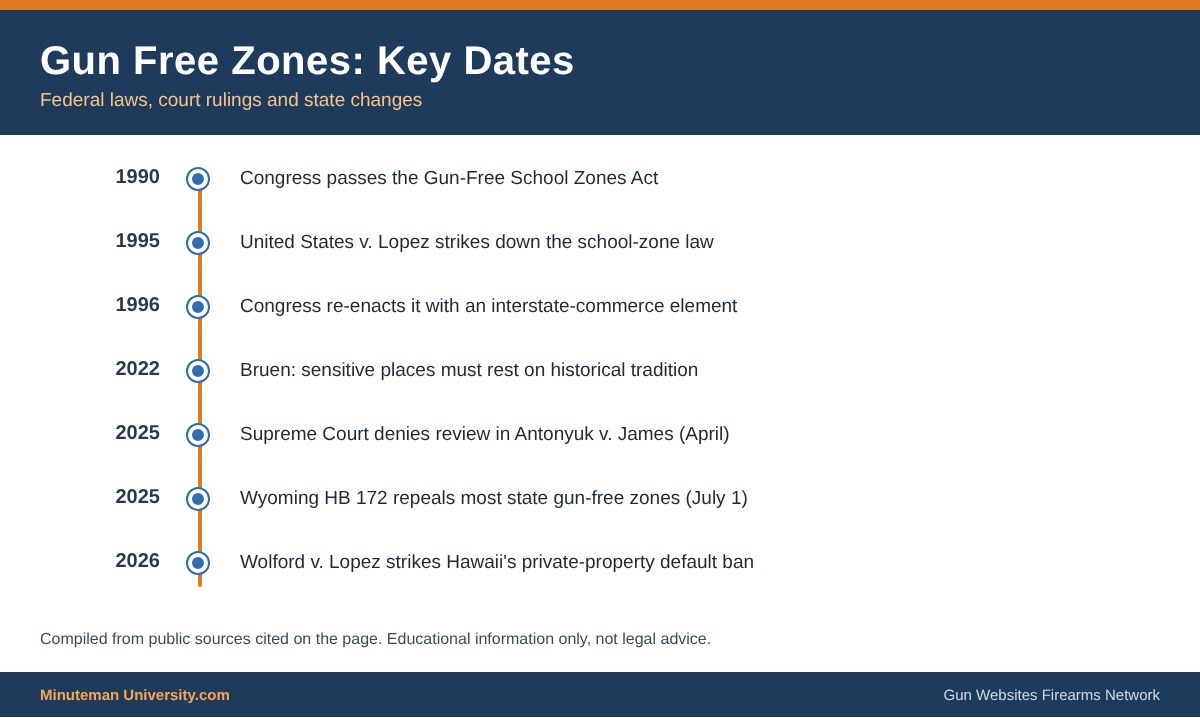
- 1990: Congress passed the Gun-Free School Zones Act. April 26, 1995: United States v. Lopez struck it down as beyond Congress’s Commerce Clause power. 1996: Congress re-enacted it with an interstate-commerce element.
- The federal school-zone law exempts people licensed by the state in which the school zone is located (18 U.S.C. 922(q)(2)(B)(ii)), which is one reason permits still matter in constitutional carry states.
- June 23, 2022: Bruen confirmed that “sensitive places” must be grounded in historical tradition.
- April 7, 2025: The Supreme Court denied review in Antonyuk v. James (No. 24-795), the challenge to New York’s post-Bruen sensitive-places law.
- July 1, 2025: Wyoming HB 172 repealed most statutory gun-free zones in the state.
- June 25, 2026: Wolford v. Lopez struck down Hawaii’s default ban on carry onto private property open to the public.
What Gun Owners Should Know
- Know your state’s list of prohibited places, and know whether posted “no guns” signs carry the force of law or only allow the owner to ask you to leave.
- Federal buildings, post offices, airports past security, and K-12 school zones have their own federal rules that apply in every state.
- Plan ahead for safe, lawful vehicle storage when you must enter a prohibited place.
- College rules vary widely; see Campus Carry.
- Follow the major rulings on the Court Cases page and support the groups challenging these laws.
Sources
- 18 U.S.C. 922 (including 922(q), Gun-Free School Zones)
- New York State Rifle & Pistol Ass’n v. Bruen (2022), Supreme Court opinion
- Supreme Court Docket No. 24-795, Antonyuk v. James
- Volokh Conspiracy: Supreme Court Decides Wolford v. Lopez (June 25, 2026)
- Wyoming Legislature: HB 172 (2025)