Last reviewed November 1, 2026
Second Amendment Sanctuary Laws: Where They Stand in 2026
Second Amendment sanctuary laws rest on a settled principle: the federal government cannot commandeer state and local officers to carry out federal programs. The Supreme Court confirmed that anti-commandeering rule in Printz v. United States (1997), a case brought by sheriffs against the Brady Act. Sanctuary counties and states use it to declare that their own officers and resources will not be used to enforce gun restrictions they view as unconstitutional.
More maps than the glovebox of a lost elk hunter: Gun Law Maps by State
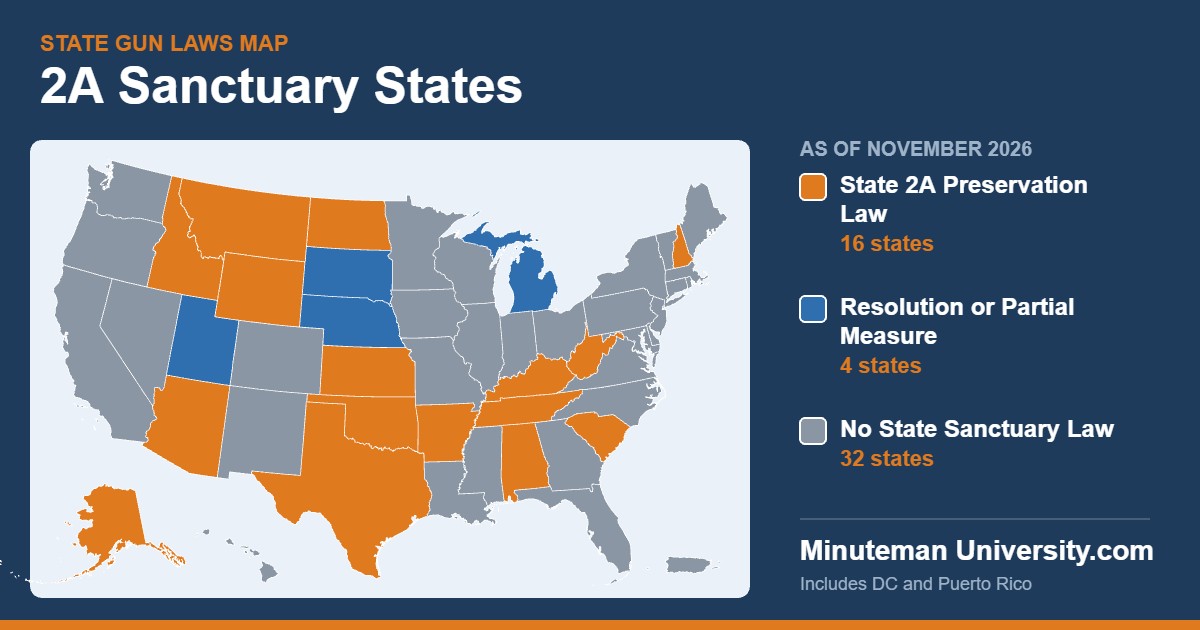
State 2A Preservation Law (16): Alabama, Alaska, Arizona, Arkansas, Idaho, Kansas, Kentucky, Montana, New Hampshire, North Dakota, Oklahoma, South Carolina, Tennessee, Texas, West Virginia, Wyoming
Resolution or Partial Measure (4): Michigan, Nebraska, South Dakota, Utah
No State Sanctuary Law (32): California, Colorado, Connecticut, Delaware, District of Columbia, Florida, Georgia, Hawaii, Illinois, Indiana, Iowa, Louisiana, Maine, Maryland, Massachusetts, Minnesota, Mississippi, Missouri, Nevada, New Jersey, New Mexico, New York, North Carolina, Ohio, Oregon, Pennsylvania, Puerto Rico, Rhode Island, Vermont, Virginia, Washington, Wisconsin
How this map is researched, from statute to state note: How We Research.
The 2A Sanctuary Counties map shows how far local action has spread in each state, from a statewide law that covers every county to states where no county has acted. Open 2A Maps to see the number of sanctuary counties printed on every state, with ALL marking states where a statewide law covers every county.
The movement exploded in 2019 through 2021. By mid-2021, sanctuarycounties.com counted 1,753 of the nation’s 3,144 counties, more than half, as Second Amendment sanctuaries or located in sanctuary states, and Missouri was described as the 14th sanctuary state. Most county resolutions are statements of policy. State laws carry more weight because they bind state agencies and police.
The courts have drawn a line, however. Missouri’s Second Amendment Preservation Act (2021) went further than refusing cooperation: it declared certain federal gun laws invalid and allowed lawsuits against local agencies whose officers helped enforce them. A federal district court struck the law down in March 2023, the Eighth Circuit affirmed in August 2024, and the Supreme Court denied review on October 6, 2025 (Missouri v. United States, No. 24-796). The lesson for 2026: refusing to lend state resources to federal enforcement is on solid ground, while declaring federal law void is not. Separately, ATF’s October 9, 2026 decision to stop enforcing NFA registration for suppressors, short-barreled rifles and shotguns, and AOWs has taken much of the pressure off state “NFA sanctuary” laws, though state laws on those items still apply.
Key Facts
- June 27, 1997: Printz v. United States holds that Congress cannot require state and local officers to run federal background checks; the basis for anti-commandeering sanctuary laws.
- June 2021: sanctuarycounties.com counts 1,753 of 3,144 U.S. counties as sanctuaries or in sanctuary states.
- 2021: Missouri enacts the Second Amendment Preservation Act (SAPA), with $50,000 civil penalties against agencies that employ officers who enforce covered federal laws.
- March 2023: SAPA struck down in federal district court; August 2024: Eighth Circuit affirms; October 6, 2025: Supreme Court denies certiorari.
- October 9, 2026: ATF announces nationwide non-enforcement of NFA approval and registration for suppressors, SBRs, SBSs and AOWs, a federal change that does not depend on any state sanctuary law.
What Gun Owners Should Know
- A sanctuary resolution does not make anything legal under federal law. Federal agents can still enforce federal law in a sanctuary county.
- State sanctuary laws do not change state gun laws. If a state requires a permit or bans an item, a county resolution does not override that.
- Read the actual text. Many county resolutions are non-binding, while some state statutes limit what state police and agencies may do.
- For NFA items, follow federal and state rules on NFA Buyers Guide.com and Suppressor Buyers Guide.com.
- Related pages: State Preemption, State Firearm Laws, and Court Cases.
Sources
- SCOTUSblog: Missouri v. United States
- The Reload: Supreme Court Rejects Missouri Gun Law Nullification Case
- Duke Center for Firearms Law: Second Amendment Sanctuaries
- American Rifleman: ATF Ends Enforcement of NFA Registration Requirements
Background and Resources
Second Amendment Sanctuaries
- Second Amendment Sanctuary States
- Second Amendment Sanctuary Counties
- NFA Sanctuary States
The origin and history of Second Amendment Sanctuary laws
The Second Amendment Sanctuary movement began in the United States in the early 2010s, although the origins of the movement can be traced back to earlier events. The Second Amendment to the U.S. Constitution protects the right of Americans to keep and bear arms, and this right has been a subject of intense debate and controversy for many years.
In recent years, there have been concerns among some gun owners and activists that the federal government is seeking to restrict or regulate gun ownership and possession in ways that violate the Second Amendment. In response to these concerns, a number of local governments and jurisdictions have adopted so-called “Second Amendment Sanctuary” laws or resolutions.
The first Second Amendment Sanctuary law was passed in 2018 by Effingham County, Illinois. Similar laws and resolutions have since been adopted by a growing number of counties and municipalities across the country, particularly in states with strong gun cultures such as Texas and Florida.
These laws and resolutions generally declare that local officials will not enforce federal laws or regulations that they believe infringe on the Second Amendment rights of citizens. Supporters of these laws argue that they are necessary to protect the constitutional rights of citizens, while opponents argue that they undermine the rule of law and can lead to confusion and conflict between state and federal authorities.
The movement gained significant momentum in 2020, as the COVID-19 pandemic and social unrest prompted a surge in gun sales and heightened fears of government overreach. In response, several states, including Arizona, Idaho, and Wyoming, passed laws strengthening the legal protections for gun owners and declaring their states to be “Second Amendment sanctuaries.”
Overall, the Second Amendment Sanctuary movement reflects ongoing debates and controversies over gun ownership and regulation in the United States, and highlights the tension between federal and state authority in a country with a strong tradition of individual rights and local autonomy.
- Much like the Marijuana laws in some states that protect the citizens from federal laws
Second Amendment Sanctuary States
 Hand-drawn in 2021, a sanctuary for human craftsmanship before the robots moved in.
Second Amendment Sanctuary Counties
 Every county on this 2021 map was colored by a human. The robots still have not forgiven us for the workload.

https://sanctuarycounties.com/category/map-updates/national-maps/
NFA Sanctuary States
 Another 2021 classic from the before-times, when maps were static and the robots were still in training.