Last reviewed October 31, 2026
ATF Comment Periods: Where It Stands in 2026
Public comment periods are one of the few places where gun owners get a direct, on-the-record say in federal firearm regulation. Under the Administrative Procedure Act, ATF must publish a proposed rule, accept public comments and respond to them before a rule becomes final. Gun owners used that process to build the record against the 2021 brace and frame/receiver proposals listed below, and courts later relied on procedural failures in that record when they struck rules down.
2026 brought the largest wave of ATF proposals in years, and this time most of them roll back burdens instead of adding them. On April 29–30, 2026, the Justice Department announced ATF’s “New Era of Reform,” a package of more than 30 actions issued under Executive Order 14206. Several of these were published in the Federal Register on May 6, 2026, with comment windows that closed in early August 2026. Gun-rights groups, gun-control groups and 22 state attorneys general all filed comments, so the final rules are expected to face litigation from both directions.
Not every reform goes through a comment period. ATF issued some technical changes as final rules directly, and it says more proposals, including possible changes to the frame/receiver rule upheld in Bondi v. VanDerStok (March 26, 2025), will be released for comment once legal review is complete.
Key Facts
- Removing Factoring Criteria for Firearms with Attached “Stabilizing Braces”: published May 6, 2026; Docket ATF-2026-0335, RIN 1140-AA98; 90-day comment period. It would remove the 2023 brace rule’s additions to the definition of “rifle,” a rule already vacated in Mock v. Garland (N.D. Tex., June 2024).
- Revising Regulations Defining “Engaged in the Business” (RIN 1140-AB01): comments closed August 4, 2026. A federal court had already vacated the 2024 rule nationwide.
- Firearm Records Retention Periods (RIN 1140-AA95): comments closed August 4, 2026. It would end indefinite retention of Forms 4473 and set a 20- or 30-year limit.
- Firearms Transactions and Straw Purchases (RIN 1140-AA78): comments closed August 4, 2026. NRA urged withdrawal, arguing the proposed definition goes beyond the 2022 Bipartisan Safer Communities Act.
- Revising Form 4473 (RIN 1140-AA82): comments closed August 6, 2026. It would clarify ID and residency documents (important for military members) and extend a 4473’s validity from 30 days to two calendar months.
- Bump stocks: the 2018 rule, which drew 193,297 comments, was struck down by the Supreme Court in Garland v. Cargill (June 14, 2024).
What Gun Owners Should Know
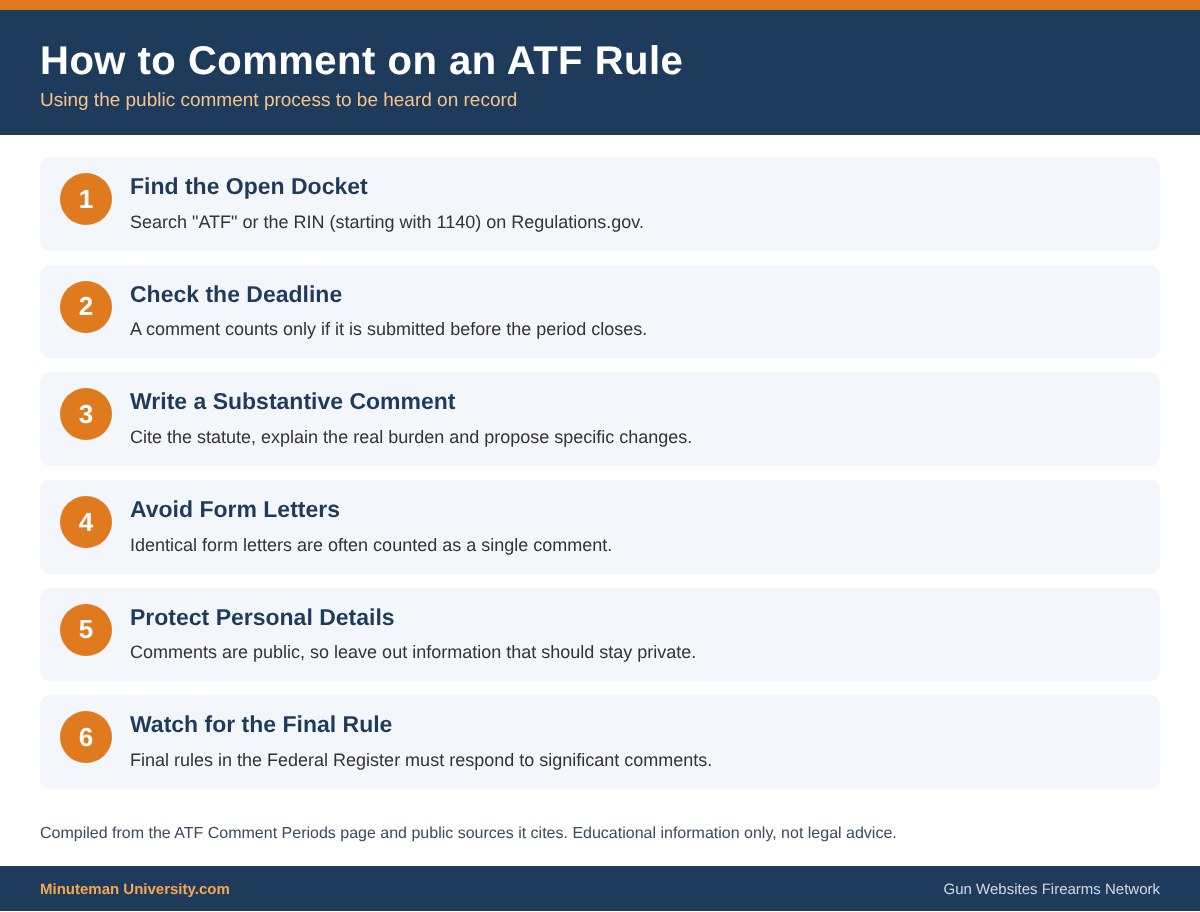
- Find open dockets by searching “ATF” or the RIN (it starts with 1140) on Regulations.gov. A comment counts only if it is submitted before the deadline.
- Write substantive comments: cite the statute, explain the real cost or burden, and propose specific changes. Form letters are often counted as a single comment.
- Comments are public. Leave out personal details you would not want published.
- Watch for final rules in the Federal Register. A final rule must respond to significant comments, and that response is often what courts review.
- Follow the litigation on the Court Cases page, enforcement changes on the Firearm Law Enforcement page, and NFA updates at NFA Buyers Guide.com.
Sources
- Federal Register: Removing Factoring Criteria for Firearms with Attached “Stabilizing Braces” (NPRM, May 6, 2026)
- ATF: New Era of Reform Questions and Answers
- NRA-ILA: NRA Submits Comments on Several ATF Rulemakings (August 3, 2026)
- Supreme Court: Garland v. Cargill (June 14, 2024)
- Regulations.gov
Background and Resources
We have dealt with multiple Comment Periods from the ATF, here are the links to past ATF Comment Periods
Factoring Criteria for Firearms with Attached “Stabilizing Braces”
- June 9, 2021 – Sep 8, 2021
- Regulations.gov docket ATF-2021-0002: Stabilizing Braces proposed rule (2021)
Definition of Frame or Receiver & Identification of Firearms
- May 20, 2021 – Aug 19, 2021
- Regulations.gov docket ATF-2021-0001: Frame or Receiver proposed rule (2021)
Classifying Weapons with “Stabilizing Braces”
- Dec 17, 2020
– Ended after a week - 7,500 comments approved
- 73,536 submitted
- Regulations.gov docket ATF-2020-0001: Stabilizing Braces notice (2020)
Bump-Stock Type Device
- March 28, 2018
- 95,500 comments approved
- 193,297 submitted
- Regulations.gov docket ATF-2018-0002: Bump-Stock-Type Devices proposed rule (2018)
SS109 and M855 cartridges
- March 10, 2015
– Ended a week early - 80,000 comments
- 236 members of Congress to express their “serious concern.”
- 52 senators expressed displeasure