About Facts vs. Emotion
Gun policy debates often follow high-profile tragedies, when emotions run highest and claims spread fastest. Grounding a discussion in evidence, while respecting the real grief and fear behind it, is the most credible path for Second Amendment advocates. One of the most comprehensive neutral references is RAND Corporation’s Gun Policy in America initiative, first released in March 2018 and updated in 2020 and 2024. Its fourth edition of The Science of Gun Policy reviews research published from 1995 through early 2023 across 18 classes of state gun laws and eight outcomes, and rates the evidence for each policy as supportive, moderate, limited, inconclusive or nonexistent.
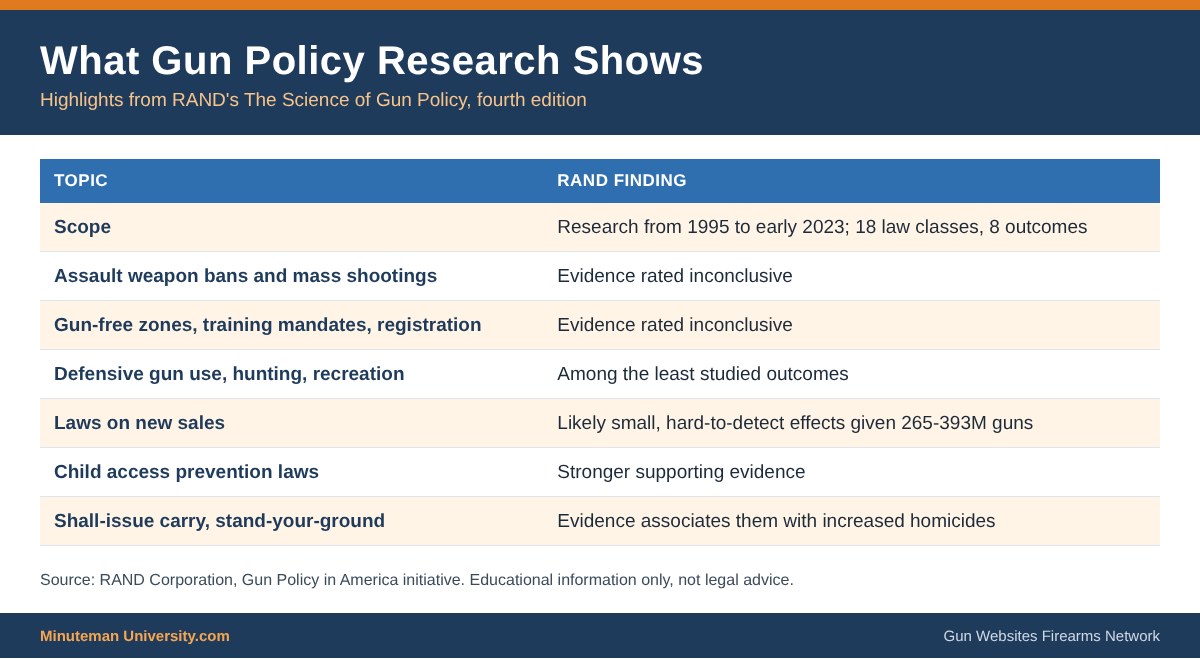
The results cut in more than one direction, which is exactly why they are useful. RAND rates the evidence on assault weapon bans and mass shootings as inconclusive, along with gun-free zones, training mandates and registration. It also notes that defensive gun use, hunting and recreation are among the least studied outcomes, making full cost-benefit analysis difficult, and that with an estimated 265 to 393 million privately owned guns in the U.S., laws affecting new sales are likely to have small, hard-to-detect effects. At the same time, RAND reports stronger evidence for some measures, such as child access prevention laws, and finds evidence associating shall-issue carry and stand-your-ground laws with increased homicides, findings advocates should be prepared to discuss. Knowing what the research does and does not show builds trust.
Key Facts
- March 2018: RAND launches its Gun Policy in America initiative
- April 2020: Second edition adds five policy classes and 123 more qualifying studies
- 2019: Congress appropriates $25 million for gun-related mortality research
- 2024: Fourth edition reviews research from January 1995 through February 2023
- 2024: Evidence on assault weapon bans and mass shootings rated inconclusive; defensive gun use among least studied outcomes