Last reviewed November 1, 2026
U.S. v. Hemani (2026)
On June 18, 2026, the Supreme Court ruled 9-0 in United States v. Hemani that the government could not prosecute a man for owning a gun at home based only on his regular marijuana use. Federal law, 18 U.S.C. 922(g)(3), bars any “unlawful user” of a controlled substance from possessing firearms. The Court found no historical tradition supporting that blanket ban as applied to someone who was not shown to be dangerous or intoxicated while armed.
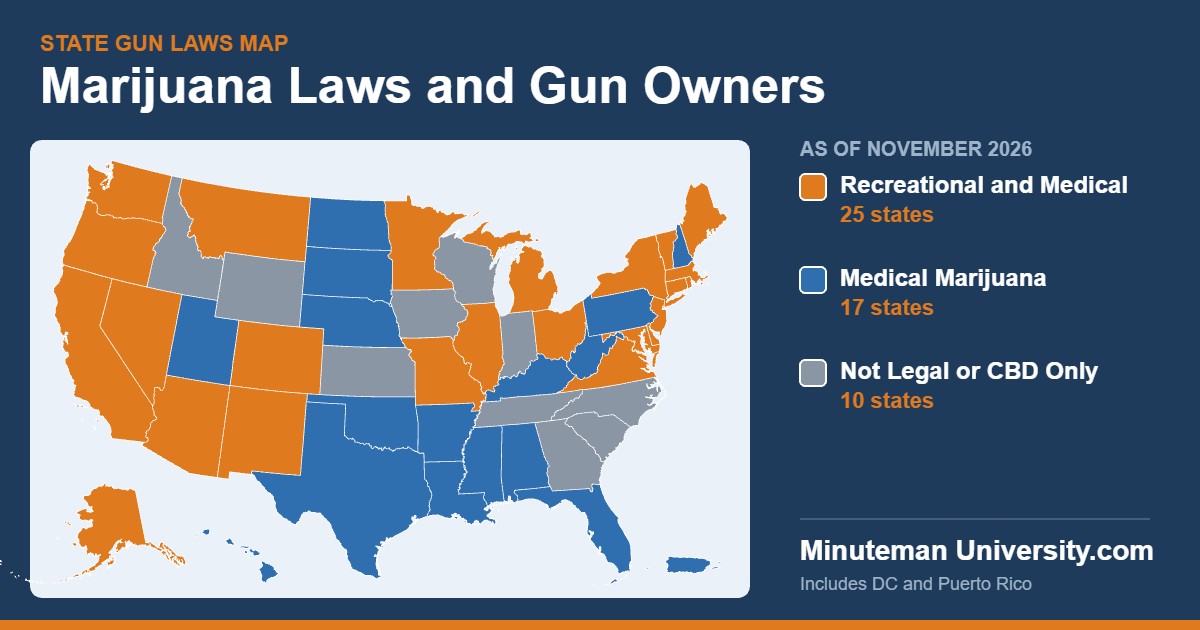
Recreational and Medical (25): Alaska, Arizona, California, Colorado, Connecticut, Delaware, District of Columbia, Illinois, Maine, Maryland, Massachusetts, Michigan, Minnesota, Missouri, Montana, Nevada, New Jersey, New Mexico, New York, Ohio, Oregon, Rhode Island, Vermont, Virginia, Washington
Medical Marijuana (17): Alabama, Arkansas, Florida, Hawaii, Kentucky, Louisiana, Mississippi, Nebraska, New Hampshire, North Dakota, Oklahoma, Pennsylvania, Puerto Rico, South Dakota, Texas, Utah, West Virginia
Not Legal or CBD Only (10): Georgia, Idaho, Indiana, Iowa, Kansas, North Carolina, South Carolina, Tennessee, Wisconsin, Wyoming
What it does not change
- The ruling is narrow. Section 922(g)(3) is still law and can apply where there is evidence of danger, addiction or intoxication.
- Marijuana remains federally controlled, and the Form 4473 still asks about drug use. A false answer on the 4473 is a separate federal felony.
- State medical or recreational legalization does not override federal law, and some states have their own restrictions.
History of Marijuana and Gun Laws
 Hand-made in 2021 with a perfectly clear head. The robots, for the record, have never been offered any.
- 1951 Boggs Act
– 1st federal Mandatory Minimum Sentence in the US
– first time cannabis possession = minimum of 2-10 years & $20,000 fine
– 1970 repealed - 1986 Anti-Drug Abuse Act
– 1st Offense: 2–5 years.
– 2nd Offense: 5–10 years