Firearm Quotes: Verified Words on Arms and Liberty, and How to Spot the Fakes
Quotes are among the most shared items in the gun debate, and among the most often wrong. A single fabricated line attributed to a Founder can undercut an otherwise solid argument the moment someone checks it. This page collects a short list of quotations about arms and liberty that can be traced to a primary or authoritative source, with the author, document and year for each, so they can be used with confidence.
Where to start: the founding-era record is now easy to search. Founders Online, run by the National Archives, publishes the papers of Washington, Jefferson, Madison, Adams, Franklin and Hamilton. The University of Chicago’s Founders’ Constitution collects source documents for each clause, including the Second Amendment. For Jefferson and Washington, the research libraries at Monticello and Mount Vernon each maintain a list of spurious quotations. Supreme Court opinions are available from the Court and from Cornell’s Legal Information Institute.
Fairness matters too. The list below includes a line from the Heller dissent, because understanding the strongest opposing reading of the Second Amendment is part of making an accurate case. Quotes are shown as they appear in the source, with ellipses or partial quotes marked where a sentence is long.
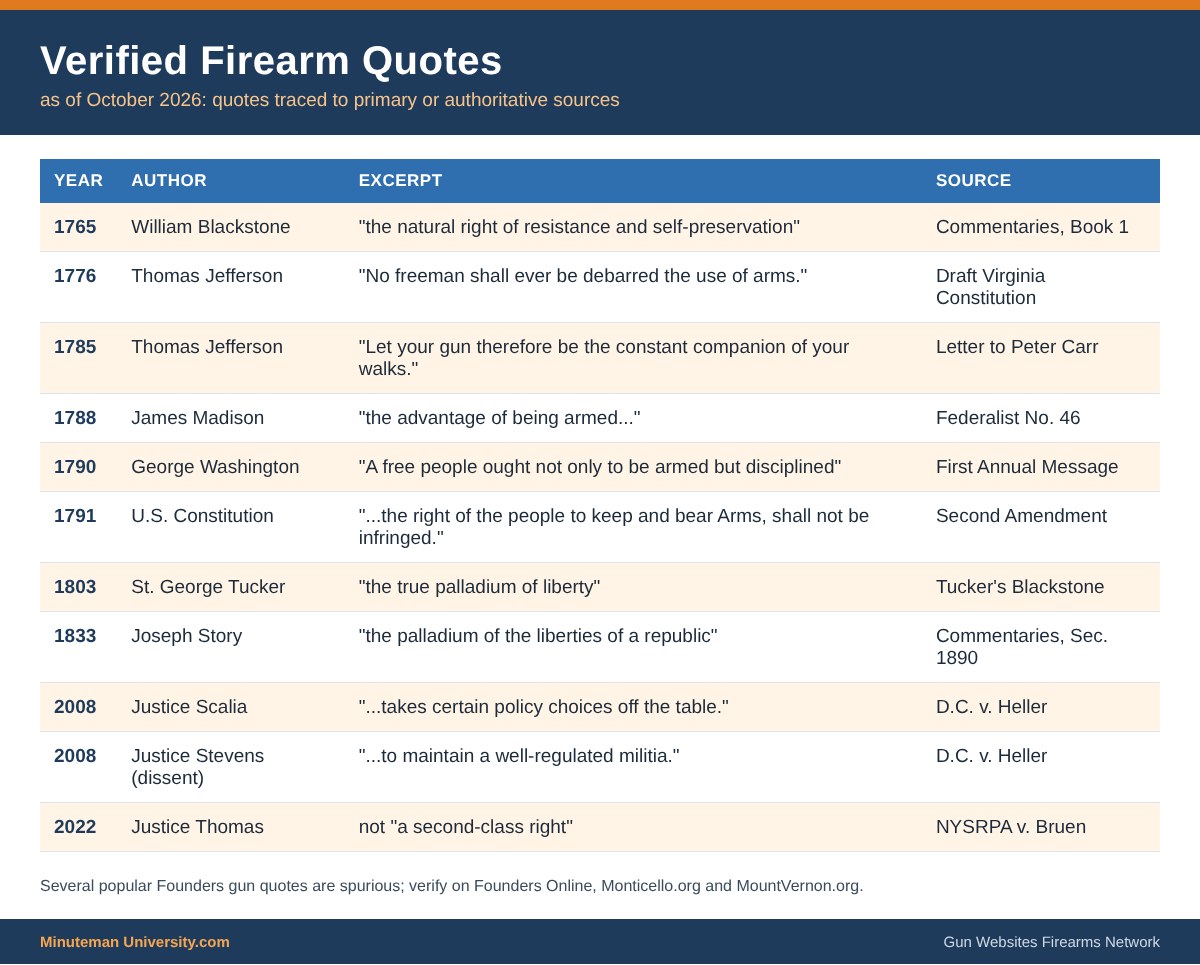
Verified Quotes
- “A well regulated Militia, being necessary to the security of a free State, the right of the people to keep and bear Arms, shall not be infringed.” Second Amendment, ratified December 15, 1791.
- “No freeman shall ever be debarred the use of arms.” Thomas Jefferson, first draft of the Virginia Constitution, 1776 (not in the adopted version; later drafts add “within his own lands or tenements”).
- “Let your gun therefore be the constant companion of your walks.” Thomas Jefferson to Peter Carr, August 19, 1785.
- “Besides the advantage of being armed, which the Americans possess over the people of almost every other nation…” James Madison, Federalist No. 46, January 29, 1788.
- “A free people ought not only to be armed but disciplined; to which end a Uniform and well digested plan is requisite…” George Washington, First Annual Message to Congress, January 8, 1790.
- Arms for defense rest on “the natural right of resistance and self-preservation.” William Blackstone, Commentaries on the Laws of England, Book 1, 1765.
- “This may be considered as the true palladium of liberty…” St. George Tucker, on the Second Amendment, Tucker’s edition of Blackstone, 1803.
- “The right of the citizens to keep and bear arms has justly been considered, as the palladium of the liberties of a republic…” Joseph Story, Commentaries on the Constitution, Section 1890, 1833.
- “But the enshrinement of constitutional rights necessarily takes certain policy choices off the table.” Justice Antonin Scalia, District of Columbia v. Heller, June 26, 2008.
- “The Second Amendment was adopted to protect the right of the people of each of the several States to maintain a well-regulated militia.” Justice John Paul Stevens, dissenting, District of Columbia v. Heller, 2008.
- The right to carry in public for self-defense is not “a second-class right, subject to an entirely different body of rules than the other Bill of Rights guarantees.” Justice Clarence Thomas, NYSRPA v. Bruen, June 23, 2022 (quoting McDonald v. Chicago, 2010).
Spotting Misattributed Quotes
- Jefferson, “The strongest reason for the people to retain the right to keep and bear arms is, as a last resort, to protect themselves against tyranny in government”: Monticello lists it as spurious; its earliest known appearance is a 1989 newspaper column.
- Washington, “Firearms stand next in importance to the Constitution itself”: Mount Vernon lists it as spurious, with no recorded source.
- Washington’s 1790 “free people ought not only to be armed” line is genuine, but versions that continue with “sufficient arms and ammunition” or resistance to government are altered; the real sentence continues “but disciplined.”
- Check before sharing: search the exact words on Founders Online or the Founders’ Constitution; if no document, date or recipient can be found, treat the quote as unverified.
- Watch for modern phrasing, slogans or words that did not exist in the 18th century; these are common signs of a fabricated quote.
- For more on gun-related language, see Guns in Language, Gun Phrases and the Court Cases page. Test your knowledge at Tactical Quiz.com.
Sources
- Founders Online: Washington, First Annual Message, January 8, 1790
- Founders Online: Jefferson to Peter Carr, August 19, 1785
- Monticello: No freeman shall be debarred the use of arms and spurious “strongest reason” quotation
- Mount Vernon: Spurious Quotations
- The Founders’ Constitution: Amendment II (Story, Commentaries) and Cornell LII: District of Columbia v. Heller