History of Ammo: From Black Powder to the Modern Cartridge
Every firearm is only as useful as the ammunition it fires, and most of the major leaps in firearm design followed a leap in ammunition. Repeating rifles, revolvers, semi-automatic pistols and modern sporting rifles all depended on one invention in particular: the self-contained metallic cartridge, which packs the projectile, propellant and primer into a single weatherproof unit. Its development took roughly a thousand years, beginning with gunpowder in China and ending, for practical purposes, with smokeless powder and jacketed bullets in the 1880s.
Black powder, a mix of saltpeter, charcoal and sulfur, was described in Chinese military writing by the 11th century and reached Europe by the 13th. For centuries shooters loaded loose powder and a round lead ball down the muzzle and lit the charge with a match, wheel or flint. Paper cartridges, which pre-measured the powder and ball together, sped up loading but still needed a separate spark. Two 19th-century breakthroughs changed that. Scottish clergyman Alexander Forsyth patented a percussion ignition system in 1807 using shock-sensitive fulminate, which led to the copper percussion cap; and in 1849 French officer Claude-Etienne Minie introduced a hollow-based conical bullet that expanded into the rifling, making rifled muskets as fast to load as smoothbores.
Self-contained cartridges followed quickly. Louis-Nicolas Flobert produced a small rimfire round around 1845, and Smith and Wesson developed its .22 rimfire cartridge, later called the .22 Short, by 1857. In 1866 Edward Boxer in Britain and Hiram Berdan in the United States developed the two centerfire primer systems still used today; Boxer primers can be easily replaced, which is why most American reloaders favor them. In 1884 Paul Vieille in France created Poudre B, the first practical smokeless powder, and France’s 8mm Lebel of 1886 became the first military smokeless cartridge. Smokeless powder produced higher velocity without the cloud of smoke, which in turn required harder, jacketed bullets. From there, 20th-century development was largely refinement: new calibers, better primers, and industry standards set by the Sporting Arms and Ammunition Manufacturers’ Institute (SAAMI), founded in 1926.
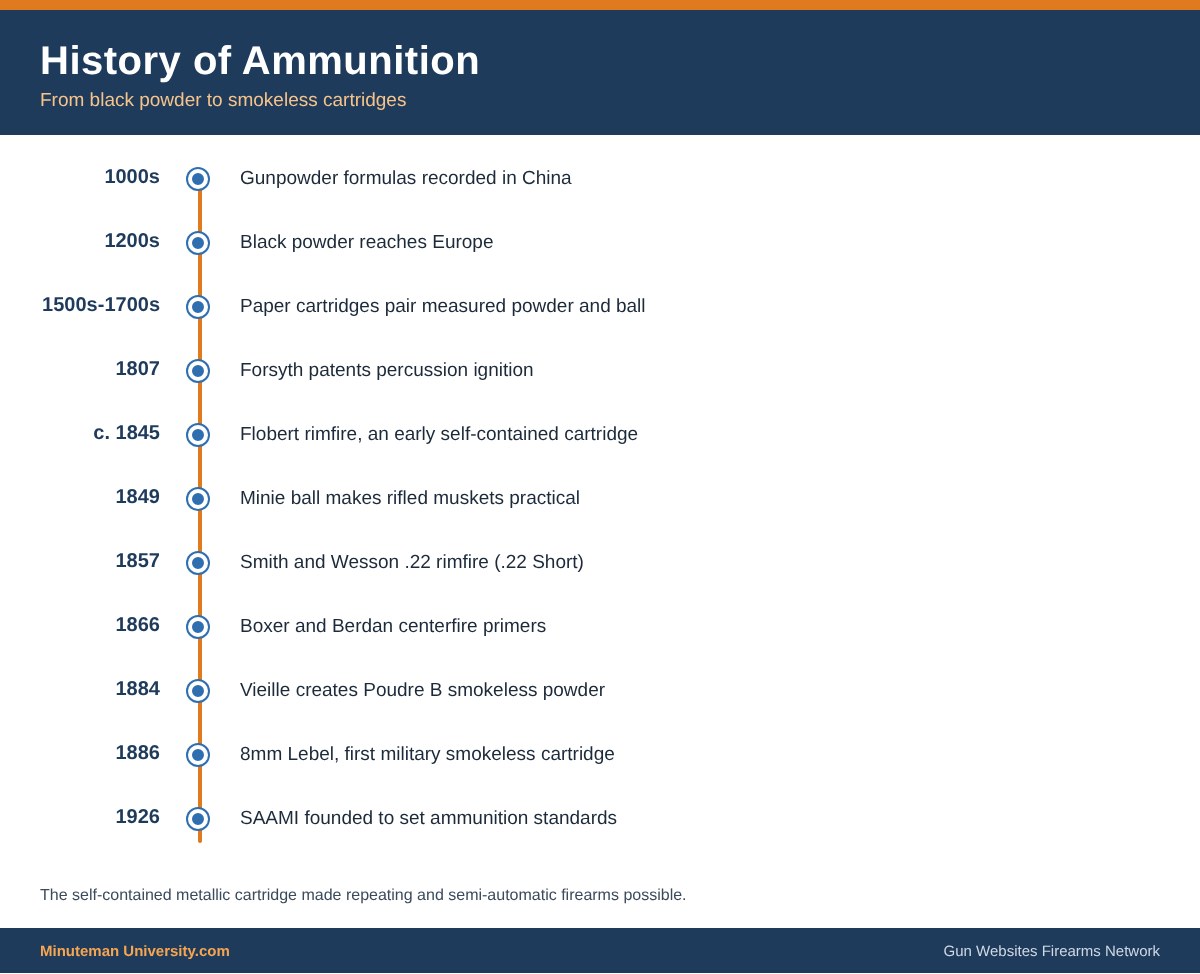
Key Facts
- By 11th century: Gunpowder formulas recorded in China; black powder reaches Europe in the 1200s.
- 16th to 18th centuries: Paper cartridges combine a measured charge and ball for muzzleloaders.
- 1807: Alexander Forsyth patents percussion ignition using fulminate.
- About 1845: Flobert’s rimfire cartridge, one of the first self-contained metallic rounds.
- 1849: The Minie ball makes rifled muskets practical for mass use.
- 1857: Smith and Wesson’s .22 rimfire (.22 Short) arrives with its first revolver; patented 1860.
- 1866: Boxer and Berdan centerfire primers developed.
- 1884 to 1886: Poudre B smokeless powder and the 8mm Lebel cartridge.
- 1926: SAAMI founded to set voluntary safety and interchangeability standards.
What Gun Owners Should Know
- Fire only ammunition that matches the caliber stamped on the barrel or slide. Similar-looking rounds are not interchangeable.
- Black powder firearms and many antique guns must not be fired with smokeless loads; have an antique checked by a qualified gunsmith before shooting.
- Corrosive primers, common in older military surplus ammunition, require prompt cleaning after shooting.
- Boxer-primed brass is the usual choice for handloading; Berdan-primed cases are harder to reload.
- Ammunition laws differ widely by state, from background checks at purchase to restrictions on certain types. See Ammunition Bans and State Firearm Laws.
- Have an ammo question for experienced shooters? Submit it at Ask Gun Questions.com, and test history knowledge at Tactical Quiz.com.
Across the Gun Websites Network
- Ammo Collecting Ammo Buyers Guide.com
- Calibers Ammo Buyers Guide.com
- Ammunition Quizzes Tactical Quiz.com