Building an Online Store: Platforms, Payments and Shipping Rules for 2A Projects
An online store can fund a 2A website, channel or local group through merchandise, books, training seats or memberships. Most 2A projects sell apparel and printed goods rather than firearms, and that one decision shapes everything else: which platform fits, which payment processor will accept the account and which federal and state shipping rules apply.
Platforms. WooCommerce is a free, open-source store plugin for WordPress that runs on the site owner’s own hosting and accepts many third-party payment gateways. Shopify is a hosted, subscription service with its own built-in payments. Since August 2018, its Acceptable Use Policy has restricted certain firearms and related items, including semi-automatic firearms with magazines over ten rounds, suppressors and parts for restricted firearms. Square Online and other hosted builders are simple to launch but are bound by the same processor rules described below. For a WordPress-based 2A site, WooCommerce keeps the store, content and customer data under one roof.
Payment processors. The processor matters more than the storefront. The published policies as of October 2026 are as follows. PayPal’s Acceptable Use Policy prohibits transactions involving “ammunition, firearms, or certain firearm parts or accessories.” Square prohibits sales of “firearms, firearm parts or hardware, and ammunition.” Stripe moved legal firearms and regulated parts such as suppressors from its prohibited list to a restricted list in late 2025, which means approval through its sales team, while ammunition is not addressed on that page. WooPayments, which runs on Stripe, still lists “firearms and ammunition” as prohibited. A merch-only store falls outside these product categories, but every provider’s full terms still apply, and stores that sell hardware usually work with firearm-industry merchant accounts.
Shipping, tax and merch. Firearms sold across state lines to non-licensees must be shipped to a licensed dealer (FFL) in the buyer’s state, who completes the background check. Ammunition faces a patchwork of state rules. Since South Dakota v. Wayfair (June 21, 2018), states can require remote sellers to collect sales tax once they pass an economic-nexus threshold, often $100,000 in annual sales into the state, though thresholds vary. Print-on-demand services print and ship each item as it is ordered and connect to WooCommerce or Shopify, so a project can sell shirts and stickers with no inventory.
Key Facts
- Federal transfer rule: Interstate firearm transfers between unlicensed persons must go through an FFL in the buyer’s state (18 U.S.C. 922(a)(3) and (a)(5)). See Background Checks.
- Mail: Non-licensees may not mail handguns through USPS (18 U.S.C. 1715). Long guns and all carrier shipments are subject to each carrier’s own policies.
- Ammunition age limits: Licensed dealers may not sell handgun ammunition to buyers under 21 or rifle and shotgun ammunition to buyers under 18 (18 U.S.C. 922(b)(1)).
- State ammunition rules: California requires online ammunition orders to ship to a licensed ammunition vendor or FFL. Illinois sellers typically require a FOID card or concealed carry license. New York, New Jersey, Massachusetts, Connecticut and DC add their own requirements, and many retailers do not ship ammunition to Hawaii or Alaska.
- Excise taxes: California added an 11% state excise tax on firearms, precursor parts and ammunition on July 1, 2024, and Colorado added a 6.5% excise tax on April 1, 2025. These sit on top of the federal excise tax that manufacturers and importers pay.
- Policy dates: Stripe’s restricted-businesses page was last updated September 22, 2026. Processors revise these lists often, so check them before launch and at least once a year.
Steps to Launch
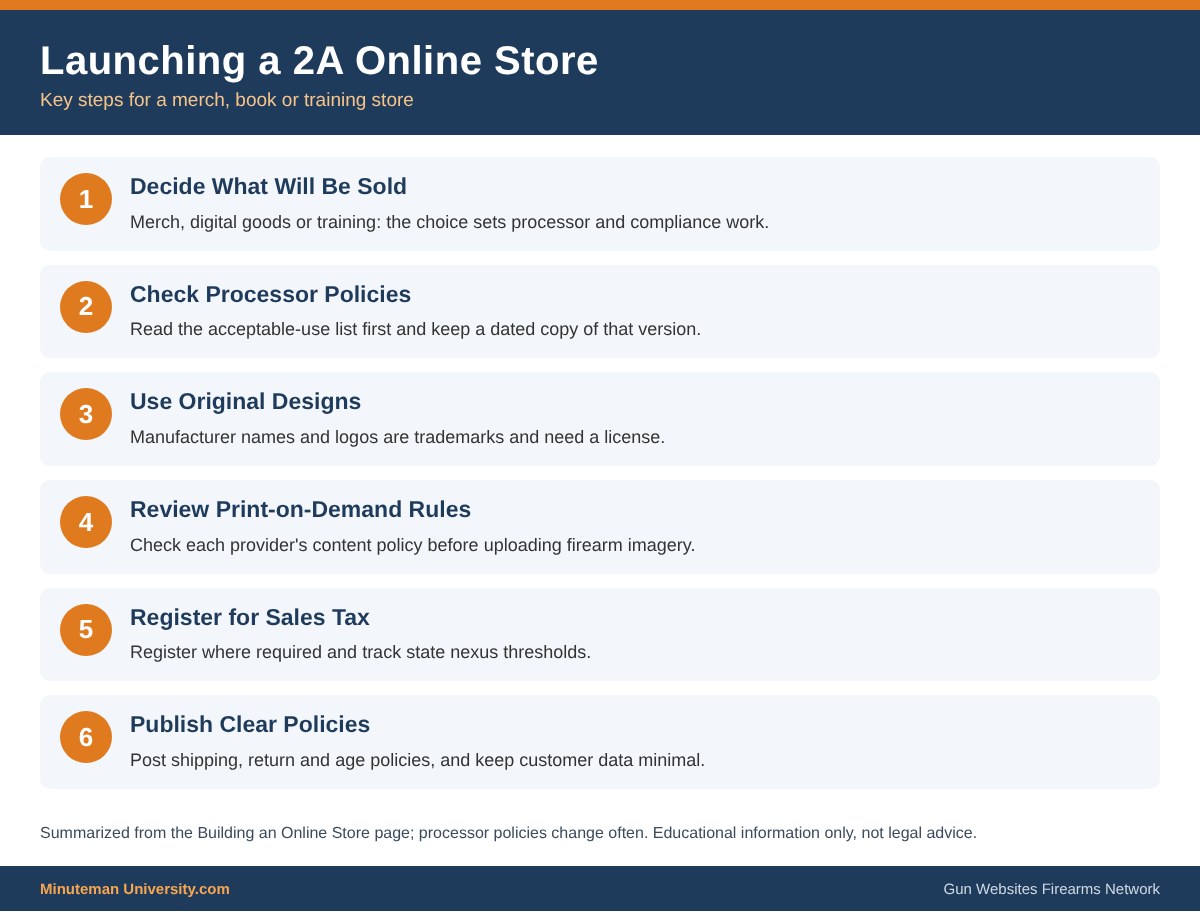
- Decide what will be sold: merch only, digital goods, training or physical firearm products. The answer determines the processor and the compliance work.
- Read the processor’s acceptable-use or restricted-business list before building, and keep a dated copy of the version you relied on.
- Use original designs. Manufacturer names and logos are trademarks and need a license.
- Check each print-on-demand provider’s content policy before uploading designs that show firearms.
- Register for sales tax where required, and use the store’s tax settings or a tax service to track nexus thresholds.
- Publish clear shipping, return and age policies, and block restricted destinations at checkout when selling ammunition or regulated items.
- Keep customer data minimal and secure. Track orders and members in a spreadsheet with tight sharing permissions (see Using Google Sheets), and explore other revenue in Affiliate Systems and Setting up an IndieGoGo Campaign.