Arguments that win the room.
Some arguments win the room.
Some arguments lose it, even when they are true.
Know the difference before the microphone is on.
The audience is rarely the person arguing with you.
It is the people watching, reading or listening, most of whom have not made up their minds.
Every argument should be judged by one test: does it make a reasonable bystander trust you more?
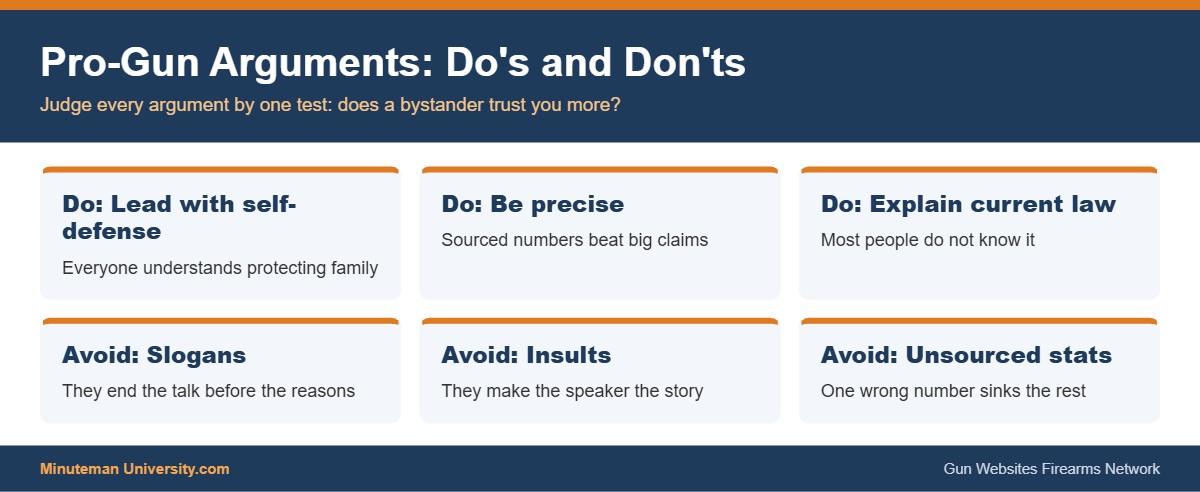
Arguments That Persuade
Self-defense is a human right
Everyone understands protecting their family. Start here, not with the Constitution.
Police cannot be everywhere
Courts have held that police have no general duty to protect a specific person. Response takes minutes; an attack takes seconds.
Laws should target criminals
Ask what a proposal does to a person who is already willing to commit murder, and what it does to a law-abiding owner.
Precision builds credibility
“Rifles of all kinds were used in about 3 percent of murders in 2019” beats “rifles never kill anyone.”
Suicide prevention is our issue
More than half of firearm deaths are suicides. Gun owners leading voluntary prevention earns respect.
Training and safety are the norm
Most owners take safety seriously. Talk about classes, safe storage and the four rules.
The law already says
Most people do not know that dealers run background checks or that felons are prohibited. Explaining current law is persuasive.
Diversity of owners
Gun owners include every background. New owners in recent years have included many women and minorities.
Arguments That Backfire
“Shall not be infringed. End of discussion.”
A slogan ends the conversation before a bystander hears why.
Insults and labels
“Snowflake,” “gun grabber” and similar names make the speaker the story.
Threat-sounding language
Anything about “cold dead hands” or violence against officials hands the other side a headline.
Statistics without sources
One wrong number can discredit everything else said.
Whataboutism
“What about Chicago?” sounds like a dodge unless it directly answers the claim.
Mocking terminology mistakes
Correcting “clip” versus “magazine” with a sneer wins a point and loses the audience.
Slippery slope first
Lead with the mechanics of a bill. Raise long-term concerns after showing the details.
Partisan framing
The right to self-defense belongs to every voter. Tying it to one party shrinks the audience.
Swap It
“Rifles of all types were about 3 percent of murders in the FBI’s 2019 data.”
“Assault weapons are never used in crimes.”
“Licensed dealers must run a background check on their sales, including at gun shows.”
“There is no such thing as a background check problem.”
“I want the same thing you do. Let us look at what would actually work.”
“You just want to take our guns.”
“Defensive gun use estimates range widely, from tens of thousands to over a million a year, depending on the survey.”
“Guns save millions of lives every year.” (stated as settled fact)
- Is every number sourced, and could a skeptic find the source in one click?
- Would the sentence still sound reasonable read aloud on the evening news?
- Did you say “murderer” and “criminal,” not “shooter” and “gun owner”? See Words Matter.
- Did you leave the listener a question to think about?
- 2A Conversation Skills – the full learning path and the CALM Method
- Conversation Trainer – practice with twelve real scenarios
- Words Matter – accurate language that keeps the focus on the criminal
- FBI Uniform Crime Report, Expanded Homicide Data Table 8, 2019
- Castle Rock v. Gonzales, 545 U.S. 748 (2005)
- CDC WONDER: firearm deaths by intent
- National Research Council, Firearms and Violence: A Critical Review (2005), on the range of defensive gun use estimates
- William English, “2021 National Firearms Survey,” SSRN (2021)