Last reviewed November 1, 2026
State Firearm Laws: Where They Stand in 2026
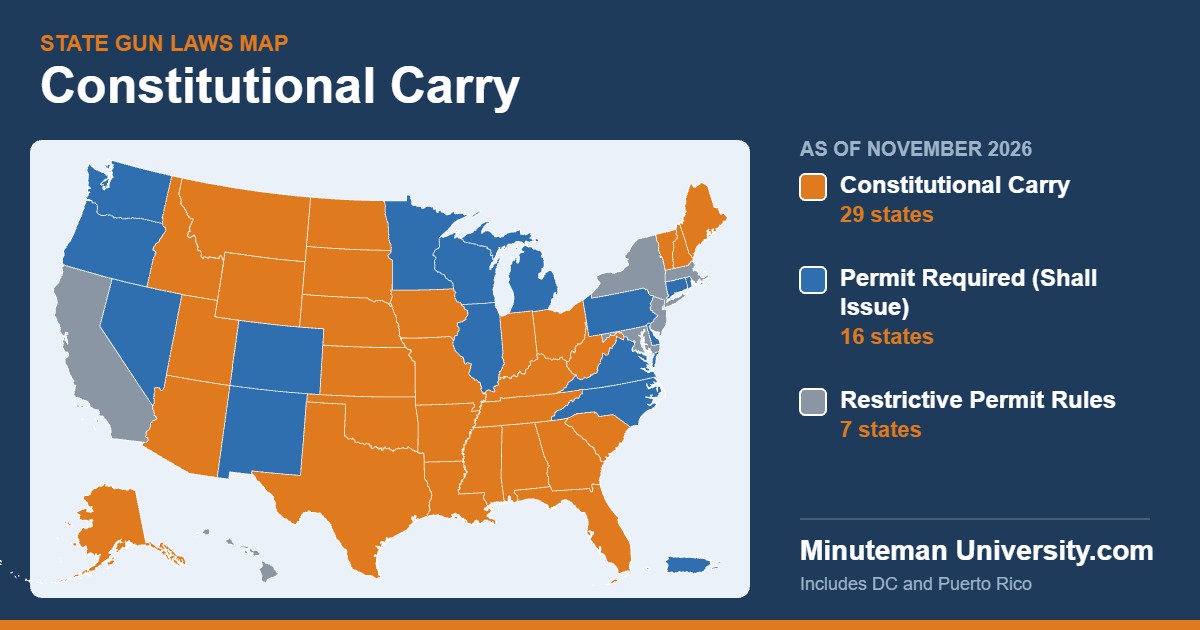
America now has two very different sets of gun laws depending on which state line a gun owner stands behind. In most of the country, the trend has been toward freedom: 29 states recognize constitutional (permitless) carry for law-abiding adults as of October 2026, and Florida’s open carry ban was struck down by a state appeals court on September 10, 2025. In a smaller bloc of states, lawmakers keep adding permits, registries, waiting periods and bans that fall hardest on ordinary citizens.
Constitutional Carry (29): Alabama, Alaska, Arizona, Arkansas, Florida, Georgia, Idaho, Indiana, Iowa, Kansas, Kentucky, Louisiana, Maine, Mississippi, Missouri, Montana, Nebraska, New Hampshire, North Dakota, Ohio, Oklahoma, South Carolina, South Dakota, Tennessee, Texas, Utah, Vermont, West Virginia, Wyoming
Permit Required (Shall Issue) (16): Colorado, Connecticut, Delaware, Illinois, Michigan, Minnesota, Nevada, New Mexico, North Carolina, Oregon, Pennsylvania, Puerto Rico, Rhode Island, Virginia, Washington, Wisconsin
Restrictive Permit Rules (7): California, District of Columbia, Hawaii, Maryland, Massachusetts, New Jersey, New York
See every map at once: open the 2A War Room for all 21 maps on one screen, with state dossiers and a 2A Freedom Score.
The 2025 and 2026 sessions widened that gap. Rhode Island added a sales ban on popular semiautomatic rifles effective July 1, 2026, and Virginia passed one that a state court has blocked statewide. Colorado’s permit-to-purchase law for many semiautomatics took effect August 1, 2026, and Washington’s permit-to-purchase system for all firearms is scheduled for May 1, 2027. On the other side, North Carolina’s permitless carry bill (SB 50) cleared the Senate veto override in 2025, but the House had not completed the override as of mid-2026.
Federal courts are pushing back on the most aggressive laws. Wolford v. Lopez (June 25, 2026) struck Hawaii’s rule banning carry on private property open to the public without express owner consent. The Supreme Court will hear challenges to the Cook County and Connecticut rifle bans on December 2, 2026. On November 3, 2026, Massachusetts voters decide Question 9 on whether to keep or repeal the state’s sweeping 2024 gun law (Chapter 135), and Arkansas voters decide Issue 2, which would strengthen the state’s constitutional right to arms.
Key Facts
- 29 constitutional carry states as of October 2026; the most recent additions were South Carolina and Louisiana in 2024.
- September 10, 2025: Florida First District Court of Appeal holds the state’s open carry ban unconstitutional (McDaniels case).
- July 1, 2026: Rhode Island’s rifle sales ban (S 0359A) takes effect with existing owners grandfathered; Virginia’s (SB 749 / HB 217) is blocked statewide by a court injunction.
- August 1, 2026: Colorado SB25-003 permit-to-purchase for many semiautomatic firearms takes effect; challenged in Del Toro v. Polis.
- May 20, 2025: Washington HB 1163 signed, creating a permit-to-purchase system with live-fire training and five-year renewals, set for May 1, 2027.
- June 25, 2026: Wolford v. Lopez (6-3) strikes Hawaii’s private-property default carry ban.
- November 3, 2026: Massachusetts Question 9 (a “No” vote repeals Chapter 135 of the Acts of 2024) and Arkansas Issue 2 (right-to-arms amendment) on the ballot.
What Gun Owners Should Know
- Constitutional carry rules differ by state, including minimum age, whether non-residents are covered, and where carry is prohibited. A permit still matters for reciprocity when traveling.
- Check the laws of every state on a travel route, not only the destination. Use official state police or attorney general reciprocity pages.
- New laws often have delayed effective dates and grandfather clauses. Note the dates, and keep proof of when items were acquired.
- Subtopics: State Gun Bans, State Preemption, 2A Sanctuary Laws and State 2nd Amendments. Training resources are on After Action.net, and questions can go to Ask Gun Questions.com.
Across the Gun Websites Network
- State Gun Laws Quiz Tactical Quiz.com
- State NFA Laws NFA Buyers Guide.com
- Suppressor Laws by State Suppressor Buyers Guide.com
Sources
- AP via WSLS: Appeals Court Finds Florida’s Open Carry Ban Unconstitutional
- NRA-ILA: Washington Governor Signs Permit-to-Purchase Legislation
- NRA-ILA: North Carolina Permitless Carry Override Update (July 2026)
- Massachusetts Secretary of the Commonwealth: 2026 Ballot Question 9
- National Constitution Center: Wolford v. Lopez
Background and Resources
Firearm laws in the United States are primarily governed by state-level legislation, with each state having its own set of laws and regulations that apply to the manufacture, sale, possession, and use of firearms. These laws can vary significantly from state to state, and it is important for gun owners and prospective gun owners to familiarize themselves with the laws in their state of residence.
Some common firearm laws that are regulated by states include background check requirements for gun purchases, restrictions on the types of firearms that can be owned or possessed, and laws related to carrying firearms in public places. Some states also have laws related to gun registration, storage requirements, and waiting periods for firearm purchases.
- Permit to Buy
- Permit to Own
- Pistol Registration
- State Definitions
- State Preemption
- NFA Sanctuary Laws
firearm laws in the United States are a complex and constantly evolving area of law, and it is important for individuals to stay up to date on the laws in their state and at the federal level in order to ensure compliance and avoid legal issues.
 Exhibit A in the museum of hand-made maps: 2021, back before the robots joined the staff.
 Exhibit B, also 2021. The robots have asked us to stop calling these ‘the good old days.’
 Exhibit C, from 2021. Made with markers, mouse clicks and zero artificial intelligence.
 Exhibit D, another 2021 original. The robots preempted these maps eventually, but they still look great.
 Exhibit E. Hand-made in 2021 and still standing, like a sanctuary for old-fashioned map making.
2A Sanctuary States Exhibit F, the last of the 2021 set. After this, the humans handed the colored pencils to the robots.