Last reviewed October 31, 2026
Strict Scrutiny vs. Intermediate Scrutiny: How Courts Test Gun Laws in 2026
When a law is challenged as unconstitutional, courts need a yardstick. For most of the 20th century that yardstick was one of three "tiers of scrutiny," each asking how important the government's goal is and how closely the law fits it. For Second Amendment cases, the Supreme Court replaced that approach in 2022, but the vocabulary still comes up constantly in debates, older rulings and other constitutional areas such as free speech.
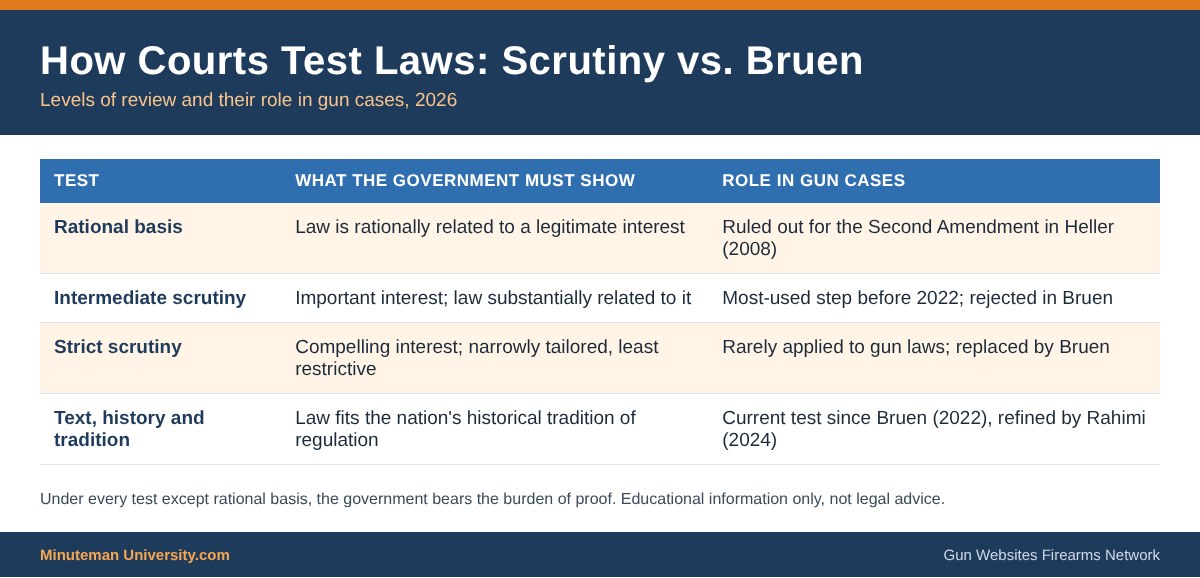
Rational basis is the easiest test: a law survives if it is rationally related to any legitimate government interest. In District of Columbia v. Heller (2008), the Court said rational basis could not be used for an enumerated right like the Second Amendment. Intermediate scrutiny requires an "important" government interest and a law "substantially related" to it. Strict scrutiny requires a "compelling" interest and a law narrowly tailored, using the least restrictive means available. Under strict scrutiny the government carries a heavy burden, and most laws fail.
Between Heller and 2022, federal appeals courts built a two-step framework: first ask whether the conduct was protected, then apply means-end scrutiny, usually intermediate. Most gun laws survived that second step. In New York State Rifle & Pistol Association v. Bruen (June 23, 2022), the Court rejected the second step. Now, if the Second Amendment's plain text covers the conduct, the government must show that the law is consistent with the nation's historical tradition of firearm regulation. In United States v. Rahimi (June 21, 2024), the Court clarified that a modern law does not need a "historical twin," only a fit with the principles behind historical laws.
The questions in the notes below, such as whether the government has a compelling interest and whether a law reaches only the dangerous conduct it targets, are the language of means-end scrutiny. Under Bruen, those questions are no longer the test for gun laws, though judges and advocates still use them in argument.
Key Facts
- Heller (2008) ruled out rational basis for Second Amendment claims.
- Before 2022, most circuits applied intermediate scrutiny to most gun laws.
- Bruen (2022) replaced means-end scrutiny with the text-history-tradition test.
- Rahimi (2024) upheld the federal ban on gun possession by people under domestic violence restraining orders, applying Bruen with a principles-based analogy.
What Gun Owners Should Know
- Pre-2022 rulings that upheld gun laws under intermediate scrutiny are open to fresh challenge.
- In debate, "compelling interest" arguments answer an old test; the current question is historical tradition.
- The government, not the challenger, bears the burden of proving the historical tradition.
- Strict scrutiny still governs other rights, such as content-based speech limits, which is why the terms remain useful.
Related: Court Cases, Circuit Court Cases, Commerce Clause, and Gun Websites.com.
Sources
- NYSRPA v. Bruen, 597 U.S. 1 (2022)
- United States v. Rahimi, 602 U.S. 680 (2024)
- District of Columbia v. Heller, 554 U.S. 570 (2008)
- Cornell LII: Strict Scrutiny
Strict Scrutiny vs. Intermediate Scrutiny
Compelling State Interest
Why are the things being taken problematic or Dangerous
Are they removing them in a way that affects just those things?