About the Psychology of a Difficult Discussion
Conversations about firearms often stall because both sides treat them as contests of arguments. Peer-reviewed research on persuasion suggests a different approach works better. In a widely cited 2016 study published in Science, political scientists David Broockman and Joshua Kalla tested “deep canvassing,” a method in which the canvasser does very little talking, listens carefully, and invites the other person to recall a relevant experience from their own life. A conversation of roughly 10 to 15 minutes produced measurable attitude change that lasted at least three months, the length of the follow-up period, and the effect largely survived exposure to an opposing attack ad.
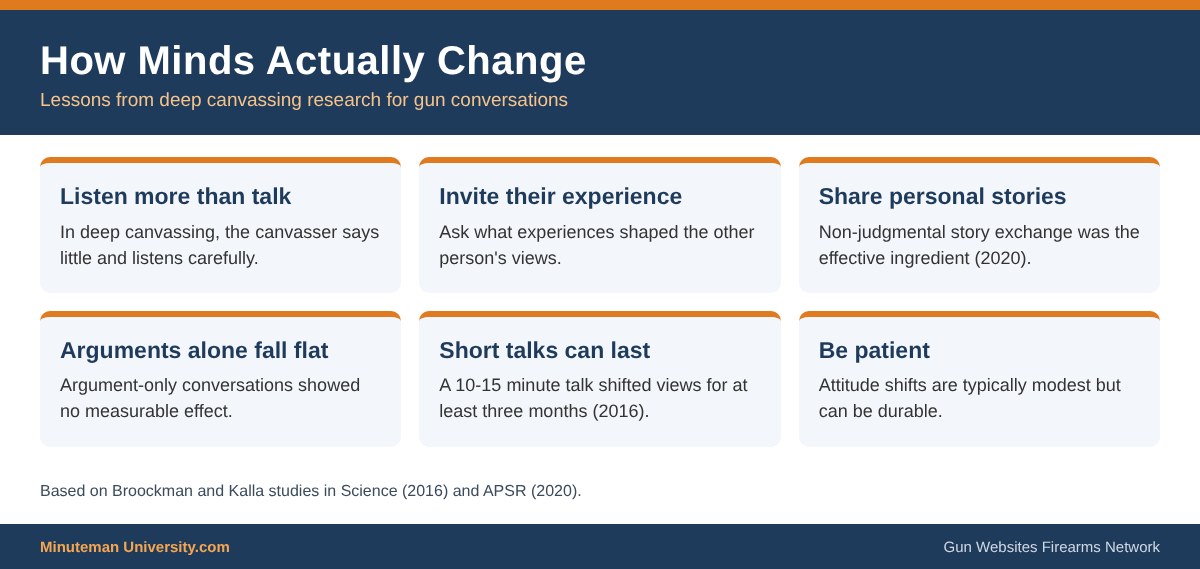
A 2020 follow-up in the American Political Science Review sharpened the lesson: in three field experiments, conversations changed views only when they included a non-judgmental exchange of personal stories. Conversations built on arguments alone had no measurable effect. Although these studies addressed other social issues, the takeaways apply directly to gun discussions. Asking what experiences shaped a person’s views, sharing a personal reason for owning a firearm, such as protecting a family or a lifelong hunting tradition, and avoiding a lecture tone are more likely to open minds than a list of statistics. The research also counsels patience: attitude shifts are typically modest but can be durable.
Key Facts
- 2014: An earlier Science paper on canvassing was later retracted after Broockman and Kalla found fabricated data
- 2016: Broockman and Kalla publish their deep canvassing field experiment in Science
- 2016: Effects of a 10 to 15 minute listening-based conversation last at least three months
- February 2020: APSR study finds non-judgmental exchange of personal narratives is the effective ingredient
- 2020: Argument-only conversations show no measurable effect in the same experiments