Youth Shooting Sports: Programs That Teach Safety, Skill and Responsibility
Youth shooting sports are among the fastest-growing school and club activities in the country. Organized programs give young people supervised, structured time on the range with certified instructors, and they teach safe gun handling, discipline, focus and sportsmanship along with marksmanship. Many families see them as the best way to pass on a hunting or shooting tradition responsibly. Competitive paths now run from local 4-H clubs to state and national championships, college teams, scholarships and the Olympic pipeline.
Clay target shooting has led the recent growth. The USA Clay Target League reported more than 40,100 student-athletes on 2,094 high school and college teams in its spring 2026 season. The Scholastic Clay Target Program, started under the National Shooting Sports Foundation and now run by the Scholastic Shooting Sports Foundation, drew 3,675 athletes from 37 states to its 2025 national championships, up from just over 200 at the first nationals in 2001.
The programs listed below this section differ in age range, discipline and how they are organized. Most families start with whatever is offered through their school, county extension office or local gun club.
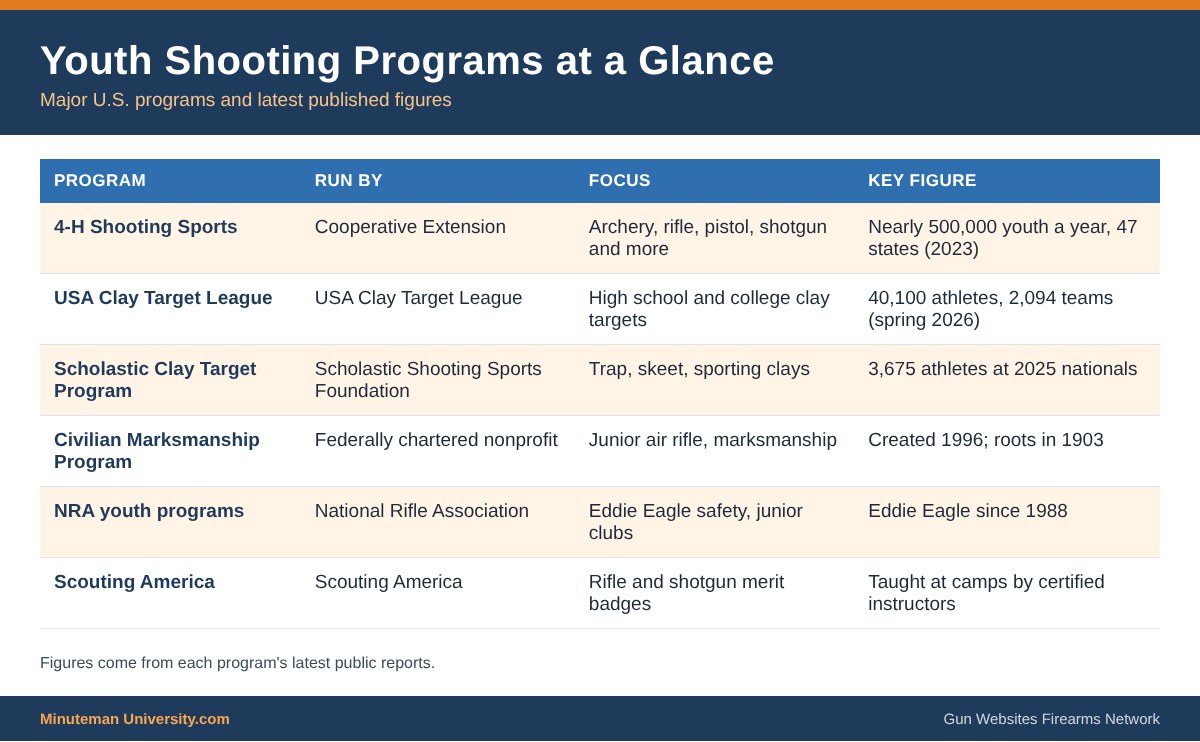
Major Programs
- 4-H Shooting Sports: run through land-grant university Cooperative Extension; launched nationally in 1980. Its 2023 fact sheet reports nearly 500,000 youth a year in 47 states, in archery, rifle, pistol, shotgun, muzzleloading, hunting and Western Heritage.
- Scholastic Clay Target Program (SCTP): trap, skeet and sporting clays for students from about age 9 through college, organized as volunteer-run club teams.
- USA Clay Target League: school-approved high school and college clay target leagues, scored remotely so teams compete from their home ranges.
- Civilian Marksmanship Program (CMP): a federally chartered nonprofit created in 1996, tracing its roots to the 1903 National Board for the Promotion of Rifle Practice; it supports junior air rifle and junior marksmanship clinics.
- NRA youth programs: include Eddie Eagle GunSafe, a firearm-safety lesson for young children that uses no firearms (since 1988), plus junior shooting clubs and the Youth Hunter Education Challenge.
- Scouting America (formerly Boy Scouts of America): rifle and shotgun shooting merit badges taught at camps by certified instructors.
- Others: American Legion Junior Shooting Sports (air rifle), ATA youth trapshooting, USA Shooting junior programs, and the National Archery in the Schools Program.
What Parents Should Know
- Look for certified coaches and a written range safety plan.
- Ask about costs for ammunition, targets, eye and ear protection and travel; many programs loan firearms.
- Check state law on minors’ possession and transport of firearms for practice and competition.
- Complete a hunter education course; many states require it for young hunters.
Related Pages
- National 4-H Shooting Sports Program
- Scholastic Clay Target Program
- Civilian Marksmanship Program
- Youth Shooting Sports Alliance
- Olympic Shooting
- Training resources at After Action.net
Across the Gun Websites Network
- At what age should a parent teach a kid to shoot? Ask Gun Questions.com
- Shooting Sports Quizzes Tactical Quiz.com
Sources
- SSUSA: USA Clay Target League Tops 40,000 Student-Athletes
- SSSF: Father of SCTP Feted at SHOT Show
- 4-H Shooting Sports Fact Sheet (2023)
- Arizona Game and Fish: Scholastic Clay Target Program
Youth Shooting Sports
- National 4-H Shooting Sports Program
- The Boy Scouts of America
- Civilian Marksmanship Program
- Scholastic Clay Target Program
- National Archery in the Schools Program
- After School Archery Program
- American Legion Junior Shooting Sports Program
- National Rifle Association
- USA Shooting
- ATA Youth Trapshooting Program
- Youth Shooting Sports Alliance