Email is still how most advocacy gets organized. Pick a provider with care.
eMail Apps: Privacy, Security and Practical Use for 2A Communication
Email remains the standard way to contact legislators, organize club events, receive range bookings and confirm online firearm and ammunition orders. It was designed in the 1970s and 1980s without privacy in mind, and most messages still travel in a form the providers can read. Even when the body of a message is encrypted, the “envelope” (sender, recipients, date, often the subject line and IP information in the headers) usually is not. That metadata alone can map who an advocate talks to and when.
Legal protection is also thinner than many assume. The federal Stored Communications Act dates to 1986 and treats stored email differently by age and type. Courts have narrowed the gap: in United States v. Warshak (6th Cir., December 14, 2010) the court held that the government needs a warrant to compel a provider to hand over email content, and major providers now generally require one. Metadata and subscriber records can still be obtained with lesser legal process, and anything stored with a company can also be exposed in a data breach.
For gun owners the practical takeaway is to treat email as a postcard: fine for routine messages, a poor choice for sensitive plans, inventories or personal details. Encrypted messaging apps are a better tool for private conversations, and the account security habits described on the Internet Privacy page matter more than which email brand is used.
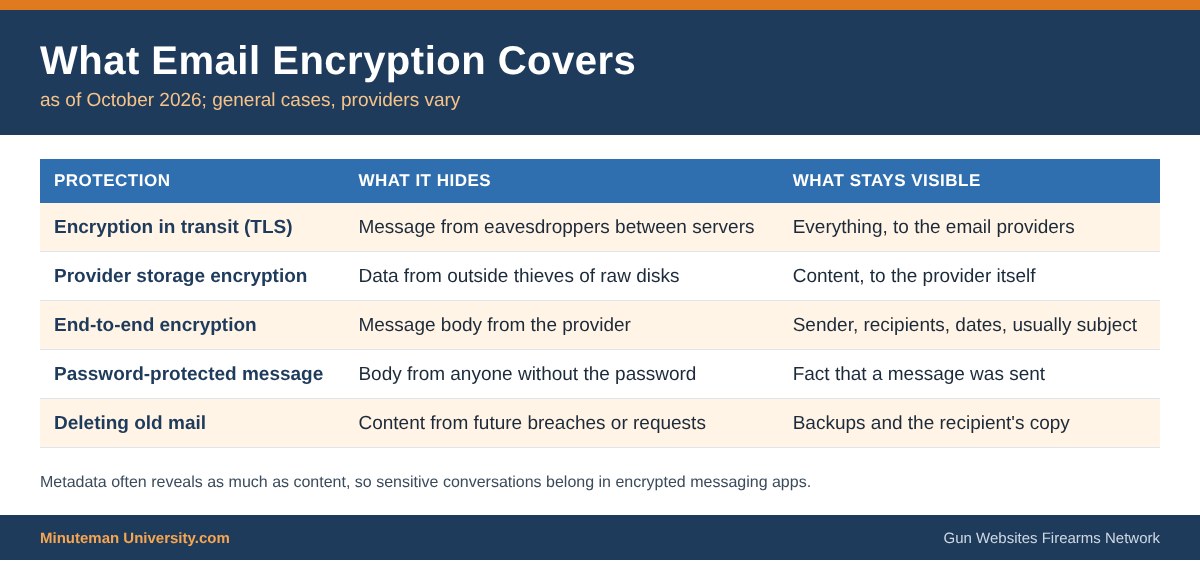
Common Email Options
- Gmail (Google) and Outlook.com (Microsoft): free, widely used, encrypted in transit between servers that support it, but readable by the provider on its servers.
- Proton Mail: based in Switzerland; messages between Proton users are end-to-end encrypted, and messages to outside addresses can be sent password-protected.
- Tuta (named Tutanota until November 2023): based in Germany; end-to-end encryption between Tuta users and encrypted mailbox storage.
- Own-domain email: an address at a club or project’s own domain stays with the organization if it changes providers, which helps continuity.
Tips for 2A Users
- Turn on two-factor authentication, preferably an authenticator app, passkey or security key rather than SMS codes.
- Use separate addresses for public advocacy, purchases and personal life; alias features can hide a main address from retailers and mailing lists.
- Delete old messages that contain serial numbers, permit numbers or addresses rather than archiving everything forever.
- Turn off automatic remote-image loading, which tells senders when and where a message was opened.
- Bulk-mail and text-message marketing services set their own content rules, and some reject firearm-related campaigns. Read the acceptable use policy before building a club or business list on one.
Related: Browsers, Speech Recognition and Using Technology & the Internet. Network hub: Gun Websites.com.
Sources
- Electronic Frontier Foundation: Privacy
- 18 U.S.C. Chapter 121: Stored Communications Act
- AlternativeTo: Tutanota rebrands to Tuta
- Twilio: Campaign rejected for firearms content (error 30957)
 email is one of the least secure methods of transferring information on the internet. Alternate methods (messaging apps, etc) should be explored and used if at all possible
eMail has a few aspects to keep in mind for 2A:
- more on the way
- ..more about Social Platforms
- …more about Audio Hosting
- …More about Video Hosting
- …more about Video Streaming
- …more about Messaging Apps
- …Mapping Apps
- … eMail Apps
- …. more about Speech Recognition
- … more about HAM Radio
- … more about Vehicles
- … more about Server Software
- … more info about Browsers