Last reviewed November 1, 2026
Red Flag Laws: Where It Stands in 2026
Red flag laws, officially called extreme risk protection orders (ERPOs), let a court order the removal of a person’s firearms based on a petition claiming that person is a danger to themselves or others. In most states with these laws, the first order can be issued ex parte, meaning before the gun owner knows a case exists or has any chance to respond. Gun-rights advocates object that this reverses due process: rights are taken first and the owner must fight to get them back, often without a lawyer provided and under a lower standard of proof than a criminal case.
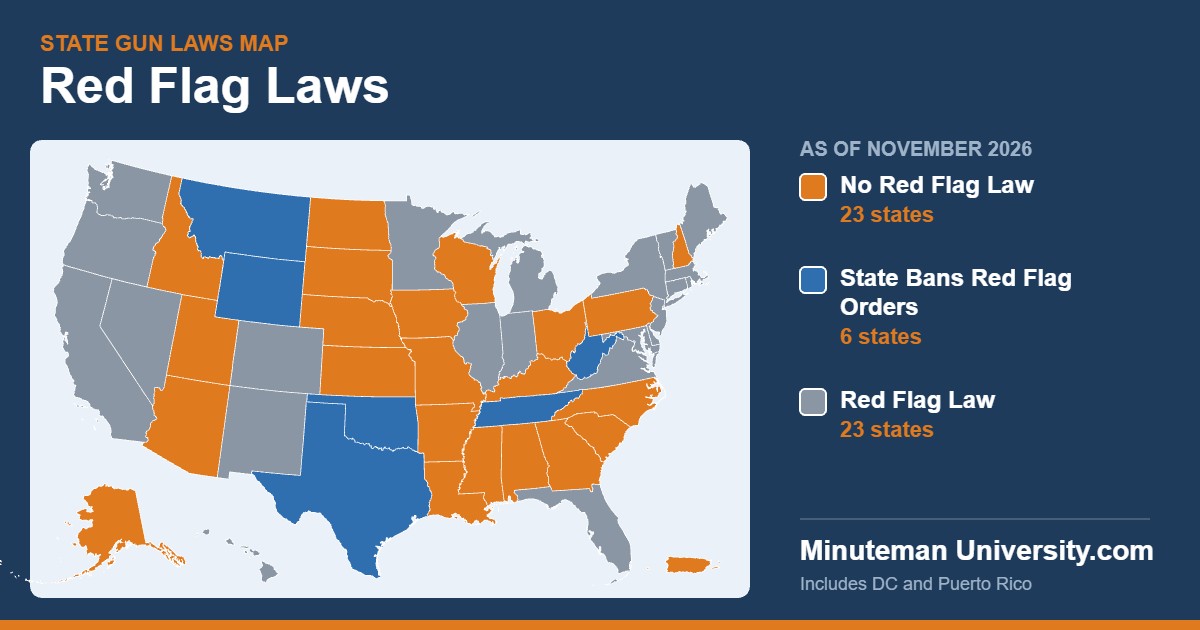
State Bans Red Flag Orders (6): Montana, Oklahoma, Tennessee, Texas, West Virginia, Wyoming
No Red Flag Law (23): Alabama, Alaska, Arizona, Arkansas, Georgia, Idaho, Iowa, Kansas, Kentucky, Louisiana, Mississippi, Missouri, Nebraska, New Hampshire, North Carolina, North Dakota, Ohio, Pennsylvania, Puerto Rico, South Carolina, South Dakota, Utah, Wisconsin
Red Flag Law (23): California, Colorado, Connecticut, Delaware, District of Columbia, Florida, Hawaii, Illinois, Indiana, Maine, Maryland, Massachusetts, Michigan, Minnesota, Nevada, New Jersey, New Mexico, New York, Oregon, Rhode Island, Vermont, Virginia, Washington
Maine became the newest red flag state when its voter-approved law took effect in February 2026. As of November 2026, 22 states and the District of Columbia have ERPO laws. The momentum in 2025 ran the other way. Montana and Texas joined Oklahoma, Tennessee, West Virginia and Wyoming as states that ban or restrict red flag orders, with Texas Governor Greg Abbott signing that state’s law on June 22, 2025. At the federal level, the 2022 Bipartisan Safer Communities Act funds state crisis intervention programs, including ERPO programs, but there is no federal red flag law.
The courts have not yet settled whether ex parte firearm seizures fit the Bruen text-history-tradition test. In U.S. v. Rahimi (2024), the Supreme Court upheld disarming a person after a court found a credible threat, following notice and a hearing. Advocates argue that makes due process before disarmament the constitutional baseline, a question likely to reach the Court again.
Key Facts
- As of November 2026, 22 states plus DC have ERPO laws: California, Colorado, Connecticut, Delaware, Florida, Hawaii, Illinois, Indiana, Maine, Maryland, Massachusetts, Michigan, Minnesota, Nevada, New Jersey, New Mexico, New York, Oregon, Rhode Island, Vermont, Virginia and Washington.
- Connecticut (1999) and Indiana (2005) were the first; Maine (approved by voters in November 2025, effective February 2026) is the most recent.
- Six states ban or restrict red flag orders: Oklahoma (the first, 2020), Montana, Tennessee, West Virginia, Wyoming and Texas (signed June 22, 2025).
- June 25, 2022: the Bipartisan Safer Communities Act created federal grant funding for state crisis intervention programs, which states may use for ERPO programs.
- June 21, 2024: U.S. v. Rahimi upheld 18 U.S.C. 922(g)(8), which applies only after notice and a hearing.
What Gun Owners Should Know
- Know who can file in your state. Depending on the state, petitioners may include police, family or household members, and in some states doctors, school officials or coworkers.
- If served with an order, comply and contact a firearms attorney immediately. Ignoring an order is a separate crime.
- Ask for the full hearing, bring evidence and witnesses, and keep records of every firearm surrendered so it can be returned.
- Filing a false petition is a crime in many ERPO states; report knowingly false claims.
- For related prohibitions, see Mental Health and Gun Ownership, and follow the litigation on the Court Cases page. Questions can go to Ask Gun Questions.com.
Sources
- Ballotpedia News: Texas Gov. Abbott Signs Bill Restricting the Use of Extreme Risk Protection Orders (June 24, 2025)
- Cornell Legal Information Institute: Extreme Risk Protection Order (ERPO)
- Supreme Court Docket No. 22-915: United States v. Rahimi (decided June 21, 2024)
- Bureau of Justice Assistance: Byrne State Crisis Intervention Program
Background and Resources
 An original 2021 map. The only red flag here is that it was made before the robots learned to color inside the lines.