Mapping Apps: Location Data, Privacy and the Law in 2026
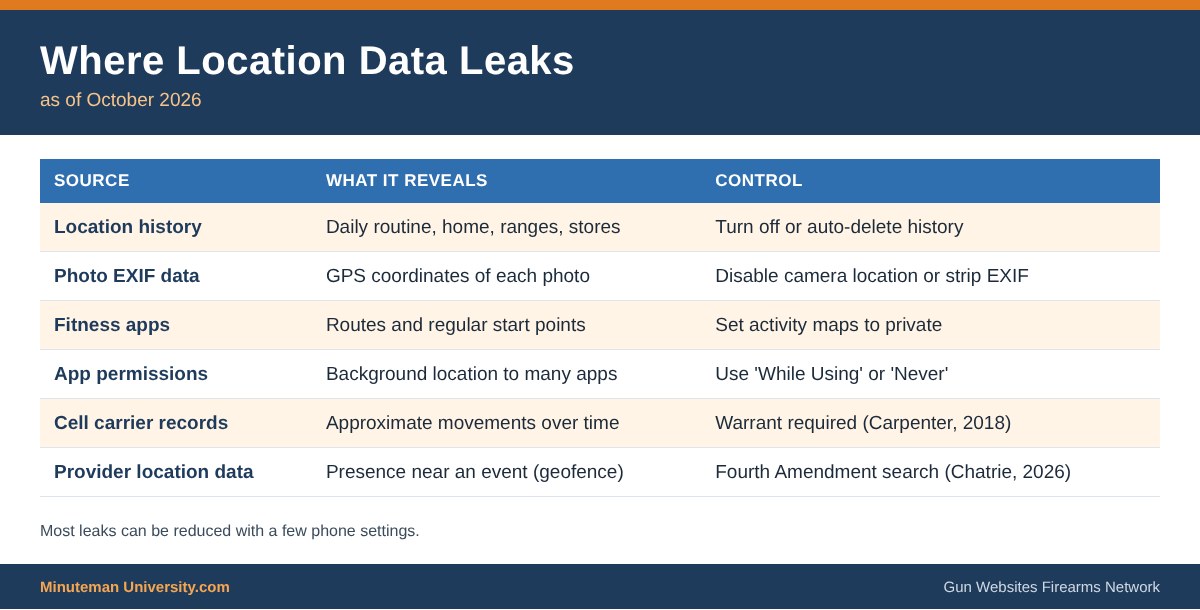
Mapping and navigation apps are among the most useful tools on a phone: finding a new range, routing to a match, checking public land boundaries for hunting, or getting to a state capitol for lobby day. To work, they need constant access to location, and many keep a record of it. A location history shows where a person lives, works, shops, shoots, hunts and worships, and it can reveal gun store visits, range memberships and travel across state lines with firearms.
Location data has been central to recent Fourth Amendment law. In Carpenter v. United States (June 22, 2018) the Supreme Court required a warrant for historical cell-site location records. In Chatrie v. United States (June 29, 2026) the Court held that obtaining a person’s location data from Google through a “geofence” request is a Fourth Amendment search, because people have a reasonable expectation of privacy in their phone location information; it sent the case back to the Fourth Circuit to decide whether that particular warrant was valid. Companies have also changed course: Google began moving Maps Timeline history from its servers to users’ devices after announcing the change in December 2023.
Location also leaks through photos. Most phone cameras write GPS coordinates into each picture’s EXIF data. Major social platforms generally strip this on upload, but files posted to a personal website, shared in some messaging apps or sent as email attachments may keep it, which can reveal a home address alongside a photo of a gun collection.
Common Mapping Apps
- Google Maps: the most widely used; Timeline history is now stored on the device by default, with optional encrypted backup.
- Apple Maps: default on iPhone; Apple says it does not tie trips to an Apple Account.
- Waze (owned by Google): crowd-sourced traffic reports that require sharing location while driving.
- Organic Maps and OsmAnd: open-source apps based on OpenStreetMap that work with offline maps.
Tips for 2A Users
- Set location permission to “While Using” rather than “Always,” and review which apps have it.
- Turn off or regularly delete location history, and turn off camera location tagging or strip EXIF data before posting photos.
- Download offline maps for hunting areas and remote ranges where coverage is poor.
- Fitness and activity apps can publish routes; a 2018 Strava heatmap exposed patterns around military bases. Keep activity maps private.
- When traveling with firearms, check each state’s laws in advance; a navigation app will not warn about state or local restrictions.
Related: Internet Privacy, Browsers and Using Technology & the Internet. Event locations: Gun Calendars.com.
Sources
- Chatrie v. United States (2026)
- Supreme Court: Carpenter v. United States (2018)
- TechRadar: Google Maps Timeline moves on-device
 Applications that track our locations are some of the most convenient and useful, and also some of the most dangerous to our privacy
Mapping Apps have a few aspects to keep in mind for 2A:
- more on the way
- EXIF Data in photos