Last reviewed October 31, 2026
Firearm Law in the USA: Where It Stands in 2026
Gun law in America has changed more since 2022 than in the previous several decades. The Supreme Court’s decision in NYSRPA v. Bruen (June 23, 2022) requires gun laws to fit the Second Amendment’s text and the nation’s historical tradition, and that test is now being applied to everything from carry permits to rifle bans. Congress and ATF have also rolled back long-standing federal burdens on law-abiding owners, while a handful of states have moved hard in the opposite direction.
This section of Minuteman University.com is organized so 2A advocates can find the current status of each area quickly. Federal law covers the NFA, the Gun Control Act and background checks. State law covers carry, bans, preemption, sanctuary laws and state constitutions. Court cases track the rulings that decide which laws survive.
Key Facts
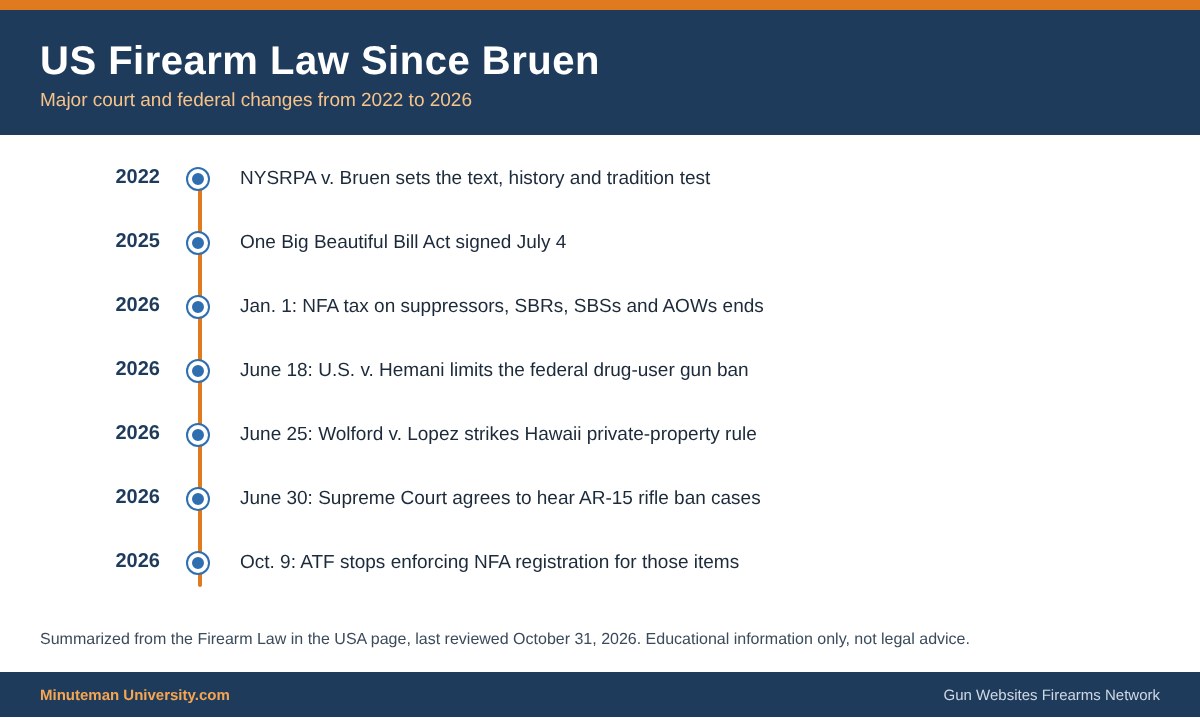
- January 1, 2026: the NFA tax on suppressors, short-barreled rifles, short-barreled shotguns and AOWs drops from $200 to $0 under the One Big Beautiful Bill Act (signed July 4, 2025).
- October 9, 2026: ATF announces nationwide non-enforcement of NFA registration and approval for those four categories, following Silencer Shop Foundation v. ATF (N.D. Tex., August 5, 2026). Machine guns and destructive devices are unchanged.
- June 18, 2026: United States v. Hemani limits the federal drug-user gun ban as applied to a marijuana user.
- June 25, 2026: Wolford v. Lopez (6-3) strikes Hawaii’s ban on carry onto private property open to the public without express consent.
- June 30, 2026: the Supreme Court agrees to decide whether AR-15 platform rifles are protected (Viramontes v. Cook County and Grant v. Higgins); argument December 2, 2026.
- October 2026: 29 states recognize constitutional (permitless) carry; twelve states plus D.C. ban sales of so-called “assault weapons.”
Guide to This Section
- Federal Laws: the NFA, Gun Control Act, NICS and the 2025-2026 NFA changes.
- State Firearm Laws: carry, permits and new 2025-2026 state laws, with subpages on State Gun Bans, 2A Sanctuary Laws, State Preemption, State Firearms and State 2nd Amendments.
- Court Cases: Supreme Court and circuit rulings, plus U.S. Judges.
- Firearm Bans: historical and current federal and state bans.
What Gun Owners Should Know
- Federal, state and sometimes local law all apply at once. The strictest applicable rule is the one that controls in practice.
- A court ruling or agency policy can be stayed, appealed or reversed. Confirm that a change is in effect before acting on it.
- Keep records: purchase receipts, approved NFA forms, permits and training certificates.
- For NFA items, see NFA Buyers Guide.com and Suppressor Buyers Guide.com. For training, see After Action.net. Key dates are on Gun Calendars.com, and questions can go to Ask Gun Questions.com.
Sources
How the state law maps in this section are researched, from statute to state note: How We Research.
- Supreme Court: NYSRPA v. Bruen opinion (2022)
- American Rifleman: ATF Ends Enforcement of NFA Registration Requirements
- CRS: Supreme Court Rules Federal Gun Ban Unconstitutional as Applied to Marijuana User
- Supreme Court Docket No. 25-238, Viramontes v. Cook County
Background and Resources
The history of gun laws in the United States is a long and complex, spanning over hundreds of years. We offer a brief overview of the major events and legislative milestones in the history of gun laws in the United States:
firearm laws in the United States are a complex and constantly evolving area of law, and it is important for individuals to stay up to date on the laws in their state and at the federal level in order to ensure compliance and avoid legal issues.
History of 2A Laws in the USA
Early Years: There were few restrictions on gun ownership in the beginning of the US. The Second Amendment to the Constitution, ratified in 1791, protected the right of the people to keep and bear arms.
- Second Amendment to the United States Constitution (1791)
- Militia Acts of 1792 (provided for the organization of the state militias)
- Militia Act of 1862 (African-Americans participate as soldiers for first time)
Post-Civil War Era: After the Civil War, some states enacted laws to prohibit ownership of firearms by African Americans and other minority groups.
- Freedmen’s Bureau Act 1865
- U.S. v. Cruikshank 1876
- Presser v State of Illinois 1886
- Militia Act 1903 (Dick Act)
- National Defense Act 1916
- Firearms and Ammunition Excise Tax (FAET) 1919
- Mailing of Firearms Act of 1927
National Firearms Act (NFA) In reaction to organized crime, the federal government regulated the manufacture and sale of certain types of firearms, such as machine guns, short-barreled shotguns, and silencers.
Gun Control Act (GCA) established a system for licensing firearm dealers and prohibited certain people, (under 18, convicted felons, etc) from owning guns.
- Omnibus Crime Control and Safe Streets Act of 1968
- Gun Control Act of 1968
- Privacy Act of 1974
- Arms Export Control Act of 1976
- Armed Career Criminal Act 1984
- Firearm Owners Protection Act of 1986
- Law Enforcement Officers Protection Act 1986
- Undetectable Firearms Act (1988)
- Semiautomatic Rifle Import Ban (1989)
- Gun-Free School Zones Act (1990)
- Brady Handgun Violence Prevention Act
- Brady Bill (1993) interim waiting-period provision ended in 1998 when NICS began
- Printz v. United States 1997
Federal Assault Weapons Ban prohibited the manufacture, sale, and possession of certain types of firearms, including some semi-automatic rifles and pistols. The ban expired in 2004 and was not found to be effective, so was not renewed.
- Assault Weapons Ban (AWB) (1994) expired in 2004
- Dickey Amendment 1996
- Domestic Violence Offender Gun Ban – Lautenberg Amendment 1996
- 2003 Tiahrt Amendment
- Protection of Lawful Commerce in Arms Act (PLCAA) 2005
- 2008 District of Columbia v. Heller
- 2009 Montana Firearms Freedom Act
Firearm laws in the United States vary widely by state and locality, with some areas having strict regulations on gun ownership and others having less restrictions. The debate over gun control remains a highly controversial and politically charged issue in the United States.
- 1903 – War Department Appropriations Act
- 1976 – International Traffic in Arms Regulations (ITAR)
- National Defense Authorization Act for Fiscal Year 1996