1927
- Mailing of Firearms Act
“National Firearms Control Act” - 18 U.S.C.A. § 1715
- prohibiting the use of the U.S.Postal Service to ship concealable firearms
- banned the shipping of concealable handguns through the mail
About the Mailing of Firearms Act
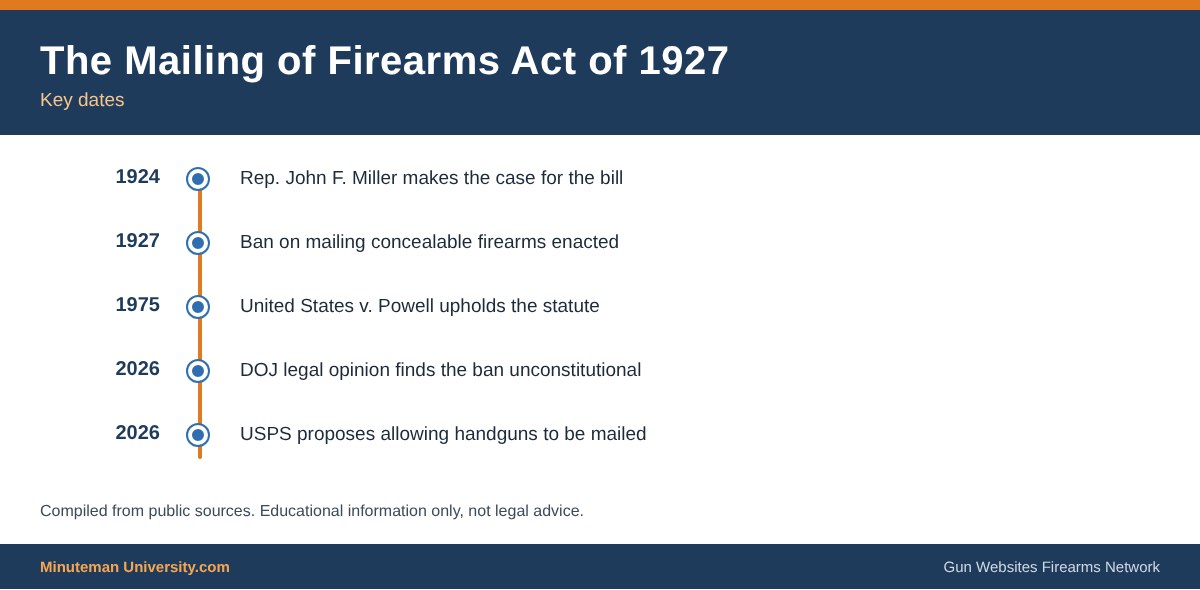
The Mailing of Firearms Act of 1927, sometimes called the Miller Act after Representative John F. Miller of Washington, made pistols, revolvers and other firearms capable of being concealed on the person nonmailable through the U.S. Post Office. Now codified at 18 U.S.C. 1715, it was intended, according to its legislative history, to keep the Post Office from helping criminals obtain concealable weapons in violation of local laws. It was one of the first federal laws aimed at firearms. Exceptions allow mailing by and to military and law enforcement officers and between licensed manufacturers and dealers, but ordinary gun owners could not mail a handgun through the Postal Service.
In United States v. Powell (1975), the Supreme Court upheld the statute against a vagueness challenge and held that a jury could find a 22-inch sawed-off shotgun to be concealable. After nearly a century in force, the law came under renewed scrutiny in 2026. In January 2026 the Justice Department’s Office of Legal Counsel issued an opinion concluding that the ban violates the Second Amendment and cannot be enforced, and the Postal Service proposed a rule that would permit mailing handguns under conditions similar to those for long guns. Twenty-two state attorneys general opposed the proposal in comments, and its final status should be checked before relying on it.
Key Facts
- 1924 – Representative John F. Miller argues the bill would keep concealable weapons from criminals
- 1927 – Congress enacts the ban on mailing concealable firearms
- 1975 – United States v. Powell upholds the statute
- January 2026 – Justice Department Office of Legal Counsel opinion finds the ban unconstitutional
- May 4, 2026 – Public comment period closes on a USPS proposal to allow mailing handguns