February 25, 1919
- Section 4181 of the Internal Revenue Code
- imposes an excise tax on imported firearms and ammunition
- since January 2003 – administered by the Alcohol and Tobacco Trade Bureau (TTB) within the U.S. Dept. of Treasury
- 10% tax of the sales price is imposed on pistols and revolvers
- 11% tax of the sales price is imposed on other portable weapons (rifles & shotguns) and ammunition
About the Firearms and Ammunition Excise Tax
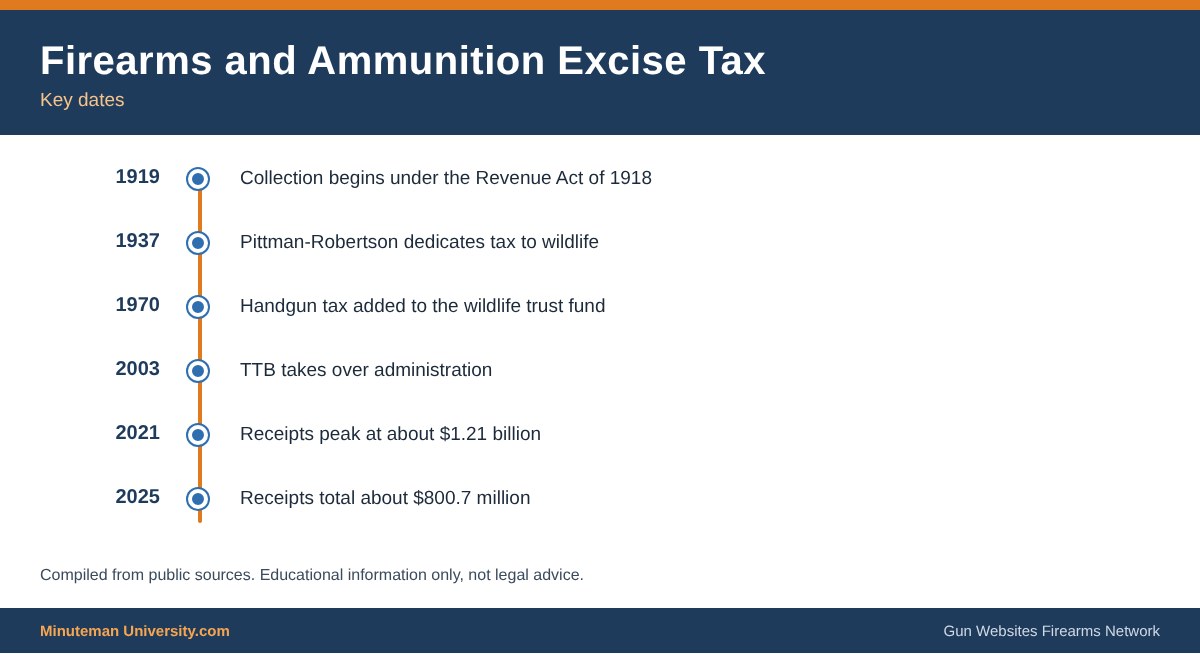
The Firearms and Ammunition Excise Tax (FAET), found at Section 4181 of the Internal Revenue Code, is a federal tax paid by manufacturers, producers and importers on firearms and ammunition sold for domestic use. It was first imposed by the Revenue Act of 1918, with collection beginning in 1919. The current rates are 10 percent of the manufacturer’s sale price for pistols and revolvers and 11 percent for other firearms, such as rifles and shotguns, and for shells and cartridges. Exports are exempt. Since January 2003 the tax has been administered by the Treasury Department’s Alcohol and Tobacco Tax and Trade Bureau (TTB).
For hunters and shooters, the FAET is the funding engine of American wildlife conservation. The Pittman-Robertson Federal Aid in Wildlife Restoration Act of 1937 dedicated the tax on long guns and ammunition to a trust fund distributed to state wildlife agencies, and 1970 amendments added the tax on handguns. The money pays for habitat restoration, wildlife research, hunter education and public shooting ranges. According to the Congressional Research Service, receipts peaked at about $1.21 billion in fiscal 2021 and totaled about $800 million in fiscal 2025.
Key Facts
- 1919 – Collection begins under the Revenue Act of 1918
- 1937 – Pittman-Robertson Act directs long gun and ammunition taxes to wildlife restoration
- 1970 – Amendments add the handgun tax to the wildlife trust fund
- January 2003 – TTB takes over administration of the tax
- FY2021 – Receipts peak at about $1.21 billion
- FY2025 – Receipts total about $800.7 million