enacted June 3, 1916
updated the Militia Act of 1903
expansion of the Army and the National Guard, the creation of an Officers’ and an Enlisted Reserve Corps, and the creation of a Reserve Officers’ Training Corps
About the National Defense Act of 1916
The National Defense Act of 1916 was signed by President Woodrow Wilson on June 3, 1916, as the United States prepared for possible entry into World War I and responded to Pancho Villa’s raid on Columbus, New Mexico, on March 9, 1916. It reorganized the nation’s land forces around the Regular Army, the National Guard and new reserve components. The act authorized expansion of the Army and the Guard, created the Officers’ Reserve Corps and Enlisted Reserve Corps, and established the Reserve Officers’ Training Corps (ROTC) at colleges and universities.
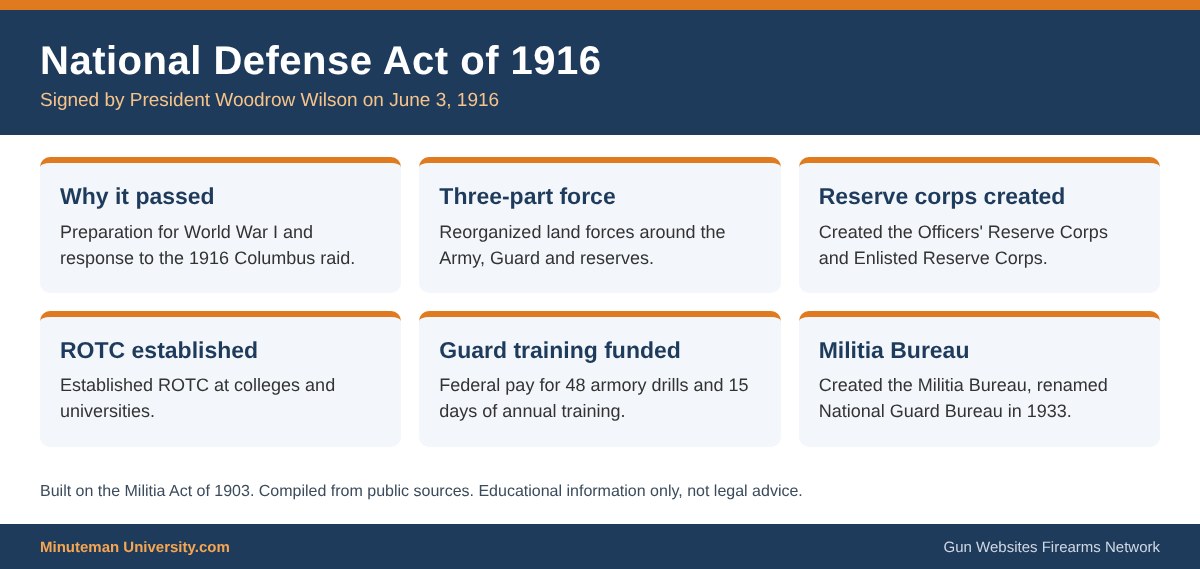
For the National Guard, the act brought far greater federal funding and oversight. Federal pay covered 48 armory drills and 15 days of annual training a year, up from five days of summer camp and no paid drills, and the old Division of Militia Affairs became the Militia Bureau, renamed the National Guard Bureau in 1933. Weeks after it passed, the entire Guard was mobilized for service on the Mexican border. The act built on the Militia Act of 1903 and shaped the modern relationship between state forces and the federal government, a structure central to debates over the militia clause of the Second Amendment.
Key Facts
- March 9, 1916 – Pancho Villa’s raid on Columbus, New Mexico
- June 3, 1916 – Signed into law by President Woodrow Wilson
- 1916 – ROTC established and the National Guard mobilized for the Mexican border
- 1933 – The Militia Bureau created by the act is renamed the National Guard Bureau