Last reviewed October 31, 2026
Firework Laws by State: Where They Stand in 2026
Consumer fireworks are not firearms, but the way they are regulated will look familiar to any gun owner: a short list of federal rules, a patchwork of state laws, and city or county ordinances layered on top. What is legal to buy in one state can be a citation, or worse, a few miles across the border. This page gives the big picture before the state-by-state list below.
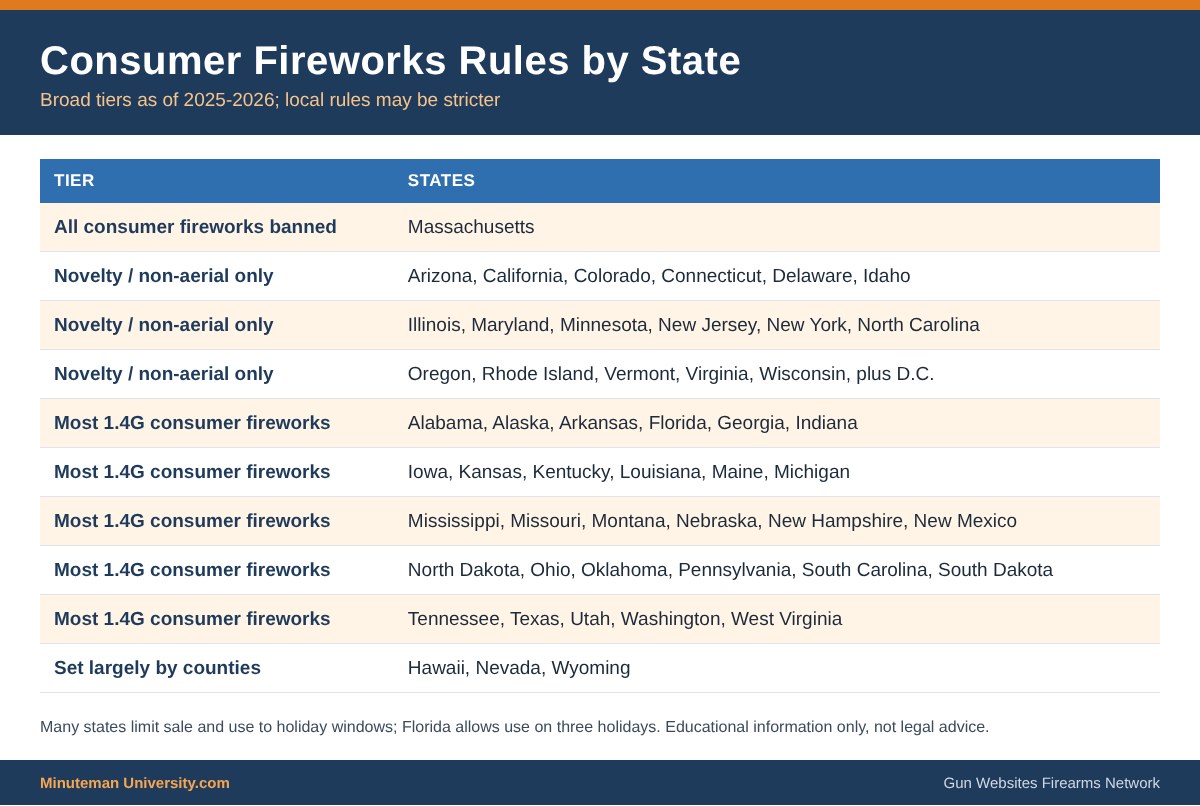
At the federal level, the Consumer Product Safety Commission (CPSC) sets safety standards for consumer fireworks (classified as 1.4G), while the ATF regulates display fireworks (1.3G) as explosives, which require a federal license to buy and store. Everything beyond that is left to the states. Industry summaries based on American Pyrotechnics Association groupings sort the states into a few broad tiers: one state, Massachusetts, bans all consumer fireworks, including sparklers; roughly a third of the states allow only ground-based and handheld "novelty" items such as sparklers, fountains and snakes; most states allow the full range of 1.4G consumer fireworks, including aerial items; and a few, such as Hawaii, Nevada and Wyoming, leave much of the decision to counties.
The trend over the past decade has been toward more access. Iowa legalized aerial consumer fireworks in 2017, Florida in 2020 allowed their use on New Year's Eve, New Year's Day and the Fourth of July, and Ohio's law allowing residents to discharge consumer fireworks on set holidays took effect July 1, 2022. At the same time, many cities still ban use within city limits, and fire officials can impose burn bans during dry seasons regardless of state law.
Key Facts
- Massachusetts is the only state that bans all consumer fireworks for the public; its prohibition dates to the 1940s.
- States in the "novelty only" tier include California, New York, New Jersey, Illinois, Minnesota and Virginia, among others (see the graphic).
- Many states that allow fireworks limit sales and use to windows around the Fourth of July and New Year's Eve.
- Local ordinances and seasonal burn bans can be stricter than state law, and they are enforced separately.
- Ohio (2022), Florida (2020) and Iowa (2017) are among the most recent states to expand legal consumer use.
What Gun Owners Should Know
- Check both state law and the city or county ordinance where the fireworks will be used, not just where they were bought.
- Buying in a permissive state does not make it legal to bring fireworks home to a restrictive one.
- Never celebrate with gunfire. Firing into the air is illegal in many jurisdictions (Arizona made it a felony in 2000 under "Shannon's Law") and the rounds come back down with lethal force.
- Keep fireworks, ammunition and powder stored separately and away from heat and open flame.
- Holiday weekends bring heavy enforcement; carry permit holders should also review local rules for crowded public events.
Related: State Firearm Laws, State Preemption, and Independence Day events on Gun Calendars.com.
Sources
- American Pyrotechnics Association
- CPSC: Fireworks Information Center
- Mass.gov: Leave Fireworks to the Professionals
- GL Solutions: Fireworks Regulations by State (2025)
Going LIVE to explore the 50 States of Fireworks Laws
- What is the Law about Fireworks in your state?
- What state has the best Firework Laws?
- Which State has the Worst Laws on Fireworks?
 Hand-made in 2022, the old-fashioned way: no robots, no fuses lit, and only a few colored markers lost in the process.
https://www.americanpyro.com/assets/docs/State_Laws/2022%20Fireworks%20State%20Map%20%281%29.pdf
https://americanmerchandiser.com/fireworks-regulations-by-state/
- Alabama
- Alaska
- Arizona
- Arkansas
- California
- Colorado
- Connecticut
- Delaware
- Florida
- Georgia
- Hawaii
- Idaho
- Illinois
- Indiana
- Iowa
- Kansas
- Kentucky
- Louisiana
- Maine
- Maryland
- Massachusetts
- Michigan
- Minnesota
- Mississippi
- Missouri
- Montana
- Nebraska
- Nevada
- New Hampshire
- New Jersey
- New Mexico
- New York
- North Carolina
- North Dakota
- Ohio
- Oklahoma
- Oregon
- Pennsylvania
- Rhode Island
- South Carolina
- South Dakota
- Tennessee
- Texas
- Utah
- Vermont
- Virginia
- Washington
- West Virginia
- Wisconsin
- Wyoming