1976
United States regulatory regime to restrict and control the export of defense and military related technologies to safeguard U.S. national security and further U.S. foreign policy objectives
Defense-related articles and services on the United States Munitions List (USML) are covered by the regulations
About the International Traffic in Arms Regulations
The International Traffic in Arms Regulations, or ITAR, are the federal rules that control the export and temporary import of defense articles, defense services and related technical data. They implement the Arms Export Control Act of 1976, are codified at 22 CFR Subchapter M, and are administered by the State Department’s Directorate of Defense Trade Controls (DDTC). Items covered are listed on the United States Munitions List, whose Category I historically covered firearms. Any U.S. company that manufactures, exports or brokers USML items must register with DDTC and pay an annual fee, starting at $2,250, even if it never exports.
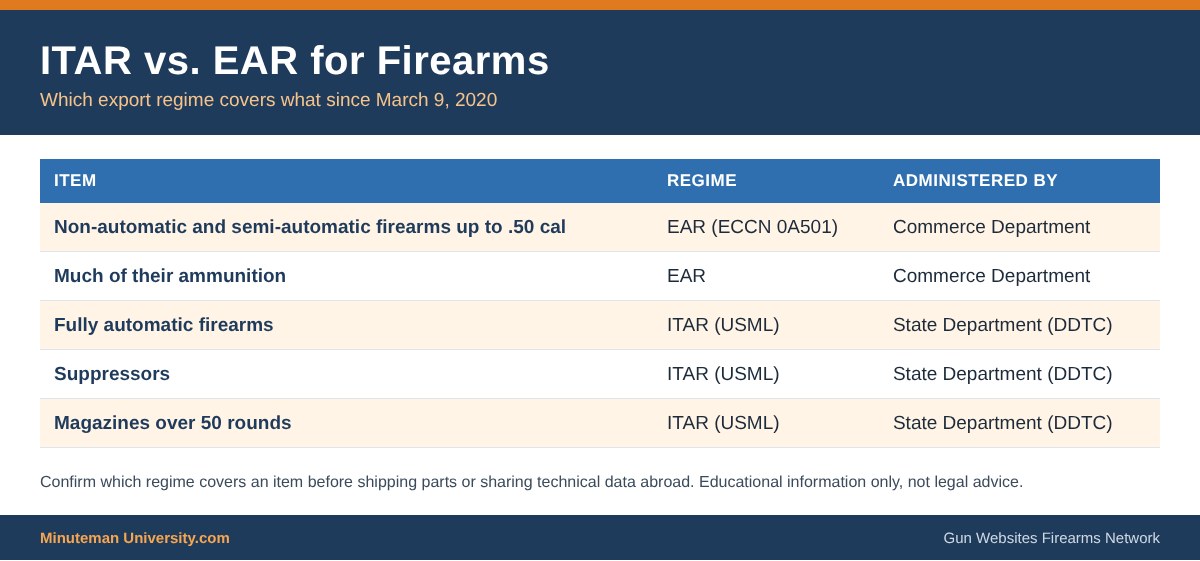
For the firearms industry, ITAR registration was long a significant cost for small manufacturers and gunsmiths. That changed on March 9, 2020, when export control reform moved most non-automatic and semi-automatic firearms up to .50 caliber, and much of their ammunition, from USML Category I to the Commerce Department’s Export Administration Regulations under ECCN 0A501. Fully automatic firearms, suppressors and magazines holding more than 50 rounds remain under ITAR. Exporters and gunsmiths should confirm which regime covers a given item before shipping parts or sharing technical data abroad.
Key Facts
- 1976 – Arms Export Control Act becomes the statutory basis for ITAR
- January 23, 2020 – Final rules published moving many firearms from the USML to the Commerce Control List
- March 9, 2020 – Transfer of non-automatic and semi-automatic firearms up to .50 caliber takes effect