Arms Export Control Act of 1976
- Title II of Pub.L. 94–329, 90 Stat. 729
- codified at 22 U.S.C. ch. 39
- H.R. 13680 legislation was passed by the 94th Congressional session
- enacted into law by the 38th President of the United States Gerald R. Ford
- on June 30, 1976
- requires international governments receiving weapons from the United States to use the armaments for legitimate self-defense
- places certain restrictions on American arms traders and manufacturers
About the Arms Export Control Act
The Arms Export Control Act of 1976 (Public Law 94-329, codified at 22 U.S.C. chapter 39) is the primary federal statute governing the export of defense articles and services. Signed by President Gerald Ford on June 30, 1976, it gives the President authority to control arms exports and imports, requires that foreign governments receiving U.S. weapons use them for legitimate self-defense, internal security and similar purposes, and requires the executive branch to notify Congress of major foreign military sales so that lawmakers can review or block them.
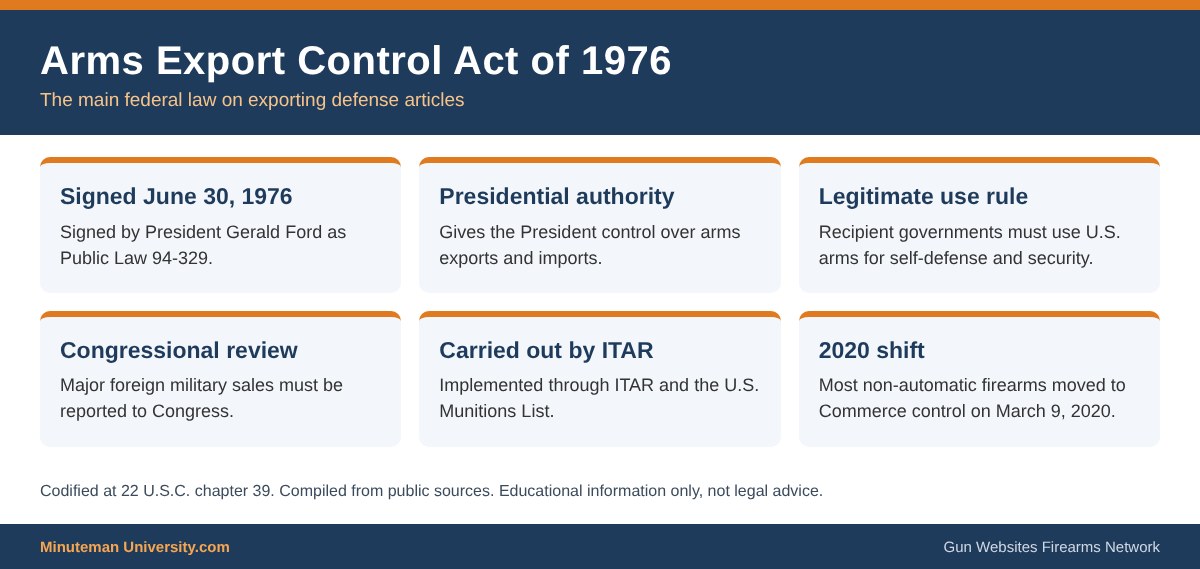
The act’s export controls are carried out through the International Traffic in Arms Regulations, administered by the State Department, and the United States Munitions List. For decades that meant commercial rifles, pistols and shotguns were treated like military hardware for export purposes. Since March 9, 2020, most non-automatic and semi-automatic firearms have been controlled instead by the Commerce Department, while machine guns, suppressors and certain other items remain under the AECA and ITAR. Section 38 of the act also supplies the authority for the permanent import controls that ATF enforces on defense articles.
Key Facts
- June 30, 1976 – Signed into law by President Gerald Ford
- 1976 – ITAR becomes the implementing regulation for the act’s export controls
- January 23, 2020 – Final rules published to move many commercial firearms to Commerce Department control
- March 9, 2020 – Transfer takes effect; automatic weapons and suppressors stay on the USML