Jan 21, 1903
created an early National Guard and codified the circumstances under which the Guard could be federalized
Unorganized Militia
which included all able-bodied men between ages 17 and 45
Organized Militia
which included state militia (National Guard) units receiving federal support
About the Militia Act of 1903
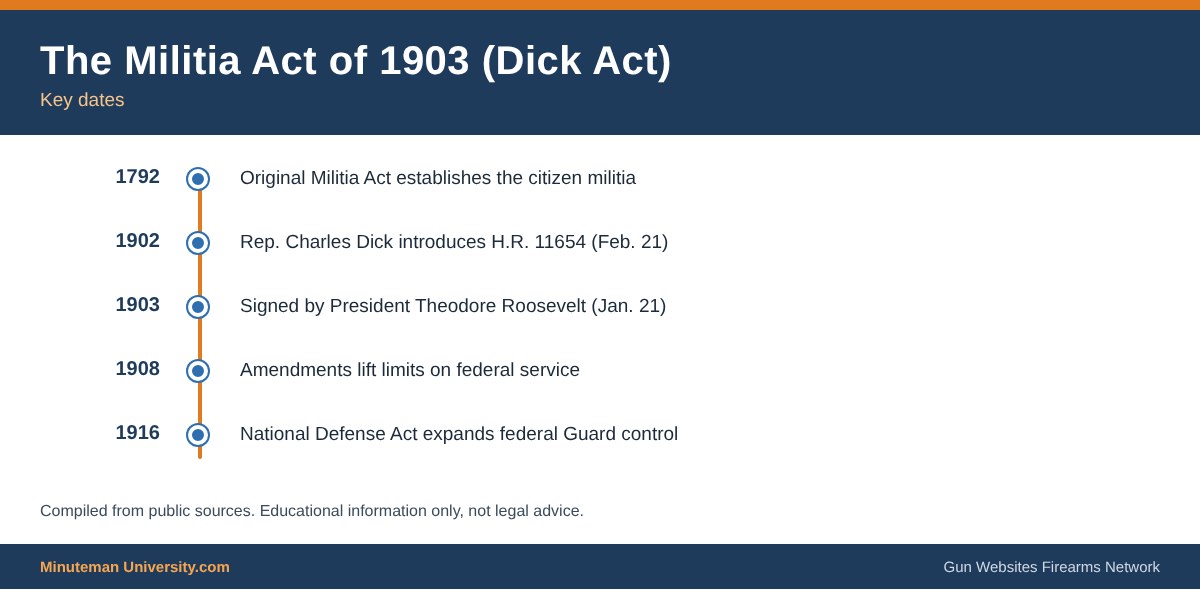
The Militia Act of 1903, known as the Dick Act after its sponsor, Representative Charles Dick of Ohio, was signed by President Theodore Roosevelt on January 21, 1903. It replaced the Militia Act of 1792 and modernized the nation’s citizen soldiers after weaknesses exposed during the Spanish-American War. The act divided the militia into two classes: the Organized Militia, made up of state units that received federal support and became known as the National Guard, and the Reserve Militia of other able-bodied men. It provided $2 million to modernize Guard equipment, funded summer encampments and set the conditions under which Guard units could be called into federal service.
The Militia Act of 1908 amended the law by removing the nine-month limit on federal service and the ban on Guard service outside the United States, and the National Defense Act of 1916 expanded federal control further. Today’s two-class definition survives in 10 U.S.C. 246, which defines the unorganized militia as able-bodied men of at least 17 and under 45 who are not in the National Guard or Naval Militia. The Dick Act is often discussed by 2A advocates in connection with the militia clause of the Second Amendment; claims circulating online that it bars all federal gun regulation are not supported by its text.
Key Facts
- February 21, 1902 – Representative Charles Dick introduces H.R. 11654
- January 21, 1903 – Signed by President Theodore Roosevelt and takes effect
- 1908 – Militia Act of 1908 removes limits on the length and location of federal service
- June 3, 1916 – National Defense Act of 1916 expands federal oversight of the Guard