1876
the Bill of Rights did not apply to private actors or state governments, despite the adoption of the Fourteenth Amendment
Argued March 30 – April 1, 1875
Decided March 27, 1876
held that the Second Amendment restricted only the federal government, not private actors or states
About United States v. Cruikshank
United States v. Cruikshank, 92 U.S. 542 (1876), arose from the Colfax Massacre of April 13, 1873, in Grant Parish, Louisiana, in which an armed white mob killed dozens of Black men, many after they had surrendered, during a dispute over control of the parish government. Federal prosecutors charged several participants under the Enforcement Act of 1870, alleging a conspiracy to deprive the victims of their constitutional rights, including the right to assemble and the right to bear arms.
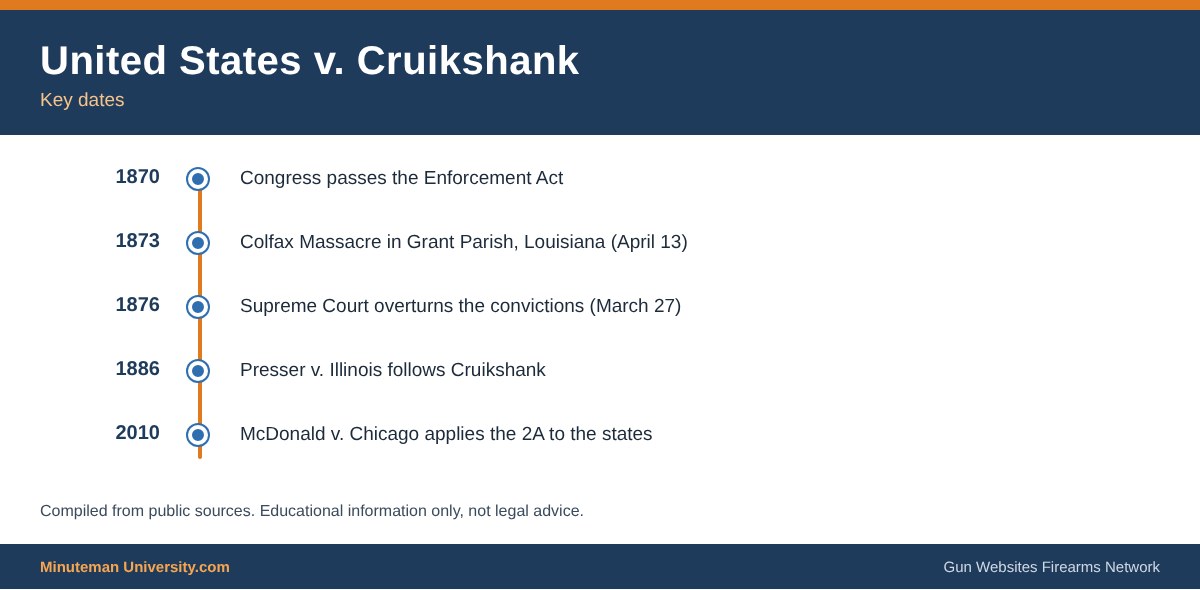
In an opinion by Chief Justice Morrison Waite, the Supreme Court overturned the convictions. The Court said the right to bear arms for a lawful purpose is not a right granted by the Constitution, nor dependent on it for its existence, and that the Second Amendment has no other effect than to restrict the powers of the national government. In other words, the Court treated the right as pre-existing, but held that the Bill of Rights restrained only Congress, leaving protection against private violence and state action to the states. The decision left freedmen in the South largely without federal protection of their arms, and it guided Second Amendment law until McDonald v. City of Chicago (2010) applied the right to the states through the Fourteenth Amendment.
Key Facts
- April 13, 1873 – Colfax Massacre in Grant Parish, Louisiana
- March 30 to April 1, 1875 – Case argued before the Supreme Court
- March 27, 1876 – Supreme Court overturns the Enforcement Act convictions
- 1886 – Presser v. Illinois follows Cruikshank’s reasoning
- June 28, 2010 – McDonald v. City of Chicago incorporates the Second Amendment against the states