Last reviewed October 31, 2026
Federal Gun Bans: Where It Stands in 2026
Federal law does not ban any common category of rifle, pistol or shotgun today. The bans that remain are narrower and fall into four groups: bans on certain items (new machine guns, undetectable firearms, armor-piercing handgun ammunition), bans on certain people (the “prohibited persons” list in 18 U.S.C. 922(g)), bans in certain places (school zones, federal facilities, post offices), and import restrictions, covered on the Firearm Import Bans page. The best-known federal ban, the 1994 assault weapons ban, expired on September 13, 2004 and has not been renewed.
Since NYSRPA v. Bruen (June 23, 2022), every federal restriction is measured against the nation’s historical tradition of firearm regulation. Results have been mixed. The Supreme Court upheld the domestic-violence restraining order ban in United States v. Rahimi (June 21, 2024), struck down ATF’s bump stock rule as a matter of statutory meaning in Garland v. Cargill (June 14, 2024), upheld ATF’s frame and receiver rule in Bondi v. VanDerStok (March 26, 2025), and in United States v. Hemani (June 18, 2026) held the drug-user ban in 922(g)(3) unconstitutional as applied to a marijuana user who was not shown to be dangerous. Challenges to the felon ban, 922(g)(1), and to the machine gun ban continue in lower courts.
Executive policy has also moved. The Justice Department settled the forced reset trigger litigation on May 16, 2025, and dropped its appeal of the court order that vacated the 2023 pistol brace rule (July 2025). The One Big Beautiful Bill Act set the NFA tax to $0 for suppressors, short-barreled rifles, short-barreled shotguns and AOWs starting January 1, 2026, and on October 9, 2026 ATF announced it would no longer enforce NFA registration and approval for those four categories after a federal court ruling. Machine guns and destructive devices remain fully regulated. In Congress, the Assault Weapons Ban of 2025 (H.R. 3115, introduced April 30, 2025) and a Senate companion have not advanced. The bigger near-term question is at the Supreme Court, which hears Viramontes v. Cook County and Grant v. Higgins on December 2, 2026, on whether state and local bans on AR-15-type rifles violate the Second Amendment.
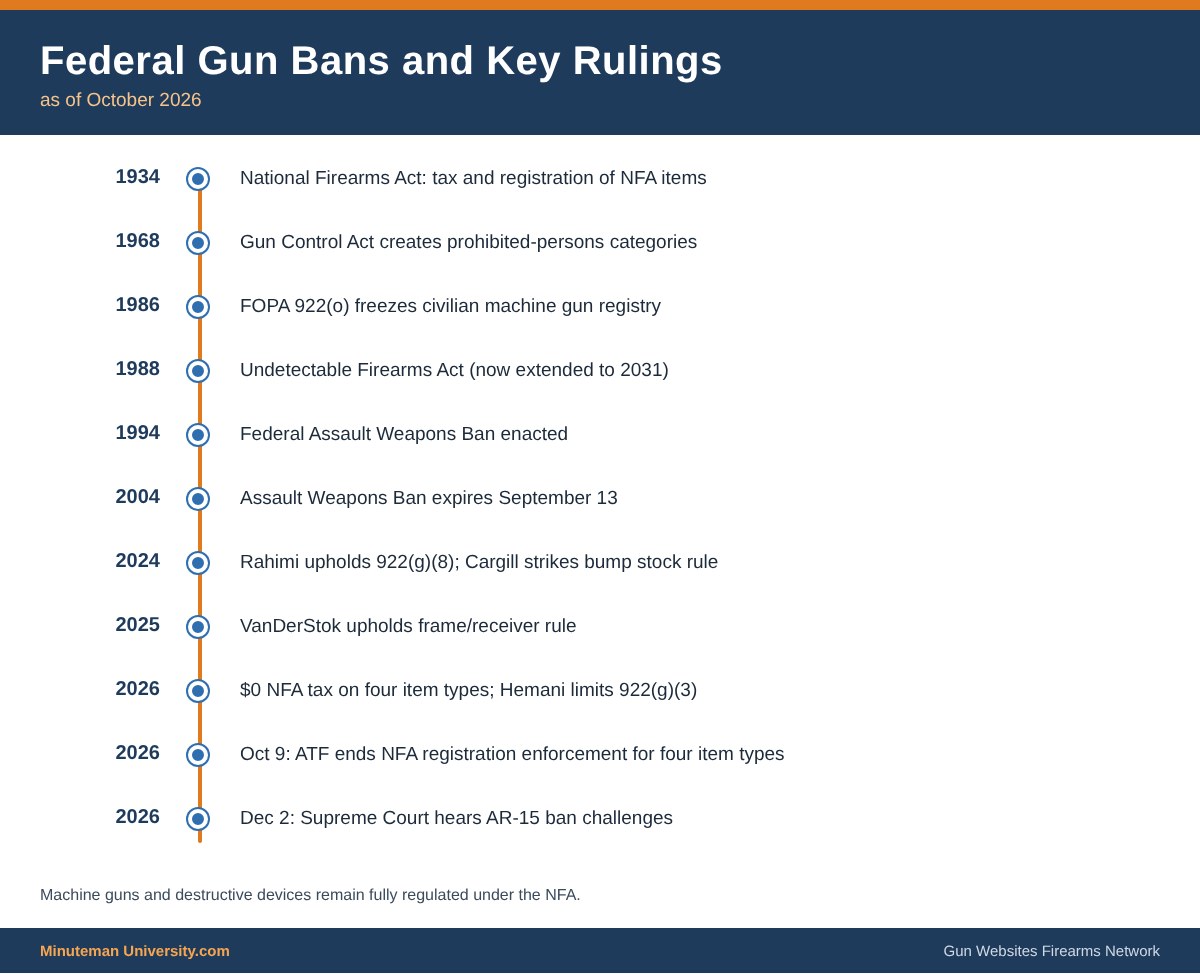
Key Facts
- 1934: The National Firearms Act taxes and registers machine guns, short-barreled long guns, suppressors and AOWs; it is a tax and registration law rather than a ban.
- 1968: The Gun Control Act creates the prohibited-persons categories, now nine in 18 U.S.C. 922(g).
- May 19, 1986: The Firearm Owners Protection Act adds 922(o): machine guns not lawfully registered by that date cannot be transferred to or possessed by civilians.
- 1986: The Law Enforcement Officers Protection Act bans making and importing defined armor-piercing handgun ammunition.
- 1988: The Undetectable Firearms Act bans guns that cannot pass a metal detector; extended in 2024 through March 8, 2031.
- 1990 / 1996: The Gun-Free School Zones Act, struck down in United States v. Lopez (1995) and re-enacted with an interstate commerce element.
- 1994 to 2004: The Federal Assault Weapons Ban restricted named rifles and new magazines over 10 rounds; it sunset after ten years.
- 1996: The Lautenberg Amendment adds misdemeanor domestic violence convictions to 922(g).
- June 18, 2026: Hemani limits 922(g)(3) as applied to non-dangerous marijuana users.
- December 2, 2026: Supreme Court argument on AR-15 bans (state and local laws, but the ruling will shape any future federal ban).
What Gun Owners Should Know
- Know the nine 922(g) categories before buying, selling privately or receiving a gift; the buyer certifies them on Form 4473. See Background Checks.
- Only machine guns registered before May 19, 1986 can be owned by civilians, and they still require full NFA approval and the $200 tax.
- The NFA changes for suppressors, SBRs, SBSs and AOWs do not change state law. Several states still ban these items outright; check State Gun Bans and NFA Buyers Guide.com.
- Firearms are generally barred in federal buildings, courthouses and post offices regardless of a state carry permit.
- Court rulings in a single case often apply only to the parties or one circuit. Do not assume a ruling elsewhere protects conduct in a given state.
- Follow the December 2026 argument and the decision expected by mid-2027 on the Court Cases page and at Gun Calendars.com.