Last reviewed October 31, 2026
Firearm Import Bans: Where It Stands in 2026
Most firearm import restrictions in the United States were never voted on as stand-alone “bans.” They come from the way federal agencies apply a short phrase in the Gun Control Act of 1968: a firearm may be imported only if it is “generally recognized as particularly suitable for or readily adaptable to sporting purposes” (18 U.S.C. 925(d)(3)). The same section bars importing NFA firearms such as machine guns and short-barreled rifles for civilian sale, and generally bars surplus military firearms. ATF, now part of the Justice Department, decides what qualifies, and the State Department and Treasury add country-based limits through arms-trade rules and sanctions.
Over the decades, those administrative tools have been used to block whole categories of firearms and ammunition. In 1989 the Bush administration stopped imports of 43 semi-automatic rifle models after ATF found they were not “sporting.” In 1998 the Clinton administration extended the test to more than 50 modified rifles that accept large-capacity military magazines. Most Chinese firearms and ammunition have been blocked since 1994, and in 2021 the State Department stopped approving permits for most Russian firearms and ammunition. None of these actions required a new act of Congress, which is why import policy can change from one administration to the next.
In 2026 the direction shifted. In May 2026 ATF published a package of proposed rules that would let dual-use frames, receivers and barrels be imported when a sporting configuration exists, replace the outdated proscribed-country list (last updated in 2007) with the State Department’s list, and drop blanket denials for several former Soviet states. Russia would stay proscribed. As of October 31, 2026 those proposals had closed for comment but had not been finalized, and the 1989 and 1998 rifle import criteria remain in place. For the original 1989 action, see Semi-Automatic Rifle Import Ban (1989), and for how imported parts affect U.S.-built rifles see 922r Restrictions on Firearms Manufacturing.
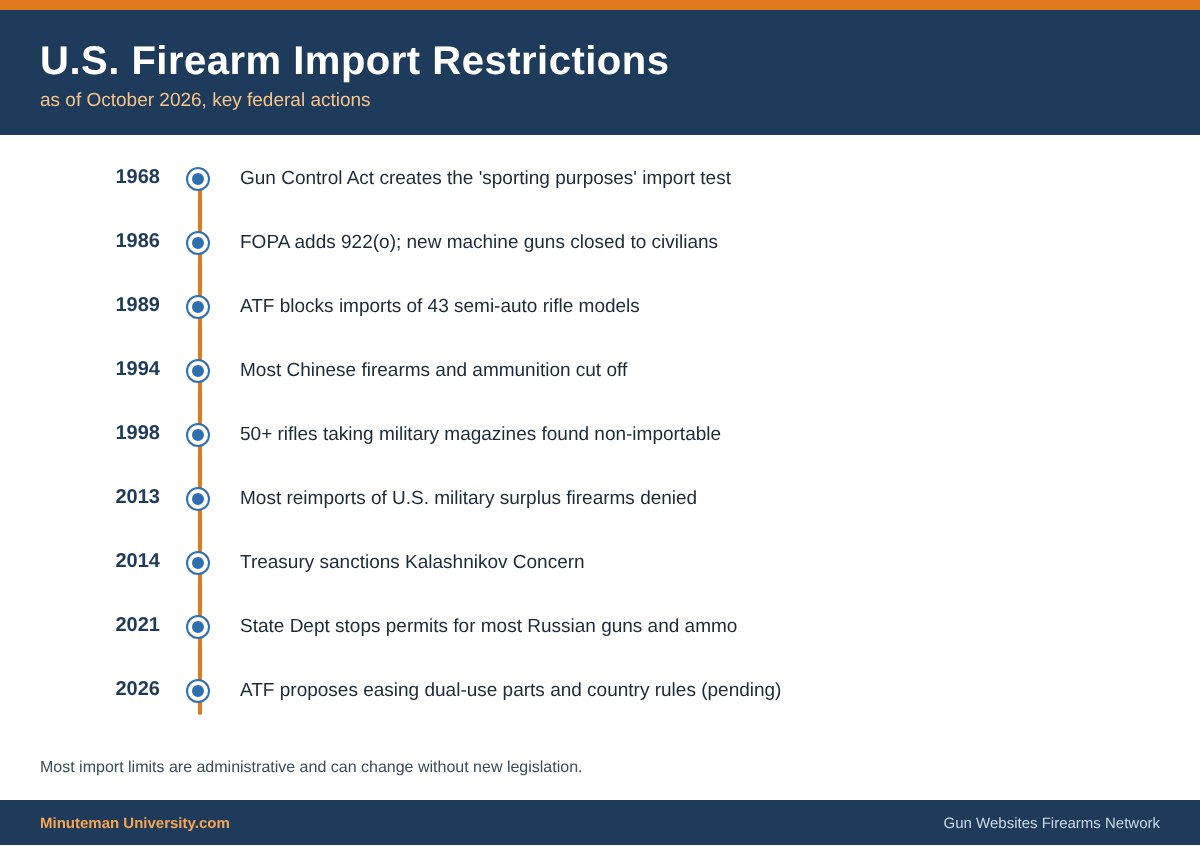
Key Facts
- 1968: The Gun Control Act creates the “sporting purposes” import test in 18 U.S.C. 925(d)(3); ATF later scores handguns with a points-based factoring system.
- May 19, 1986: The Firearm Owners Protection Act adds 18 U.S.C. 922(o), which effectively ends civilian access to newly made or newly imported machine guns.
- 1989: ATF blocks imports of 43 semi-automatic rifle models, first by temporary suspension in March, then by a July 1989 report applying the sporting test.
- 1994: Most firearms and ammunition from Chinese state manufacturers such as Norinco and Polytech are cut off during the renewal of China’s trade status; China remains on the State Department’s proscribed list.
- April 6, 1998: More than 50 rifles that accept large-capacity military magazines are found non-importable.
- August 29, 2013: An executive action denies most requests by private entities to reimport U.S.-origin military surplus firearms, such as M1 rifles and carbines previously supplied to allies.
- July 2014: Treasury sanctions Kalashnikov Concern, ending new imports of its rifles.
- September 7, 2021: The State Department stops approving permits for most Russian firearms and ammunition under sanctions law.
- May 6 and 8, 2026: ATF proposes rules on proscribed countries (FR Doc. 2026-08911, comments closed July 6) and dual-use frames, receivers and barrels (91 FR 25192, comments closed August 6). Not final as of October 31, 2026.
What Gun Owners Should Know
- An import ban limits what can enter the country, not what can be owned. Firearms lawfully imported before a ban generally remain legal to own and sell under federal law, subject to state law.
- Building a U.S. rifle from imported parts can trigger 922(r) limits on the number of foreign parts. Check parts counts before assembling an imported-pattern rifle.
- Ammunition already in the U.S. before the 2021 Russian permit stop is lawful to buy and use; availability simply declined.
- Returning with a firearm bought abroad requires ATF import approval (Form 6) and must meet the same import tests. Firearms originally taken out of the U.S. by the same person follow a separate return process.
- Pending proposed rules are not law. Watch the Federal Register and the ATF Comment Periods page for final rules.
- Related reading: Federal Gun Bans, Firearm Bans, and Magazine Buyers Guide.net for magazine background.
Across the Gun Websites Network
- 922(r) and Imported Parts AK47 Buyers Guide.com
- Laws about the AK47 AK47 Buyers Guide.com
- Revolver Importation Revolver Buyers Guide.com
Sources
- 18 U.S.C. 925, Exceptions and Relief from Disabilities (Cornell LII)
- CRS Insight IN12724: ATF’s Proposed Rules for Firearms Imports (August 2026)
- White House, April 6, 1998 import announcement (National Archives)
- Fact Sheet: New Executive Actions, August 29, 2013 (American Presidency Project)
- American Rifleman: U.S. Government Halts Permit Approvals for Russian Ammo