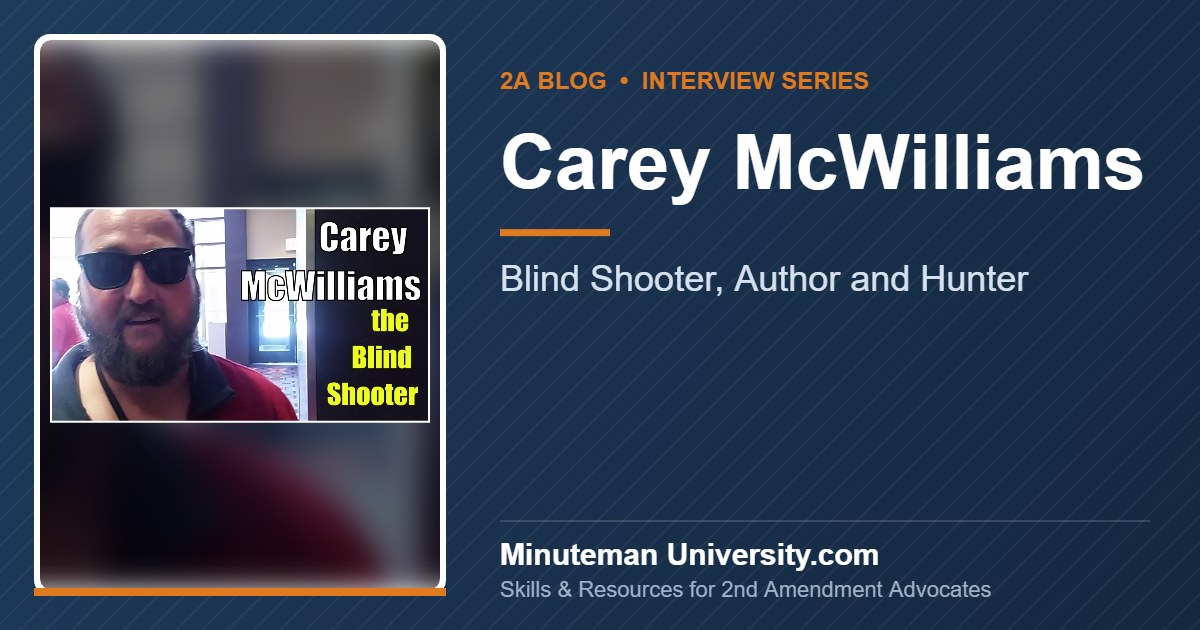
Carey McWilliams has been completely blind since the age of ten, yet he holds multiple concealed carry permits, hunts dangerous game and has written two books on firearms. In this short 2018 interview recorded at the Gun Rights Policy Conference, he explains why the right to self-defense does not depend on eyesight, and why every gun owner has a stake in defending the rights of people with disabilities.
- Who: Carey McWilliams, shooter, hunter and author who lost his sight at age ten
- Known for: The books Guide Dogs and Guns and A Shooting Guide for the Blind
- Interview: Gun Rights Policy Conference, 2018
A Shooter First, Then an Author
Carey lost his eyesight suddenly, over a matter of hours, at age ten. He picked up his first firearm, an M16, at fifteen and received instruction on how to shoot it and how to disassemble and reassemble it. In college he took an Army ROTC pistol marksmanship course, which included shooting a variety of pistols at various ranges, and earned an A. According to the video description, he learned to aim by listening to the sound of his target being placed into position.
His first book, Guide Dogs and Guns, came out in 2007 and is now out of print. He describes it as more of an autobiography, covering his life as a shooter, his guide dogs and his early run-ins with the national media. One of his first television interviews, he recalls, abandoned the questions he had been given and tried to ambush him on camera. His newer book, A Shooting Guide for the Blind, is a practical guide for visually impaired shooters and the people who train them, covering safe firearm use for hunting, target shooting and self-defense.
Five Permits, Earned the Same Way as Everyone Else
At the time of the interview, Carey held five concealed carry permits. The description notes that he qualified for his North Dakota permit in October 2000. These are not honorary credentials. He takes the same classes and shooting qualifications as any other applicant, and he carries. The point is not the paperwork; it is showing people what is possible.
He also wanted to clear up a common misconception. Many people assume a guide dog doubles as protection. In reality, a guide dog is trained to be docile in public and to do its job, not to defend its handler. A blind person who may be seen as an easier target has the same need for practical self-defense as anyone else, and Carey wrote his first book in part because a civil rights dispute in Minnesota was being reported with only half the story.
“Blind people aren’t blind people first. We’re Americans first, and we need to be able to defend ourselves.”
Carey McWilliams
Why Every Gun Owner Should Care
Carey made a point every advocate should remember. Taking gun rights away from blind people might look acceptable to some because the group is small. But once that line is crossed, the next targets could be people who are deaf, older Americans with arthritis, and eventually anyone else. Defending the rights of the smallest group is how the rights of everyone stay protected.
That is one of the strengths of the Gun Rights Policy Conference, where this interview was recorded: it exposes attendees to corners of the Second Amendment fight they may never have considered.
Hunting Big Game by Ear
The description notes that Carey started hunting in 2008 and took an alligator more than 11 feet long in 2009. He has hunted ducks and deer as well as dangerous game including bears, alligators and mountain lions. He described an antelope hunt in Wyoming with the CEO of Savage Arms, where he made a clean shot at 156 yards that dropped the animal on the spot. At the time, he was hoping to hunt crocodiles on the Nile, a hunt that requires a precise, quarter-sized shot.
He sees his visibility as a responsibility rather than a spotlight. His mission is to show blind people what they are capable of, and to help sighted family members and instructors understand how to teach them.
- The right to self-defense belongs to every American, including those with disabilities.
- Rights stripped from a small group set the precedent for stripping them from larger ones.
- Guide dogs are not protection animals; blind citizens need practical self-defense options too.
- Adaptive training methods let visually impaired shooters qualify, carry and hunt safely.
Watch the full interview
Video: Carey McWilliams – Blind Shooter – Interview – A Shooting Guide for the Blind – Guide Dogs and Guns on the Gun Websites YouTube channel.
- Accessible Shooting – adaptive shooting and hunting programs for people with disabilities
- Guns & the Elderly – protecting the rights of older gun owners
- Hunting Organizations – groups that support hunters across the country