Guns & the Elderly: Ownership, Estate Planning and Safety for Older Gun Owners
Older Americans are a large and experienced part of the gun-owning community. Many have owned firearms for decades, hold collections built over a lifetime, and rely on a firearm for self-defense at home. Age itself does not change anyone’s Second Amendment rights. What changes are the practical questions: how to keep shooting safely as strength and eyesight change, what happens to a collection when the owner passes, and how families can handle the difficult situation of cognitive decline.
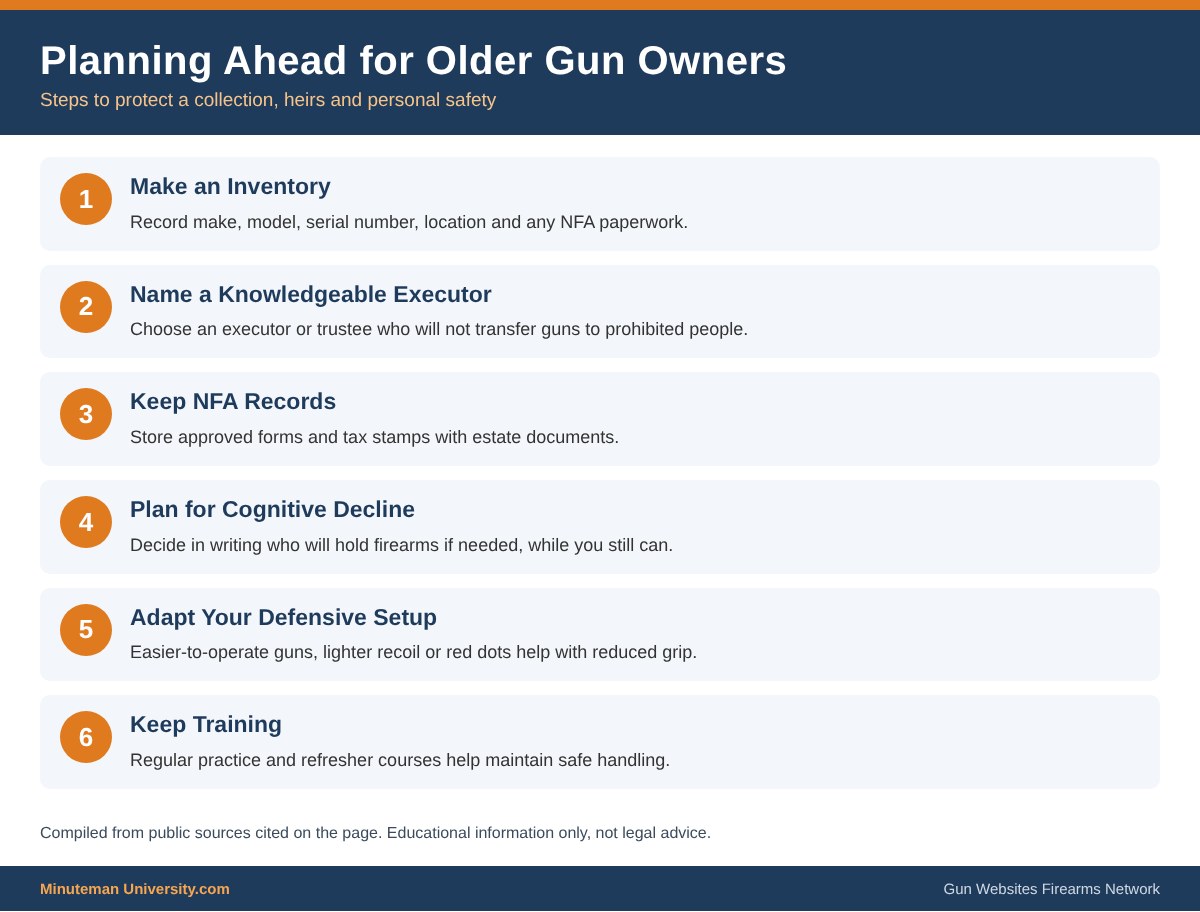
Planning ahead is the single most important step. Firearms pass through estates like other property, but they come with legal strings: an heir must be legally allowed to possess them, transfers must follow federal and state law, and National Firearms Act (NFA) items have their own rules. A clear inventory, written wishes and, for many owners, a properly drafted gun trust can prevent an executor or family member from unknowingly committing a crime.
The NFA landscape changed significantly in 2026. The federal $200 tax on suppressors, short-barreled rifles, short-barreled shotguns and “any other weapons” dropped to $0 on January 1, 2026, and on October 9, 2026 the Justice Department announced ATF would no longer enforce NFA registration for those four categories, following a federal court ruling in Silencer Shop Foundation v. ATF / Jensen v. ATF. Machine guns and destructive devices remain fully regulated, and about 15 states have their own laws tied to the federal process. Older owners with NFA collections should review their estate plans in light of these changes rather than assume the old rules or the new ones apply automatically.
Dementia is the hardest topic. A diagnosis of dementia or Alzheimer’s disease does not by itself make someone a prohibited person under federal law; that requires a court or similar body to adjudicate the person mentally incompetent or commit them. That leaves most decisions to families. Voluntary, early planning, done with the owner’s participation and dignity respected, works far better than a crisis.
Key Facts
- Federal prohibition standard: 18 U.S.C. 922(g)(4) applies to persons “adjudicated as a mental defective” or committed to a mental institution, not to a diagnosis alone.
- Inheritance across state lines: federal law (18 U.S.C. 922(a)(3)(A)) allows a person to receive a firearm by bequest or intestate succession from another state if possession is lawful in the heir’s home state. State law may add steps.
- NFA estates: ATF has long allowed registered NFA firearms to pass to lawful heirs on a tax-exempt Form 5. Machine guns and destructive devices still require this process; for suppressors, SBRs, SBSs and AOWs, ATF announced non-enforcement of registration on October 9, 2026, except where state law requires the federal process.
- NFA tax: $0 for suppressors, SBRs, SBSs and AOWs since January 1, 2026; machine guns and destructive devices unchanged.
- Veterans: on February 17, 2026, the Department of Veterans Affairs announced it would stop reporting veterans who are assigned a benefits fiduciary to the FBI’s NICS background check system and would work to remove past reports.
- Voluntary options: some states, including Washington and Virginia, let a person voluntarily add their own name to a “do not sell” list, which can be part of a plan an owner makes for themselves.
- Dementia guidance: the Alzheimer’s Association (tip sheet updated July 2024) recommends early family conversations, including the owner in decisions about inheritance, and notes that locks alone may not be enough as the disease progresses.
What Gun Owners Should Know
- Make an inventory now. Record make, model, serial number, location, and any NFA paperwork. Tell your executor where it is and where keys or safe combinations are kept.
- Name a knowledgeable executor or trustee. Executors may possess firearms while settling an estate, but they must not transfer them to anyone prohibited. A firearms-savvy attorney or a gun trust can simplify this, especially with NFA items.
- Keep NFA records. Even with registration non-enforcement, keep approved forms and tax stamps with estate documents; machine guns and destructive devices still require approved transfers, and policies can change.
- Plan for cognitive decline while you can. Decide in advance who will hold firearms if needed, put it in writing, and consider a trusted friend or relative as temporary custodian. A lawful voluntary arrangement avoids court involvement such as a red flag order.
- Adapt your defensive setup. Reduced grip strength or arthritis can make some slides hard to rack; many seniors choose revolvers, easier-to-manipulate semi-automatics, lighter recoil calibers or red-dot sights. Revolver options are covered at Revolver Buyers Guide.com.
- Keep training. Regular practice and refresher courses help maintain safe handling. Find instructors through After Action.net and review Firearm Safety.
- Store safely when grandchildren visit. See Guns & Kids for storage guidance, and Suicide and Guns for resources on a risk that rises with age.
- NFA details: see NFA Buyers Guide.com and Suppressor Buyers Guide.com.
Sources
- Transfers of National Firearms Act Firearms in Decedents’ Estates (ATF)
- Justice Department Won’t Enforce Registration Rules on Silencers and Certain Guns (AP via KSAT, Oct. 9, 2026)
- VA Restores Gun Rights to Some Disabled Veterans (Military Times, Feb. 18, 2026)
- Firearm Safety Tip Sheet (Alzheimer’s Association)
- 18 U.S.C. 922 (Cornell Legal Information Institute)