1791
“A well regulated militia, being necessary to the security of a free state, the right of the people to keep and bear arms, shall not be infringed.”
Second Amendment to the U.S. Constitution
About The 2nd Amendment
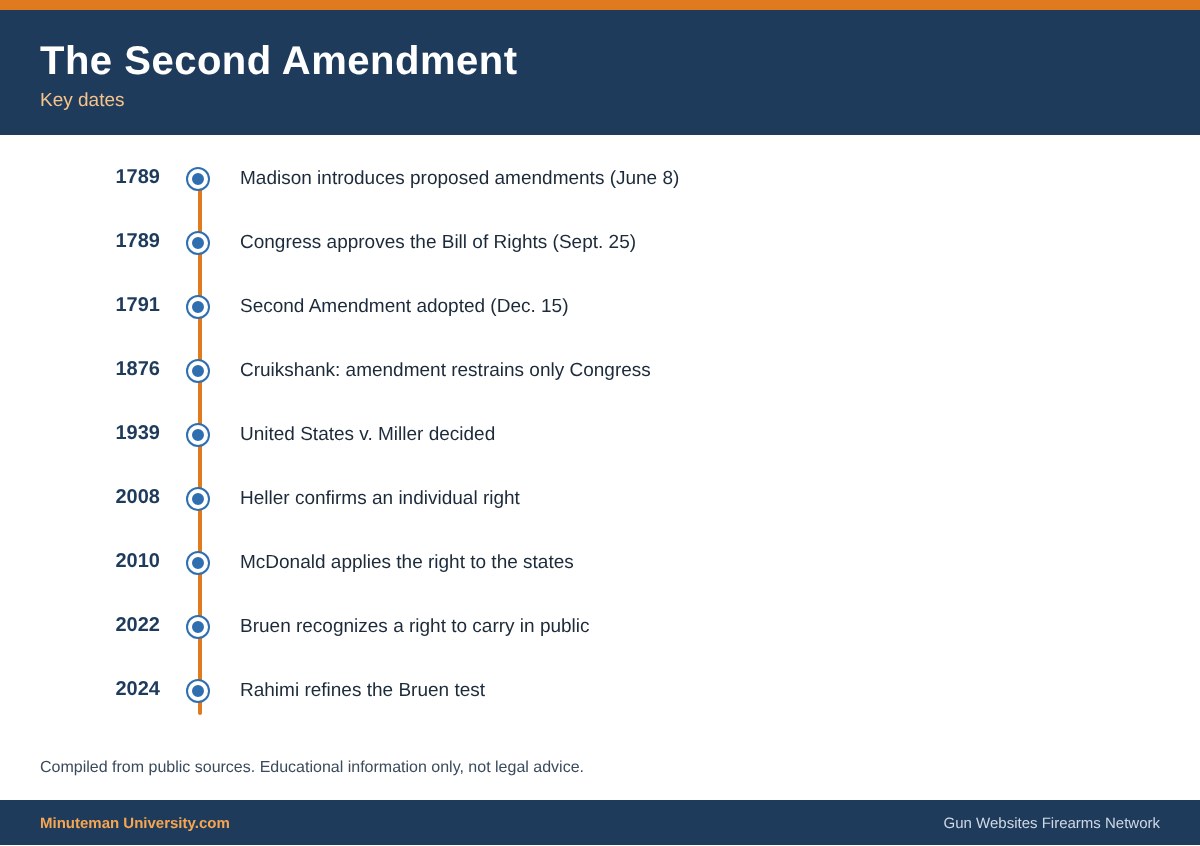
The Second Amendment is part of the Bill of Rights, the first ten amendments to the United States Constitution. James Madison introduced his proposed amendments in the House of Representatives on June 8, 1789, drawing on state ratifying convention proposals and state declarations of rights, several of which already protected the right of the people to bear arms. Congress approved the amendments on September 25, 1789, and they were ratified by the states and adopted on December 15, 1791.
For most of American history the Supreme Court said relatively little about the amendment. United States v. Cruikshank (1876) held that it restrained only the federal government, and United States v. Miller (1939) addressed a short-barreled shotgun under the National Firearms Act. The modern era began with District of Columbia v. Heller (2008), which held that the amendment protects an individual right to keep and bear arms, and McDonald v. City of Chicago (2010), which applied that right to the states. New York State Rifle and Pistol Association v. Bruen (2022) recognized a right to carry in public and adopted a text, history and tradition test, refined in United States v. Rahimi (2024). These cases shape every firearms law debated today.
Key Facts
- June 8, 1789 – James Madison introduces proposed amendments in the House
- September 25, 1789 – Congress approves the Bill of Rights for ratification
- December 15, 1791 – Second Amendment adopted as part of the Bill of Rights
- 2008 – District of Columbia v. Heller confirms an individual right
- 2010 – McDonald v. City of Chicago applies the right to the states
- 2022 – Bruen recognizes a right to carry in public
Learn More
- District of Columbia v. Heller (2008)
- United States v. Cruikshank (1876)
- Militia Act of 1903 (the Dick Act)