Militia Act of 1862: Opening Federal Military Service to Black Americans
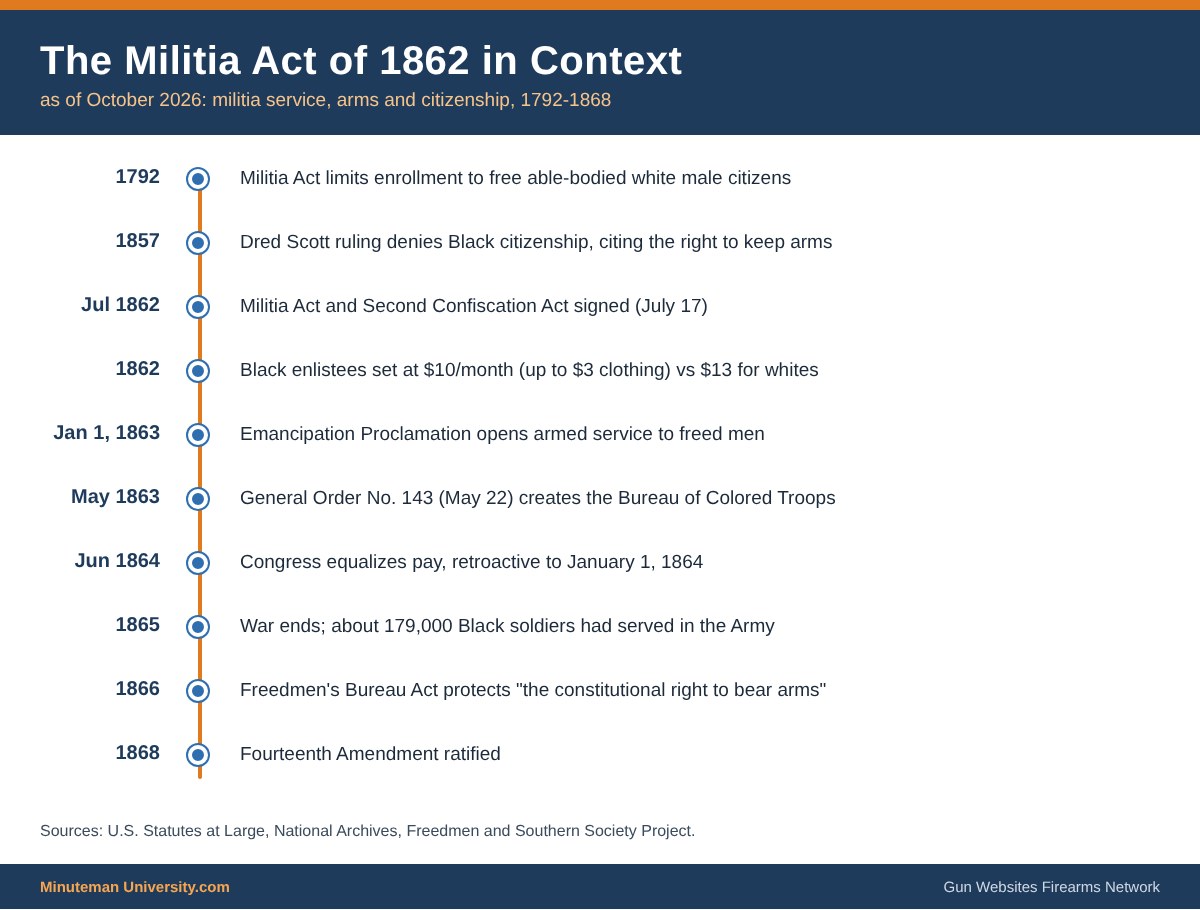
The Militia Act of 1862 (12 Stat. 597) was signed by President Abraham Lincoln on July 17, 1862, more than a year into the Civil War. Its first purpose was manpower: it let the President call state militia into federal service for up to nine months and set enrollment to include all able-bodied male citizens aged 18 to 45, with federal rules where state militia laws fell short. Its most lasting provision, Section 12, authorized the President to receive “persons of African descent” into federal service for labor or military service. The original Militia Act of 1792 had limited militia enrollment to free, able-bodied white male citizens.
The act was passed the same day as the Second Confiscation Act. That law declared that enslaved people of those engaged in rebellion who reached Union lines “shall be forever free of their servitude,” and authorized the President to employ persons of African descent to suppress the rebellion. Section 13 of the Militia Act added that a Black man or boy who served, and whose enslaver had supported the rebellion, would be “forever thereafter free,” along with his mother, wife and children if they were held by such an enslaver.
The act also built in inequality. Section 15 set pay for persons of African descent at $10 a month and one ration, with up to $3 of that in clothing, leaving as little as $7, while white privates received $13. Black soldiers and their supporters protested, and in June 1864 Congress equalized pay retroactive to January 1, 1864. After the Emancipation Proclamation of January 1, 1863, and the War Department’s General Order No. 143 of May 22, 1863, creating the Bureau of Colored Troops, about 179,000 Black men served in the U.S. Army, roughly 10 percent of Union forces, in what became the United States Colored Troops.
For Second Amendment history, the act matters because militia service, arms-bearing and citizenship were closely linked in 19th-century law. In Dred Scott (1857), the Supreme Court had cited the right “to keep and carry arms” as one reason it would not recognize Black Americans as citizens. Armed federal service by Black soldiers helped shift that debate, leading to the 1866 Freedmen’s Bureau Act’s protection of “the constitutional right to bear arms” and to the Fourteenth Amendment.
Key Facts
- Signed: July 17, 1862; 12 Stat. 597-600.
- Militia call-up: President could call militia for up to nine months; enrollment of able-bodied male citizens 18 to 45.
- Section 12: authorized “persons of African descent” for labor or military service.
- Section 13: freedom for qualifying servicemen and their families held by those aiding the rebellion.
- Section 15: $10 a month with up to $3 in clothing, versus $13 for white privates.
- Companion law: Second Confiscation Act, same day (12 Stat. 589).
- June 1864: Congress equalized pay, retroactive to January 1, 1864.
- Service: about 179,000 Black soldiers in the U.S. Army, plus about 19,000 in the Navy.
What Gun Owners Should Know
- The act shows how closely the right to bear arms was tied to militia service and citizenship in the 19th century, a theme the Supreme Court revisited in Heller (2008) and McDonald (2010).
- The history of who was allowed to bear arms is part of the case for equal application of the Second Amendment today.
- Read the act in context with the Militia Acts of 1792, the Freedmen’s Bureau Act and the Militia Act of 1903 (Dick Act).
- See the full list on Federal Laws, related rulings on Court Cases, and historical dates at Gun Calendars.com.
Sources
- Freedmen and Southern Society Project: The Militia Act of 1862 (text)
- Freedmen and Southern Society Project: The Second Confiscation Act (text)
- National Archives: Black Soldiers in the U.S. Military During the Civil War
- National Archives: War Department General Order 143 (1863)
- Mr. Lincoln and Freedom: Pay and Promotion