Last reviewed October 31, 2026
Firearm Bans: Where They Stand in 2026
The history of gun bans in America is a history of overreach followed by pushback. The 1994 federal “assault weapons” ban expired on September 13, 2004, and Congress has never renewed it. Since then, the biggest fights have moved to the courts and to federal agencies, and the last few years have gone strongly in favor of law-abiding owners.
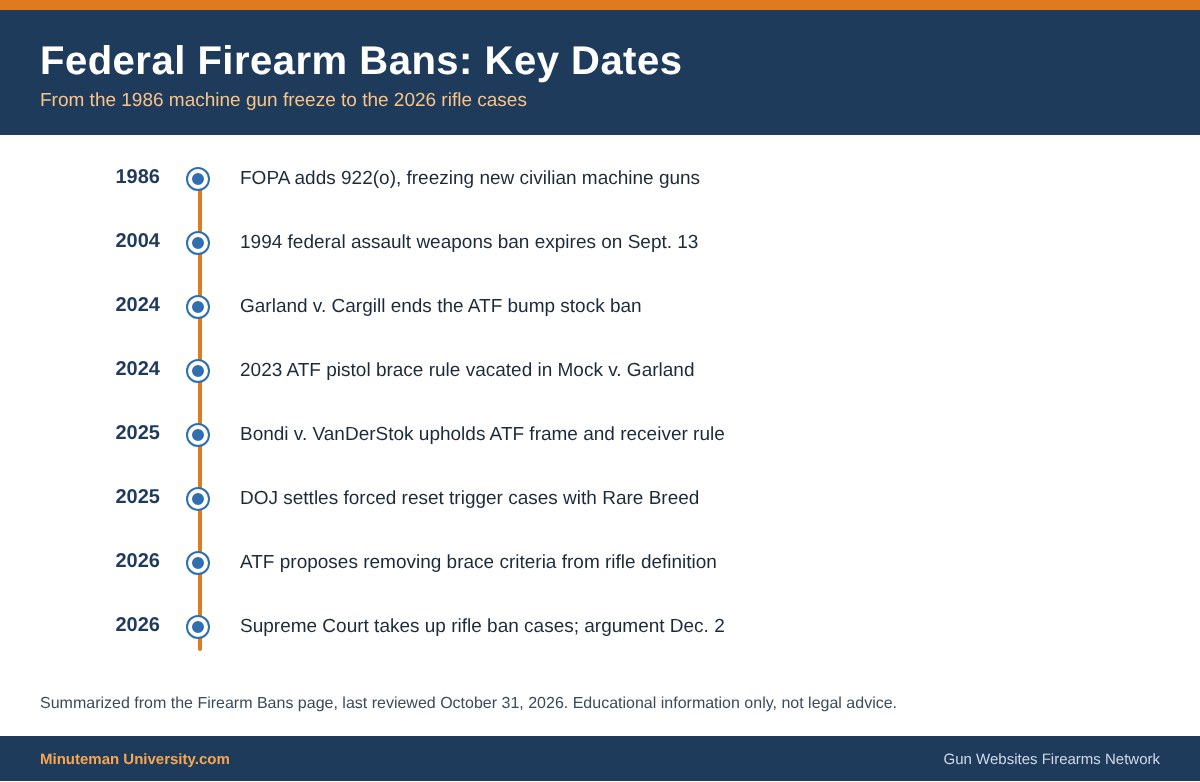
Bans created by agency rule rather than by Congress have been falling. The Supreme Court struck down the ATF bump stock ban in Garland v. Cargill (June 14, 2024). The 2023 ATF pistol brace rule was vacated in court in June 2024, and on May 6, 2026, ATF proposed formally removing the brace criteria from the definition of “rifle.” In May 2025 the Justice Department settled its litigation over forced reset triggers with Rare Breed Triggers. One rule survived: in Bondi v. VanDerStok (March 26, 2025), the Court rejected a facial challenge to ATF’s frame and receiver (“ghost gun”) rule.
The central question is now before the Supreme Court. On June 30, 2026, the Court agreed to hear Viramontes v. Cook County and Grant v. Higgins on whether the Second Amendment protects AR-15 platform and similar semiautomatic rifles, with argument set for December 2, 2026. A ruling for the challengers would put every state rifle ban on the same footing as the handgun bans struck in Heller and McDonald. The 1986 federal freeze on new civilian machine guns (18 U.S.C. 922(o)) remains in force.
Key Facts
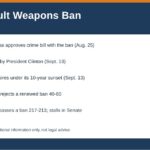
- September 13, 2004: the 1994 federal assault weapons ban expired under its own sunset clause.
- May 19, 1986: the Firearm Owners Protection Act added 922(o), barring civilian possession of machine guns made after that date. Still in force as of October 2026.
- June 14, 2024: Garland v. Cargill (6-3) held that a bump stock is not a “machine gun” under federal law, ending ATF’s ban.
- June 2024: the 2023 ATF pistol brace rule was vacated (Mock v. Garland, N.D. Tex.). ATF published a proposed rule on May 6, 2026, to remove the brace “factoring criteria”; comments closed August 4, 2026.
- March 26, 2025: Bondi v. VanDerStok (7-2) upheld ATF’s 2022 frame and receiver rule against a facial challenge.
- May 16, 2025: DOJ announced a settlement with Rare Breed Triggers resolving the forced reset trigger cases.
- June 30, 2026: Supreme Court grants review of Cook County (Illinois) and Connecticut rifle bans; argument December 2, 2026.
What Gun Owners Should Know
- A federal rollback does not change state law. Bump stocks, braces, forced reset triggers and many semiautomatics are still banned in some states; see State Gun Bans.
- Agency rules can change with each administration. Keep copies of ATF letters, receipts and product documentation for accessories you own.
- A proposed rule is not a final rule. Until ATF finalizes the brace change, rely on the court orders that vacated the 2023 rule.
- Machine guns and destructive devices are still fully regulated under the NFA. See NFA Buyers Guide.com for current transfer rules.
- Background on the original federal laws is on the Federal Laws page, and case updates are on Court Cases.
Sources
- Supreme Court: Garland v. Cargill opinion (2024)
- ATF: Removing Factoring Criteria for Firearms with Attached Stabilizing Braces
- DOJ: Settlement of Litigation with Rare Breed Triggers
- SCOTUSblog: Viramontes v. Cook County
Background and Resources
State Firearm Bans
Bans on carrying concealed weapons
-
- February 3, 1813 Kentucky
- March 25, 1813 Louisiana
- January 14, 1820 Indiana
- December 25, 1837 Georgia
- 1837-38 Legislative Session Arkansas
- January 27, 1838 Tennessee
- February 2, 1838 Virginia
- February 1, 1839 Alabama
- 1976 District of Columbia banned the possession of any handguns that were not already possessed and registered by residents, and the use of any gun for self‐defense
- 1981 Morton Grove, Illinois banned handguns
- 1982 California proposed a “handgun freeze” allowing current owners to keep their handguns but banned any new acquisitions. The measure was defeated 63–37
– Republican candidate won by 1% in the governor’s race because of so many additional voters in opposition to the handgun freeze - 1983 Chicago, and suburbs of; Evanston, Oak Park & Wilmette enacted handgun bans
– national backlash many states passed preemption laws, forbidding localities from banning handguns - 1990s most of the United States, local handgun bans were outlawed
Federal Firearm Bans
- Mailing of Firearms Act of 1927
Banned the shipping of concealable handguns through the mail - Undetectable Firearms Act (p.50)
– Effective: December 9, 1988 = originally set to expire November 10, 1998
– Congress renewed it again in 1998 for five years (2003)
– Congress renewed it again in 2003 for ten years (2013)
– Congress renewed it again in 2013 for another ten years (2023)
– Renewed repeatedly and now extended through 2031 - Semi Automatic Rifle Import Ban (1989)
– July 7, 1989 – Signed - Gun-Free School Zones Act (GFSZA)
– November 29, 1990
introduced by Senator Herb Kohl of Wisconsin signed into - Federal Assault Weapons Ban AWB
– final passage by Congress August 25, 1994; signed September 13, 1994
- Mailing of Firearms Act of 1927
 1927 Mailing of Firearms Act “National Firearms Control Act” 18 U.S.C.A. § 1715 prohibiting ...Read more...
- Semi Automatic Rifle Import Ban (1989)
 Wed March 15, 1989 – spring suspension July 7, 1989 – Signed ...Read more...
- Gun-Free School Zones Act
 Gun-Free School Zones Act (GFSZA) November 29, 1990 introduced by Senator Herb Kohl of Wisconsin signed into ...Read more...
- Federal Assault Weapons Ban AWB
 given final passage by the US Congress on August 25, ...Read more...