Last reviewed October 31, 2026
Assault Weapons: Where It Stands in 2026
“Assault weapon” is a legal term, not a mechanical one. Each law that uses it writes its own definition, usually covering semi-automatic rifles, pistols and shotguns that accept detachable magazines and have listed features such as a pistol grip, adjustable stock, flash hider or threaded barrel, often with a list of banned models by name. Functionally these firearms fire one round per trigger pull, the same as other semi-automatics. Fully automatic firearms are a separate category regulated under the National Firearms Act and covered on the NFA page.
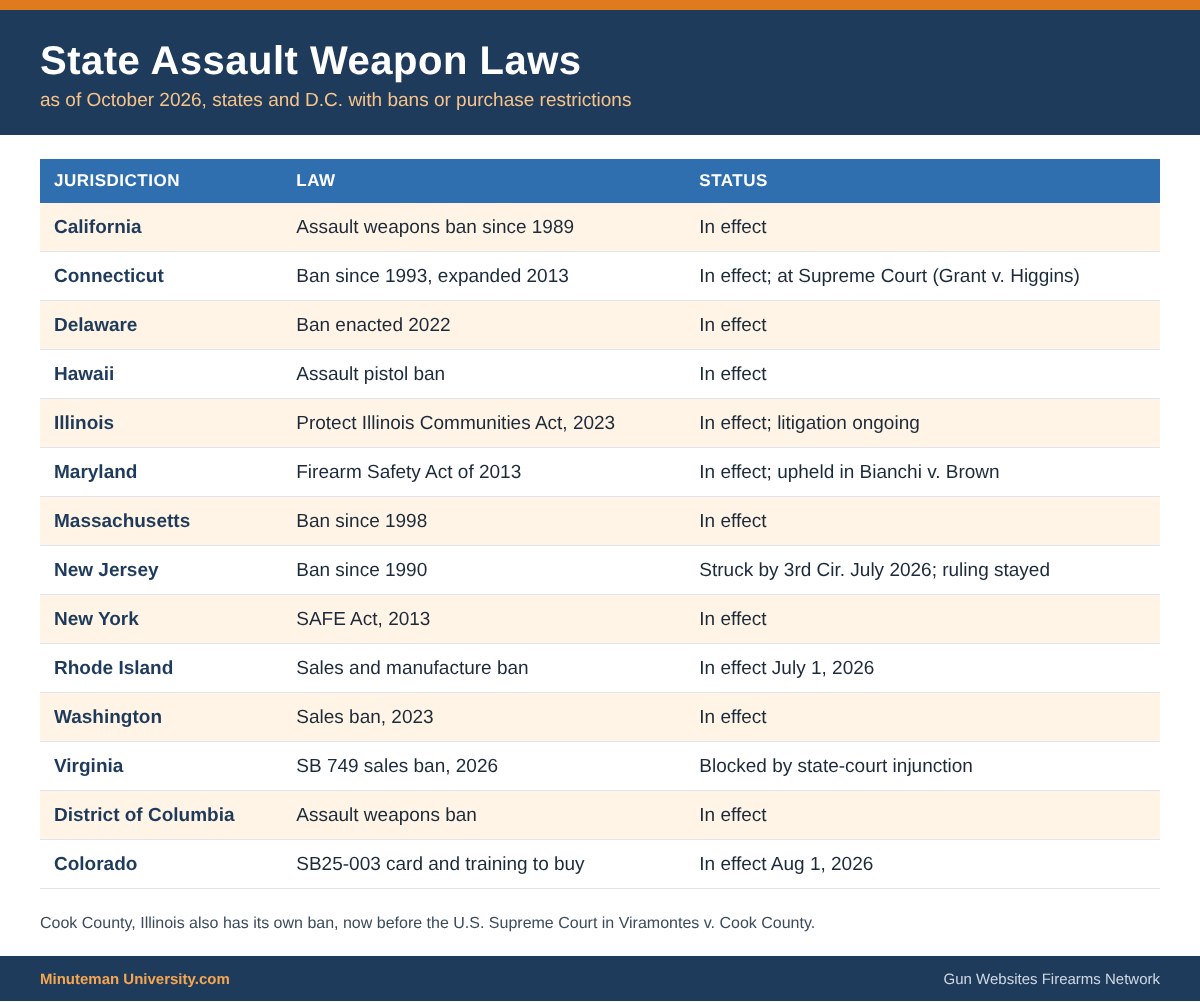
There is no federal assault weapons ban today. The 1994 federal ban expired on September 13, 2004, and Congress has not renewed it. Restrictions now come from states and a few localities. As of October 2026, about a dozen states plus the District of Columbia ban or restrict the sale of firearms they define as assault weapons, and the AR-15, the most popular rifle design in the country, sits at the center of the debate. Supporters of these laws argue the covered rifles are especially dangerous and have been used in high-profile mass shootings. Opponents argue the rifles are owned by millions of law-abiding Americans for lawful purposes, which under District of Columbia v. Heller and NYSRPA v. Bruen places them in “common use” and beyond the reach of a ban.
2026 has been the most active year for this issue since Bruen. On June 30, 2026, the U.S. Supreme Court agreed to hear Viramontes v. Cook County (No. 25-238), a challenge to Cook County, Illinois’ ban, and Grant v. Higgins (No. 25-566), a challenge to Connecticut’s ban. The consolidated cases are set for argument on December 2, 2026, and a decision is expected by the end of the Court’s term in mid-2027. On July 17, 2026, the en banc Third Circuit became the first federal appeals court to strike down a state assault weapons ban, ruling against New Jersey’s law in Association of New Jersey Rifle and Pistol Clubs v. Platkin; the court stayed its own ruling on August 4, 2026, so New Jersey’s ban is still enforced. Other circuits, including the Fourth Circuit in Bianchi v. Brown (Maryland), have upheld similar laws, which creates a clear split for the Supreme Court to resolve.
New laws keep arriving at the same time. Rhode Island’s sales ban took effect July 1, 2026. Virginia’s SB 749, signed in 2026, was blocked statewide by a state-court preliminary injunction before it could take effect and is also the subject of a U.S. Department of Justice lawsuit. Colorado took a different approach with SB25-003, which since August 1, 2026 requires buyers of specified semi-automatic firearms to hold a sheriff-issued eligibility card and complete a firearms safety course. Broader state-by-state context is on the State Gun Bans and Firearm Bans pages.
Key Facts
- September 13, 1994 to September 13, 2004: The federal Public Safety and Recreational Firearms Use Protection Act banned new manufacture of listed semi-automatic firearms; it expired under its sunset clause.
- June 2, 2025: The Supreme Court declined to review Snope v. Brown, leaving the Fourth Circuit’s en banc ruling upholding Maryland’s ban in place.
- June 30, 2026: Certiorari granted in Viramontes v. Cook County and Grant v. Higgins, the first Supreme Court merits review of an assault weapons ban.
- July 1, 2026: Rhode Island’s ban on the sale, manufacture and purchase of listed firearms took effect; existing owners may keep what they lawfully own.
- July 1, 2026: The U.S. Department of Justice filed suit in federal court challenging Virginia’s SB 749 under the Second Amendment.
- July 17, 2026: The en banc Third Circuit held New Jersey’s assault firearm and 10-round magazine bans unconstitutional; the ruling was stayed August 4, 2026.
- August 1, 2026: Colorado’s SB25-003 eligibility-card and training requirement for specified semi-automatic firearms took effect.
- December 2, 2026: Scheduled Supreme Court argument in the consolidated Viramontes and Grant cases.
What Gun Owners Should Know
- Definitions differ sharply by state. A rifle that is legal in one state can be a felony to possess in another because of a single feature, so check the exact statute before buying, building or traveling.
- Most bans grandfather firearms lawfully owned before the effective date, but many attach conditions such as registration, sworn declarations, or limits on transfer and where the firearm may be kept. Missing a deadline can turn a lawful owner into an unlawful one.
- Court rulings do not always change the law on the ground right away. New Jersey’s ban remains enforced despite the Third Circuit’s decision because of the stay; follow official guidance from your state attorney general or state police, not headlines.
- Traveling through restrictive states is governed by the federal safe-passage provision (18 U.S.C. 926A), which requires the firearm to be unloaded and inaccessible; it does not authorize stops or possession in a state where the firearm is banned.
- The Supreme Court’s decision in Viramontes and Grant is likely to shape every state ban. Upcoming dates and anniversaries are tracked on Gun Calendars.com, and AR-platform background is available at AR15 Buyers Guide.com.
- Related reading: Magazine Capacity, License to Purchase and Court Cases.
Across the Gun Websites Network
- AR15 Laws AR15 Buyers Guide.com
- Laws about the AK47 AK47 Buyers Guide.com
- Why did the Supreme Court refuse to hear the AR-15 and magazine ban cases? Ask Gun Questions.com
Sources
- SCOTUSblog: Court announces December cases, including assault weapons challenges
- Supreme Court Docket No. 25-238, Viramontes v. Cook County
- Duke Center for Firearms Law: Third Circuit strikes down New Jersey’s restrictions
- JURIST: U.S. Justice Department sues Virginia, California over firearm restrictions
- Colorado Parks and Wildlife: SB25-003 implementation