Last reviewed October 31, 2026
License to Purchase: Where It Stands in 2026
A license-to-purchase law, also called permit-to-purchase, requires a person to obtain a state-issued license, card or certificate before buying a firearm. This is in addition to the point-of-sale background check required at every licensed dealer under federal law. Depending on the state, the license may cover handguns only, all firearms, or specific categories such as semi-automatic rifles, and it may require fingerprints, a safety course, a live-fire exercise, fees and a waiting period of weeks or months while police process the application.
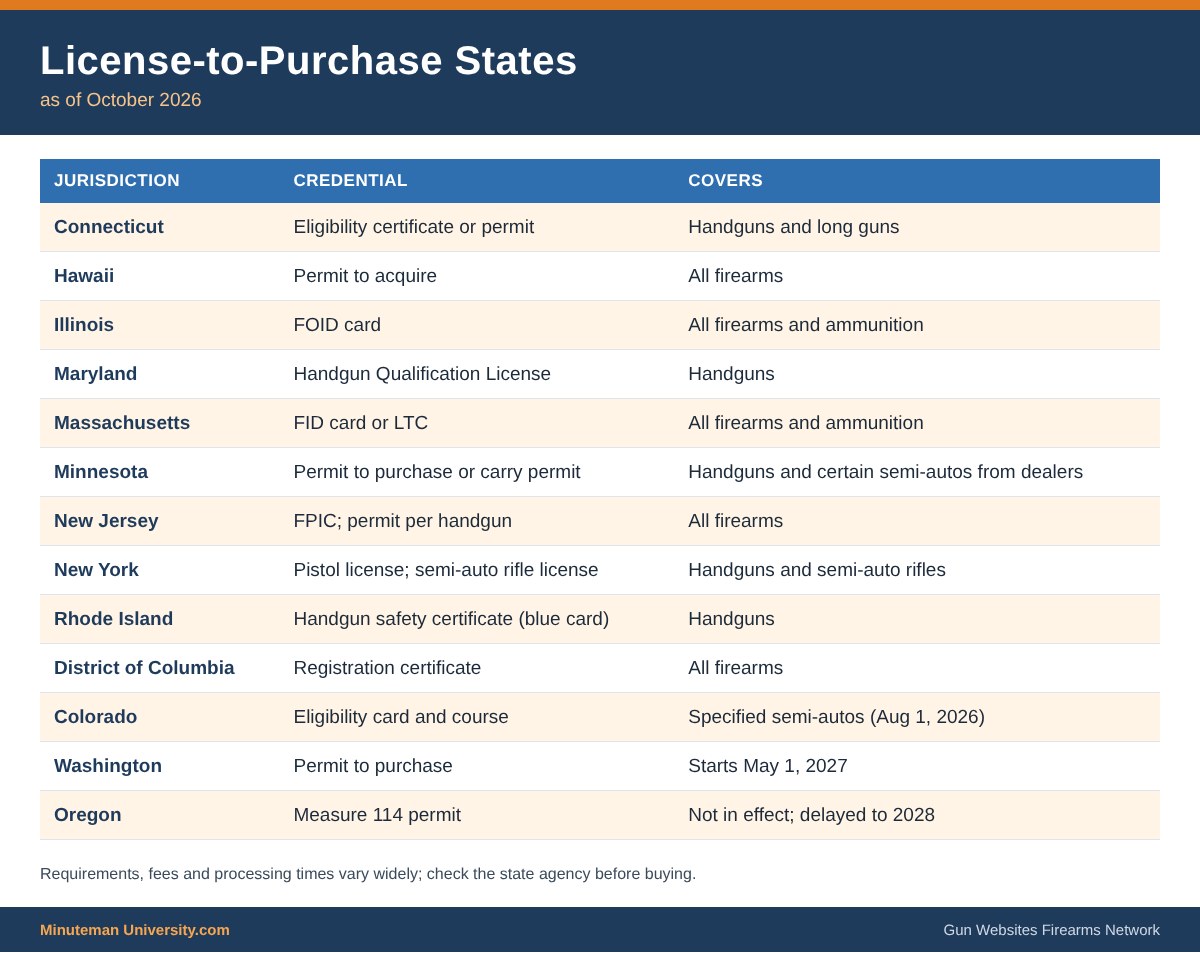
There is no federal purchase license. As of October 2026, about a dozen states plus the District of Columbia require some form of license to buy at least some firearms, and two more have enacted laws that are not yet in force. The trend has run in both directions. Missouri repealed its permit in 2007, Iowa ended its handgun purchase permit in 2021, and North Carolina and Nebraska repealed theirs in 2023. Meanwhile Colorado began requiring an eligibility card and safety course to buy specified semi-automatic firearms on August 1, 2026, and Washington’s permit-to-purchase law (HB 1163, signed May 20, 2025) takes effect May 1, 2027.
Supporters argue that licensing adds a layer of screening and training that reduces firearm trafficking and misuse. Opponents argue that it turns a constitutional right into a government privilege, with costs and delays that fall hardest on lower-income and first-time buyers, and that Bruen requires a historical analogue for such a burden. After Bruen, the en banc Fourth Circuit upheld Maryland’s Handgun Qualification License in August 2024 (Maryland Shall Issue v. Moore), and the Supreme Court declined to take up the case in January 2025. Oregon’s voter-approved Measure 114 permit has never taken effect because of state-court litigation, and 2026 implementing legislation moved its start to January 1, 2028. Carry permits, which are different, are covered on the Gun Permits page; registration is covered on the Gun Registration page.
Key Facts
- October 1, 2013: Maryland’s Handgun Qualification License requirement took effect; it requires fingerprints, a safety course and a live-fire component.
- 2021 and 2023: Iowa (2021), North Carolina (March 2023) and Nebraska (2023) repealed their handgun purchase permit requirements.
- 2022: Oregon voters approved Measure 114, including a permit to purchase; it remains unenforced as of October 2026.
- May 20, 2025: Washington enacted HB 1163, a five-year permit-to-purchase requiring certified safety training, effective May 1, 2027.
- August 1, 2026: Colorado’s SB25-003 began requiring a sheriff-issued eligibility card and in-person safety course to buy specified semi-automatic firearms.
- Licensing states: Connecticut, Hawaii, Illinois, Maryland, Massachusetts, Minnesota, New Jersey, New York, Rhode Island and the District of Columbia all require some form of purchase credential.
What Gun Owners Should Know
- Apply early. Processing times in licensing states range from days to many months, and a license often must be in hand before a purchase can even begin.
- Know which firearms are covered. Several states license handgun purchases only, while others, such as Illinois and Massachusetts, require a credential for any firearm and for ammunition.
- A purchase license is not a carry permit. Some states accept a carry permit in place of a purchase license, but the reverse is rarely true.
- Moving to a licensing state can require a license just to possess firearms you already own. Check the new state’s deadlines before or immediately after moving.
- Keep training records. Many systems require proof of a safety course taken within a set number of years; training resources are listed at After Action.net.
- Related reading: Background Checks, Approved Rosters and State Firearm Laws.