1942 – 1945
17,250 acres
Mead, Nebraska
- one of Nebraska’s 5 major ammunition plants
- 1942-1945 Nebraska Defense Corporation operated the site for the Army
– Ammunition was loaded - 1950-1956 reactivated for the Korean War
- 1959 transferred to GSA
– National Guard & Army Reserve retained roughly 1,000 acres
– 12 acres as a Nike Missile maintenance area - 1960 Air Force Atlas missile Area (AMA) site S-1
– 2,000 acres Atlas Missile site - bomb factory during the Vietnam War
- 1990 added as a Superfund site
- 1997 – 2020+ soil excavation and water treatment
- 1998 Incineration of 16,449 tons of explosives -contaminated soil

About the Nebraska Ordnance Plant
The Nebraska Ordnance Plant was a U.S. Army ammunition loading plant about half a mile south of Mead, in Saunders County, roughly 30 miles west of Omaha. Built for World War II, it covered 17,250 acres of nearly flat farmland and included four bomb load lines, a booster assembly plant, an ammonium nitrate plant, a proving ground and laboratories. Operated for the Army by the Nebraska Defense Corporation from 1942 to 1945, it loaded bombs, boosters and shells with TNT, amatol, tritonal and Composition B, making it part of the arsenal that supplied American forces overseas. It was reactivated from 1950 to 1956 for the Korean War.
After the Army declared it excess in 1959, the land was divided among the National Guard and Army Reserve, a Nike missile maintenance area, an Air Force Atlas missile site and, from 1962, the University of Nebraska–Lincoln, which runs an agricultural research center on much of the property. Investigations in the 1980s found soil and groundwater contaminated with the explosive RDX and the degreaser trichloroethylene, and the site was listed as a Superfund site in 1990. Cleanup under the U.S. Army Corps of Engineers and EPA has included excavating and thermally treating contaminated soil and ongoing groundwater treatment monitored through hundreds of wells.
Key Facts
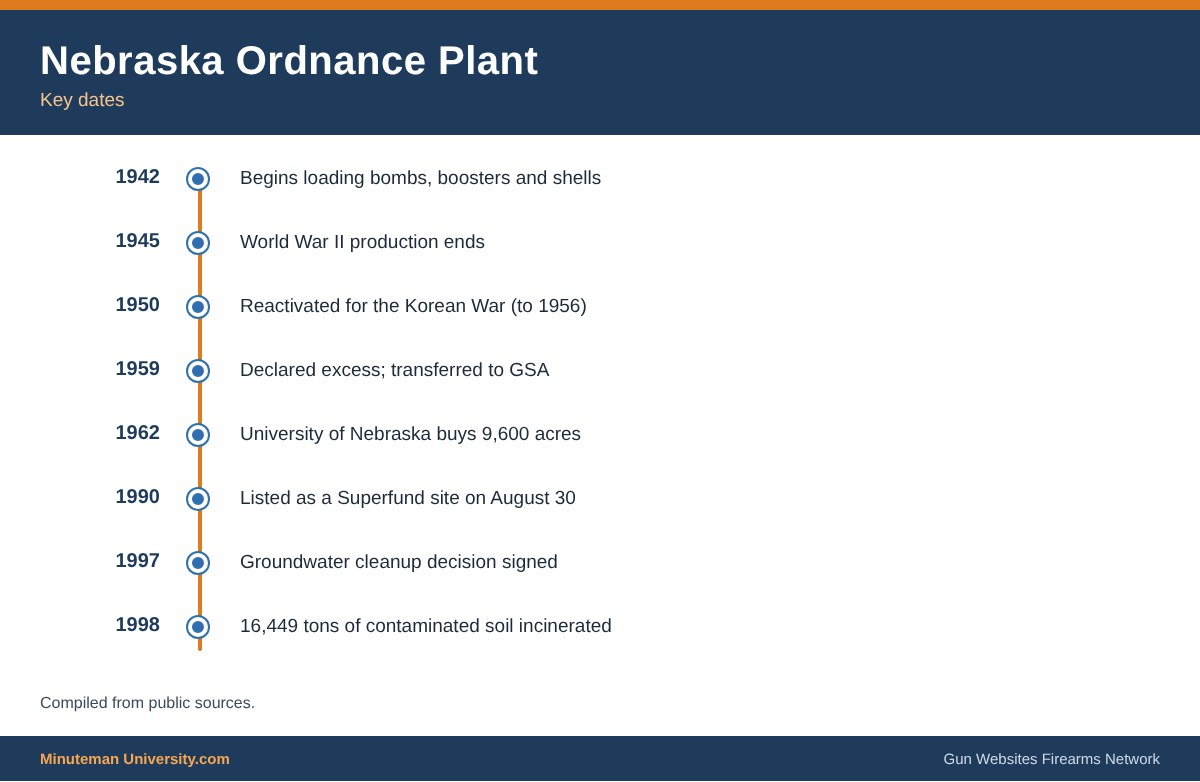
- 1942: The plant begins producing bombs, boosters and shells for World War II.
- 1950 to 1956: Reactivated to produce munitions for the Korean War.
- 1959: Declared excess to Army needs and transferred to the General Services Administration.
- 1962: The University of Nebraska–Lincoln buys about 9,600 acres for agricultural research.
- August 30, 1990: Listed on the EPA National Priorities List as a Superfund site.
- October to December 1998: 16,449 tons of explosives-contaminated soil are incinerated on site.
Sources
Profiles on Minuteman University.com are editorial content compiled from public sources. Inclusion does not imply endorsement of, sponsorship by, or affiliation with this site or the Gun Websites Firearms Network. Corrections and removal requests are welcome through Contact Us.