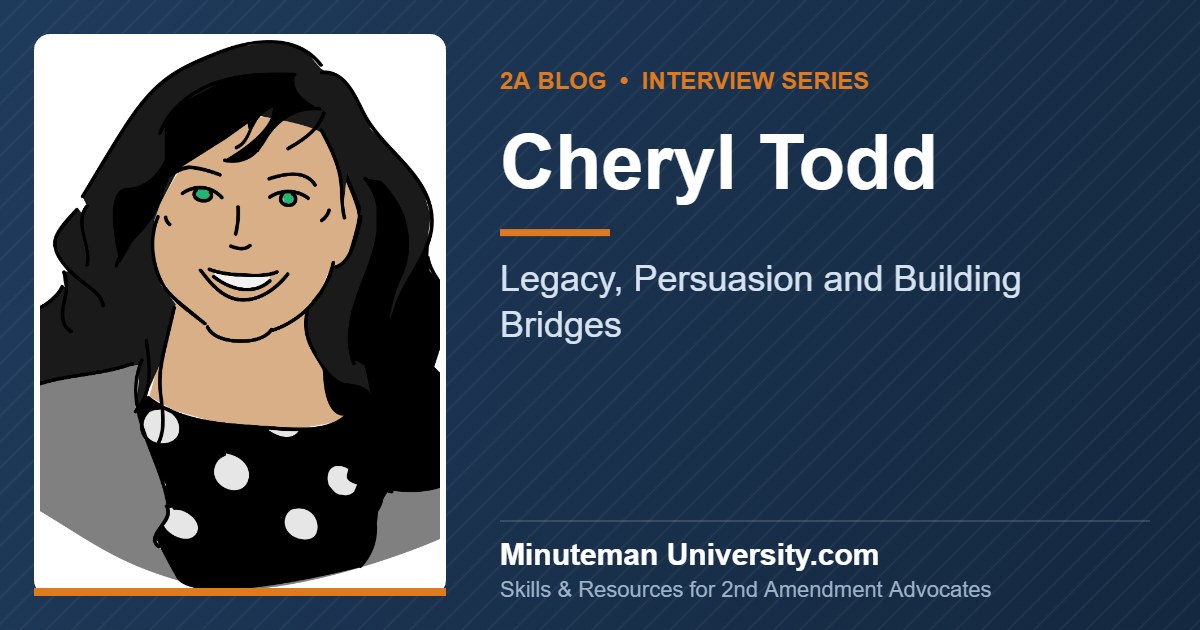
Cheryl Todd is an Arizona Second Amendment advocate, broadcaster and co-host of the Gun Freedom Radio podcast, and a leader in the DC Project and AmmCon. In this 2019 conversation, she explains why she treats advocacy as a relay race across generations and how she persuades people without ever trying to humiliate them. Her approach to communication and coalition building is a model for any advocate who wants to grow the movement.
- Who: Arizona Second Amendment advocate, broadcaster and business owner; co-host of Gun Freedom Radio
- Known for: Gun Freedom Radio, the DC Project, AmmCon, and speaking at the Gun Rights Policy Conference
- Interview: Daily Gun Show bonus interview (part 2 of 2), March 2019
- Profile: Cheryl Todd on Minuteman University.com
Advocacy as a Relay Race
Asked why she does it all, Todd answers in one word: legacy. She sees every gun owner as one runner in a long relay. Each generation takes the baton from those who came before and has to pass it on well, which means explaining what the baton is, what it represents and how to use it, not just handing it over.
“Each one of us is in a relay race from the past to the future.”
Cheryl Todd
In her view, every American is a bridge between the founders and whatever comes next. Once she understood the weight of that responsibility, she could not sit still. She speaks up, reaches out and helps others tell their stories so that her daughter and granddaughter inherit their rights intact.
That sense of responsibility shows up in one of her most useful projects. The Gun Freedom Radio website lists every guest with a biography and links to their work, creating an index of Second Amendment advocates. She describes it as an extension of two habits: collecting books for reference, and constantly connecting people. When she meets someone new, she is already thinking about who that person needs to know.
Never Make Anyone Look Stupid
A viewer asked whether she had ever lost her temper with an anti-gun guest or tried to make one look foolish. Her answer was clear: never on purpose. With a background in psychology and counseling, she was trained to meet people where they are and to set aside judgment. Her rule is to seek first to understand, and then to be understood.
Her reasoning is strategic. Even when the person she is talking to will never change their mind, many other people are listening. A clever put-down might make an advocate look good to people who already agree, but it drives away the open-minded people in the middle, who are the audience that matters. She keeps herself honest by picturing friends across the political spectrum whom she would never want to hurt. There is almost always a way, she says, to make the same point more kindly and more effectively.
She applies the same thinking to everything she produces. Every blog post, interview and speech is a brick in a larger structure. She once declined an invitation to a show built around crude language, not because she judged the hosts, but because it did not fit her message and would have confused her audience.
The Second Amendment Is an Everybody Thing
Todd puts real effort into building bridges beyond the movement’s traditional base. She describes hosting Nicki Stallard of Pink Pistols for a talk on the history of gun control and its consistently racist roots, and she points out a hard truth from that event. Many people in the LGBTQ community want to join the Second Amendment cause, but gun owners sometimes put up barriers through careless language without even realizing it.
“It’s not a conservative thing. It’s not a Republican thing. It’s an everybody thing.”
Cheryl Todd
The DC Project is one of her clearest examples of doing this well. Its founder, Dianna Muller, did not simply recruit the conservative gun owners she already knew. She invited one woman from every state to meet with their own legislators in Washington and show that women gun owners do not fit the stereotype. Through the DC Project, Todd met delegates such as Lara Smith of the Liberal Gun Club. They may disagree on most other political issues, Todd says, but on Second Amendment rights they stand shoulder to shoulder. Her target is not any one party. It is the rights restrictors, whatever letter they carry.
How She Gets It Done
Todd describes herself as ordinary. She had no journalism degree and no radio experience when she and her husband decided to try a show about guns and gun rights. Today she runs most of her work from a laptop and a phone while traveling to events, and she relies on her family, especially her adult daughter, to keep up with new technology. She says what she does would not have been possible 20 years ago. When this interview was recorded, the show was preparing to move from audio radio to a video format, another example of her habit of going where the audience is.
She is also one of the organizers of AmmCon, a one-day gathering held just before the Gun Rights Policy Conference for anyone producing Second Amendment media. Her message to bloggers, video makers and podcasters who doubt they belong is direct: if you are putting in the time and effort, you are part of that community. Her advice for anyone hesitant to start comes from Seth Godin’s book Poke the Box: just try, and you will be amazed what you can do or inspire someone else to do.
You Cannot Outsource Your Advocacy
A longtime Arizona resident, Todd acknowledges that political pendulums swing and no state is permanently safe for gun rights. She notes that people sometimes assume a gun-friendly state will stay that way, and that assumption is exactly when they stop paying attention. Her answer is involvement. She praises the Arizona Citizens Defense League for making it easy to contact legislators with ready-to-send letters, and at the time of this interview she served on the board of the Arizona State Rifle and Pistol Association.
She is an NRA life member who does not agree with everything the organization does. In her view, staying inside an organization gives you influence, while leaving puts you outside shouting in. She was struck when someone asked why they should pay NRA dues if they still had to contact their own representatives. Her answer is that even the star player on a team still has to practice. Every member has to do individual work, or they are just a spectator.
She also offers a sharp answer to polls claiming most Americans want stricter gun laws: stricter than what? Most people, she believes, simply want to feel safer, and that is an opening for education. Her advice is to talk about what you love instead of attacking what you hate, go on offense instead of always reacting, and find ways to reach younger generations that were never taught civics.
- Think in generations. Your job is to pass on the right and an understanding of why it matters.
- Seek first to understand. Winning an argument means nothing if it costs you the persuadable audience watching.
- Watch your language. Careless phrasing can shut out allies who want to stand with you.
- No organization can do your advocacy for you. Contact your own representatives, because they do listen.
- Do not wait to feel qualified. If you are putting in the effort, you belong in Second Amendment media.
Watch the full interview
Video: Cheryl Todd from Gun Freedom Radio Podcast & AZFirearms on the Gun Websites YouTube channel.
- DC Project – the women’s advocacy program Todd helps lead
- AmmCon – the gathering for Second Amendment media creators
- Charles Heller – co-founder of the Arizona Citizens Defense League
- 2A Podcasters – more podcasts carrying the Second Amendment message