passage in 1984
provides sentence enhancements for felons who commit crimes with firearms if they are convicted of certain crimes three or more times
About the Armed Career Criminal Act
The Armed Career Criminal Act (ACCA), codified at 18 U.S.C. 924(e), was enacted in 1984 as part of the Comprehensive Crime Control Act. It imposes a mandatory minimum sentence of 15 years in federal prison on a person convicted of unlawfully possessing a firearm under 18 U.S.C. 922(g), most commonly as a felon in possession, who has at least three prior convictions for a violent felony or a serious drug offense committed on different occasions. Without the enhancement, the maximum sentence for that offense is far lower, so the ACCA is one of the most consequential sentencing laws in federal firearms prosecutions.
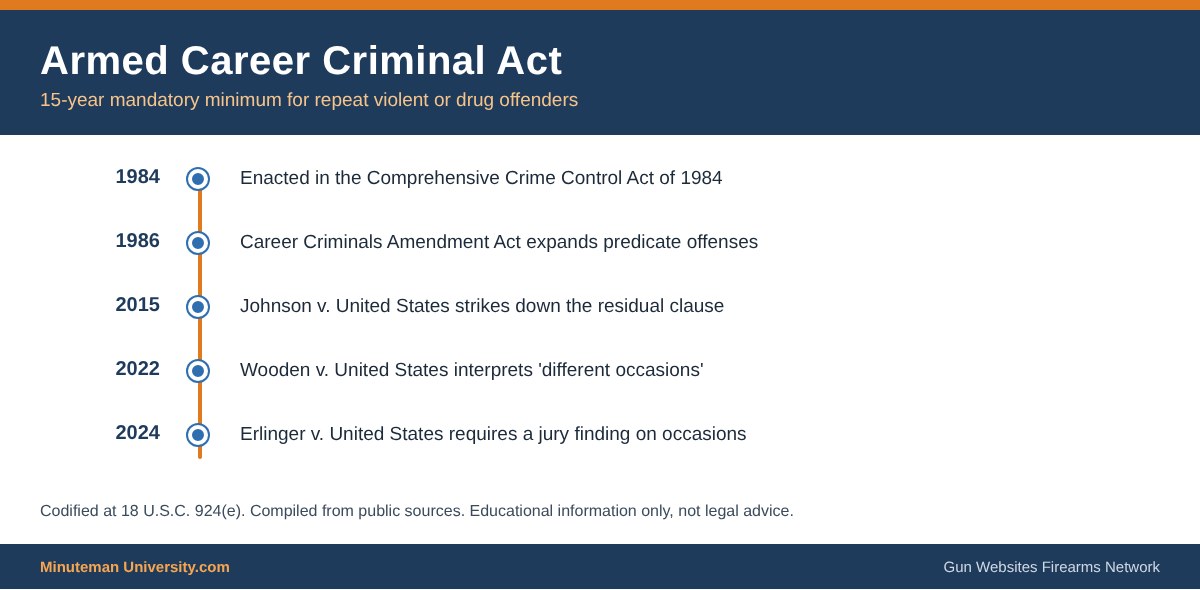
The act has generated a steady stream of Supreme Court cases over what counts as a qualifying prior conviction. In Johnson v. United States (2015), the Court struck down the act’s residual clause, which covered crimes involving a serious potential risk of physical injury, as unconstitutionally vague. In Wooden v. United States (2022) the Court clarified the different-occasions requirement, and in Erlinger v. United States (2024) it held that a jury, not a judge, must decide whether prior offenses occurred on separate occasions. The ACCA targets repeat violent offenders rather than law-abiding gun owners, but its reach depends on how state convictions are classified.
Key Facts
- 1984 – Enacted as part of the Comprehensive Crime Control Act of 1984
- 1986 – Career Criminals Amendment Act expands the qualifying predicate offenses
- June 26, 2015 – Johnson v. United States strikes down the residual clause
- 2022 – Wooden v. United States interprets the different-occasions clause
- 2024 – Erlinger v. United States requires a jury finding on separate occasions