The arms-bearing language appears in the 1866 Freedmen’s Bureau Act, passed over President Johnson’s veto on July 16, 1866.
it interfered with states’ rights, gave preference to one group of citizens over another and would impose a huge financial burden on the federal government, among other issues.
About the Freedmen’s Bureau Acts
The Bureau of Refugees, Freedmen, and Abandoned Lands, known as the Freedmen’s Bureau, was created by an act of Congress signed by President Abraham Lincoln on March 3, 1865. Placed under the War Department, it was to operate during the Civil War and for one year afterward, providing food, housing, medical care and schools to formerly enslaved people and displaced Southerners, overseeing labor contracts and managing abandoned and confiscated lands.
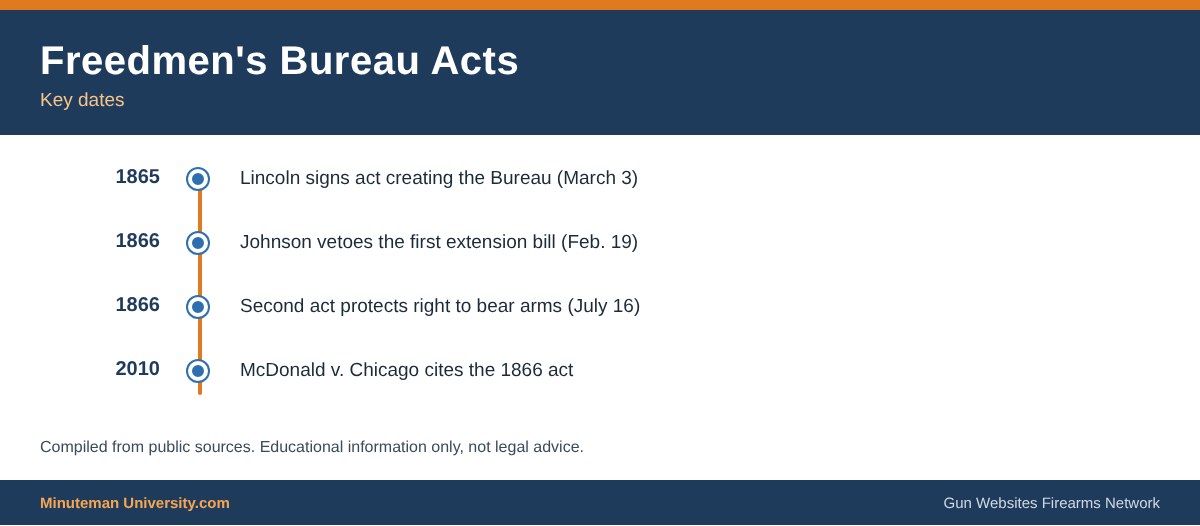
The second Freedmen’s Bureau Act is the one most important to Second Amendment history. Congress first passed an extension bill in February 1866, but President Andrew Johnson vetoed it on February 19, 1866, objecting among other things to federal intrusion on the states, its cost and its treatment of one group of citizens differently from others, and Congress failed to override. A revised bill became law over Johnson’s veto on July 16, 1866. Responding to Black Codes and violence that disarmed freedmen across the South, it guaranteed to all citizens the full benefit of laws concerning personal liberty and security, explicitly including the constitutional right to bear arms. Historians and the Supreme Court in McDonald v. City of Chicago (2010) have cited it as evidence that the Reconstruction Congress understood the right to arms as a personal right.
Key Facts
- March 3, 1865 – Lincoln signs the act creating the Freedmen’s Bureau
- February 19, 1866 – President Andrew Johnson vetoes the first extension bill
- July 16, 1866 – Second Freedmen’s Bureau Act becomes law over Johnson’s veto, protecting the right to bear arms
- 2010 – McDonald v. City of Chicago cites the 1866 act in applying the Second Amendment to the states