Gun-Free School Zones Act (GFSZA)
- November 29, 1990
- introduced by Senator Herb Kohl of Wisconsin
- signed into law by President George H. W. Bush.
- act of the U.S. Congress prohibiting any unauthorized individual from knowingly possessing a loaded or unsecured firearm at a place that the individual knows, or has reasonable cause to believe, is a school zone
- applies to public, private, and parochialelementary schools and high schools
- applies to non-private property within 1000 feet of schools
- It provides that the states and their political subdivisions may issue licenses that exempt the licensed individuals from the prohibition.
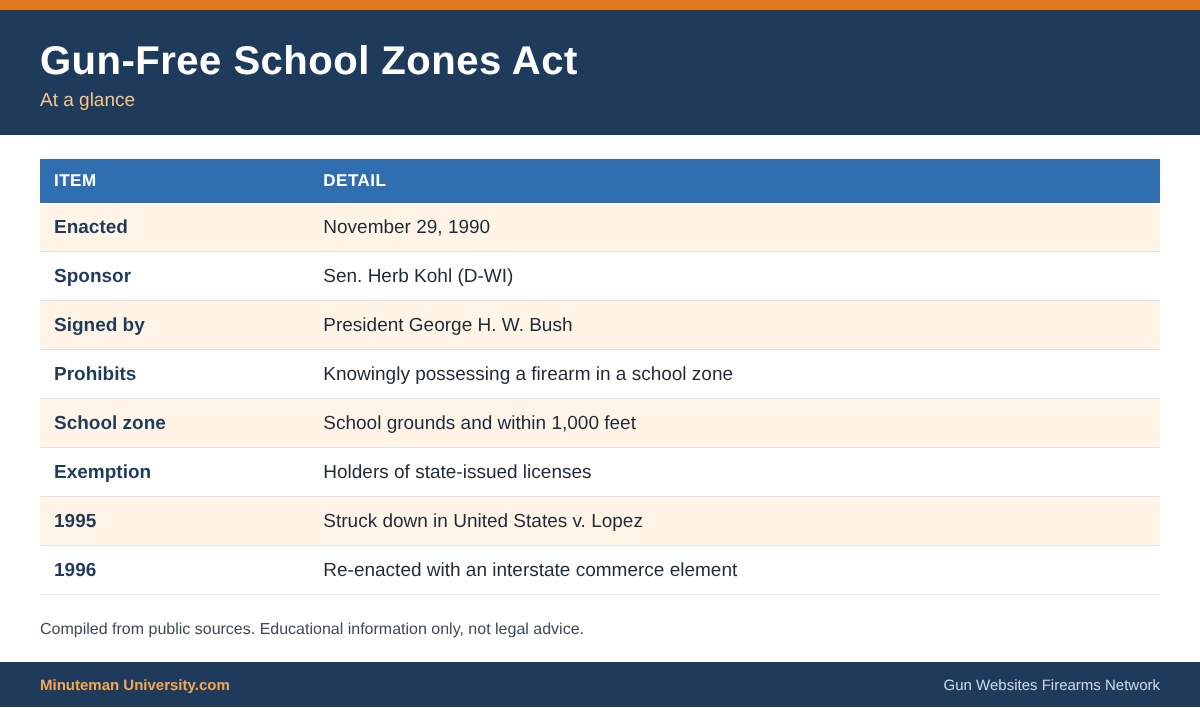
About the Gun-Free School Zones Act
The Gun-Free School Zones Act (GFSZA) is a federal law, codified at 18 U.S.C. 922(q), that makes it a crime to knowingly possess a firearm within 1,000 feet of the grounds of a public, parochial or private K-12 school. Senator Herb Kohl of Wisconsin introduced the final version as S. 3266 in October 1990, and it became law as section 1702 of the Crime Control Act of 1990, signed by President George H. W. Bush on November 29, 1990. Exemptions cover holders of a license issued by the state where the school sits, unloaded guns in a locked container or locked rack, school-approved programs, law enforcement, and private property that is not part of school grounds. Violations carry up to five years in prison.
The act is a landmark in constitutional law. In United States v. Lopez (1995), the Supreme Court struck down the original statute, holding that Congress had exceeded its Commerce Clause power. Congress re-enacted it on September 30, 1996, adding a requirement that the firearm has moved in or affects interstate commerce. Several federal appeals courts have upheld that version, and the Supreme Court has not reviewed it. As of 2026 repeal bills have not advanced past committee, and the law remains a key concern for permit holders traveling across state lines.
Key Facts
- October 27, 1990: S. 3266 passes the Senate by voice vote and the House 313-1
- November 29, 1990: signed by President George H. W. Bush as part of the Crime Control Act of 1990
- 1995: Supreme Court strikes down the original act in United States v. Lopez, 514 U.S. 549
- September 30, 1996: Congress re-enacts the law with an interstate commerce element (Pub. L. 104-208)
- 2007 to 2025: repeated repeal bills introduced in the House; none advances past committee