Last reviewed October 31, 2026
Criminal History: High-Profile Crimes and the Gun Laws That Followed
Many of the most significant American gun laws were written in the months after a widely covered crime. Supporters of those laws see this as democracy responding to tragedy. Critics argue that laws drafted under emotional pressure often target the tools and the law-abiding public rather than the offenders, and that many would not have prevented the crime that prompted them. Either way, knowing this history explains why particular laws exist and why they take the shape they do.
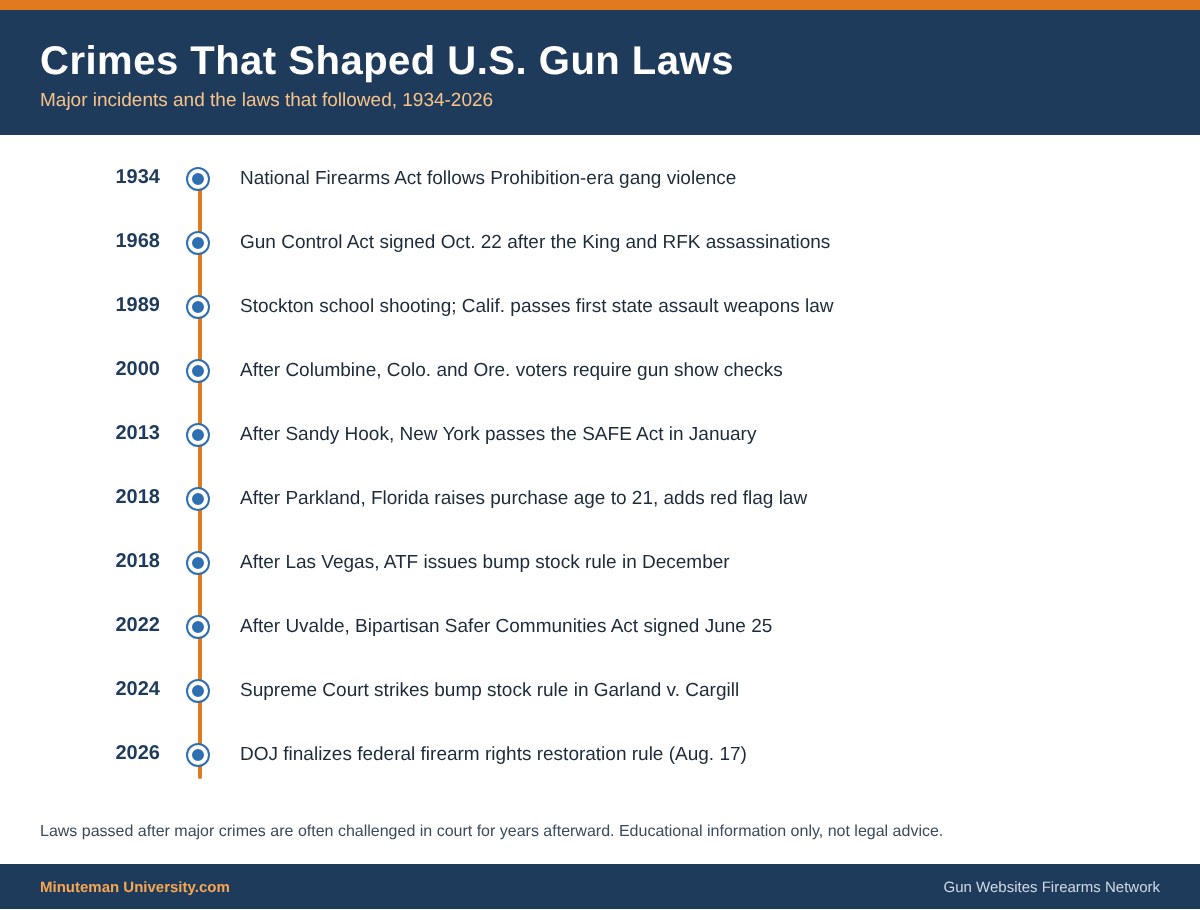
The pattern goes back nearly a century. Prohibition-era gang violence preceded the National Firearms Act of 1934. The assassinations of President John F. Kennedy in 1963 and of Martin Luther King Jr. and Senator Robert F. Kennedy in 1968 preceded the Gun Control Act, signed October 22, 1968. The January 17, 1989, schoolyard shooting in Stockton, California, which killed five children, was followed within weeks by a federal suspension of imports of certain semiautomatic rifles and, that May, by California's Roberti-Roos Assault Weapons Control Act, the first state law of its kind. After Columbine (April 20, 1999), voters in Colorado and Oregon approved ballot measures in November 2000 requiring background checks on gun show sales.
More recent examples follow the same path. The Sandy Hook shooting of December 14, 2012, led to New York's SAFE Act (January 2013) and new laws in Connecticut and Maryland. After Parkland (February 14, 2018), Florida raised the minimum age to buy any firearm to 21 and adopted a red flag law. The Las Vegas shooting of October 1, 2017, led to the federal bump stock rule, which the Supreme Court struck down in Garland v. Cargill (June 14, 2024). After Uvalde (May 24, 2022), Congress passed the Bipartisan Safer Communities Act, signed June 25, 2022.
Criminal history also matters on an individual level. Federal law bars possession by anyone convicted of a crime punishable by more than one year in prison or of a misdemeanor crime of domestic violence. In August 2026 the Justice Department finalized a rule reopening the long-dormant federal process to restore firearm rights, with tiered waiting periods and permanent presumptive bars for violent felonies.
Key Facts
- NFA (1934), GCA (1968), California's 1989 assault weapons law and the BSCA (2022) all followed high-profile crimes.
- Colorado's Amendment 22 and Oregon's Measure 5 (both November 2000) came after Columbine.
- The federal bump stock rule (2018) was struck down in 2024 as exceeding the ATF's statutory authority.
- The DOJ rights-restoration rule announced August 17, 2026, accepts applications in phases through an online portal.
What Gun Owners Should Know
- Expect new legislative proposals after major incidents; follow state legislatures and comment periods closely.
- Ask whether a proposed law would have changed the outcome of the crime cited for it; it is a fair, factual question.
- People with old convictions should research both federal relief and their own state's restoration process, since federal relief does not override state law.
Related: Felons and Guns, Waves of Infringements, Red Flag Laws, Federal Laws, and dates in firearms history on Gun Calendars.com.
Sources
- Garland v. Cargill, 602 U.S. 406 (2024)
- Congress.gov: Bipartisan Safer Communities Act (S. 2938)
- Williams Mullen: DOJ Finalizes Rule Restoring Federal Firearms Rights (Aug. 2026)
- U.S. Department of Justice: Federal Firearm Rights Restoration
Crimes the Gun Control Lobby exploited
- 1989 • Jan 17, Stockton, California – murderer at school playground
- 1999 • Apr 20, Columbine, Colorado – murderers at school