Last reviewed October 31, 2026
Felons & Guns: Where It Stands in 2026
Federal law at 18 U.S.C. 922(g)(1) makes it a crime for anyone convicted of “a crime punishable by imprisonment for a term exceeding one year” to ship, transport, possess or receive firearms or ammunition. The test is the maximum sentence the offense allowed, not the sentence actually served, so the ban reaches many nonviolent offenses and some state misdemeanors. Two exclusions in 18 U.S.C. 921(a)(20) matter: state misdemeanors punishable by two years or less are not covered, and neither are certain business offenses such as antitrust violations. A conviction also does not count if it has been expunged, set aside or pardoned, or if civil rights have been restored, unless the restoration expressly says the person may not possess firearms. Since 2022, a 922(g) violation carries up to 15 years in federal prison.
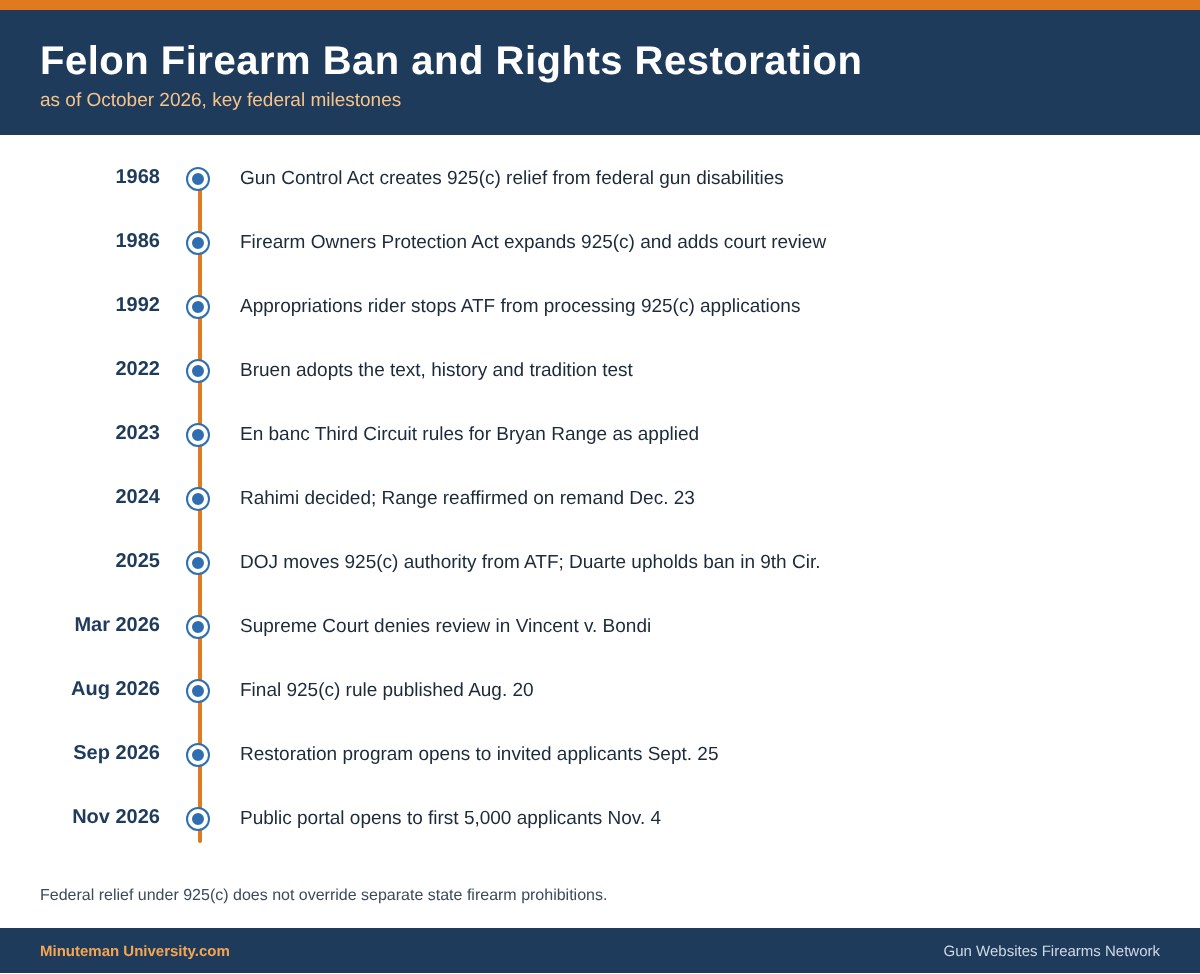
For decades, the main federal path back was closed. Section 925(c) has allowed relief from federal firearms disabilities since the Gun Control Act of 1968, but starting in 1992, Congress barred ATF from spending money to process applications. In March 2025, the Justice Department moved the authority from ATF back to the Attorney General, and after a proposed rule in July 2025, it published a final rule on August 20, 2026. The new Federal Firearm Rights Restoration program, run with the Office of the Pardon Attorney, opened to invited applicants on September 25, 2026 and opens to the first 5,000 public applicants on November 4, 2026, with 500 more on January 4, 2027, when a $30 fee begins. Applicants must show they are not likely to be dangerous to public safety, and certain violent and other serious offenses are presumptively disqualifying. Federal relief does not override any separate state prohibition.
The constitutional question remains divided after Bruen and Rahimi. In Range v. Attorney General, the en banc Third Circuit held 922(g)(1) unconstitutional as applied to Bryan Range, whose disqualifying offense was a 1995 food-stamp fraud conviction, first in 2023 and again on December 23, 2024, after a Supreme Court remand. The Sixth Circuit (United States v. Williams, 2024) allows individuals to show they are not dangerous, and the Fifth Circuit (United States v. Diaz, 2024) left room for some as-applied challenges. Other circuits, including the Ninth (United States v. Duarte, en banc, May 9, 2025), Tenth, Eighth and Eleventh, have upheld the law across the board. On March 2, 2026, the Supreme Court declined to review Vincent v. Bondi, a nonviolent-felon challenge, after the government pointed to the new restoration process. Supporters of a categorical ban argue legislatures have long disarmed people convicted of serious crimes; challengers argue history supports disarming dangerous people, not everyone with a nonviolent record. Related federal prohibitions are covered on the Marijuana & Guns and Red Flag Laws pages.
Key Facts
- Statute: 18 U.S.C. 922(g)(1) bars firearm and ammunition possession by persons convicted of crimes punishable by more than one year; 18 U.S.C. 924(a)(8) sets a maximum of 15 years.
- 1992 to 2025: Annual appropriations riders barred ATF from acting on 925(c) relief applications, leaving pardons and state remedies as the main options.
- March 20, 2025: Interim final rule withdrew ATF’s delegated 925(c) authority; a proposed rule followed July 22, 2025.
- December 23, 2024: The en banc Third Circuit again ruled for Bryan Range on remand; the government did not seek Supreme Court review.
- March 2, 2026: The Supreme Court denied review in Vincent v. Bondi; numerous other 922(g)(1) petitions remain on the docket.
- August 20, 2026: Final 925(c) rule published (RIN 1105-AB78), creating 28 CFR Part 107.
- November 4, 2026: Federal Firearm Rights Restoration portal scheduled to open to the first 5,000 public applicants.
What Gun Owners Should Know
- Check the maximum penalty, not the sentence received. An old conviction that drew probation can still be disqualifying if the offense carried a possible term of more than one year.
- State and federal restoration are separate. Under 921(a)(20), a state pardon, expungement or rights restoration generally removes a state conviction from the federal ban only if it does not expressly bar firearms; it does not affect federal convictions, which require a presidential pardon or 925(c) relief.
- States vary widely. Some restore firearm rights automatically after a waiting period, others require a pardon or a court petition, and some never restore rights for certain offenses. The Restoration of Rights Project tracks each state’s rules.
- A favorable appeals court ruling such as Range applies to the specific person and circuit. It is not a general license; anyone uncertain about their status should consult a qualified attorney and seek formal relief before acquiring a firearm.
- Households with a prohibited member face real risk: a firearm or ammunition the prohibited person can access may be treated as constructive possession. Secure storage and legal advice matter.
- A NICS denial can be appealed through the FBI if it is based on an error; see the Background Checks page.