Most federal gun laws rest on Congress’s power to regulate interstate commerce.
Last reviewed October 31, 2026
Commerce Clause: How It Powers, and Limits, Federal Gun Law
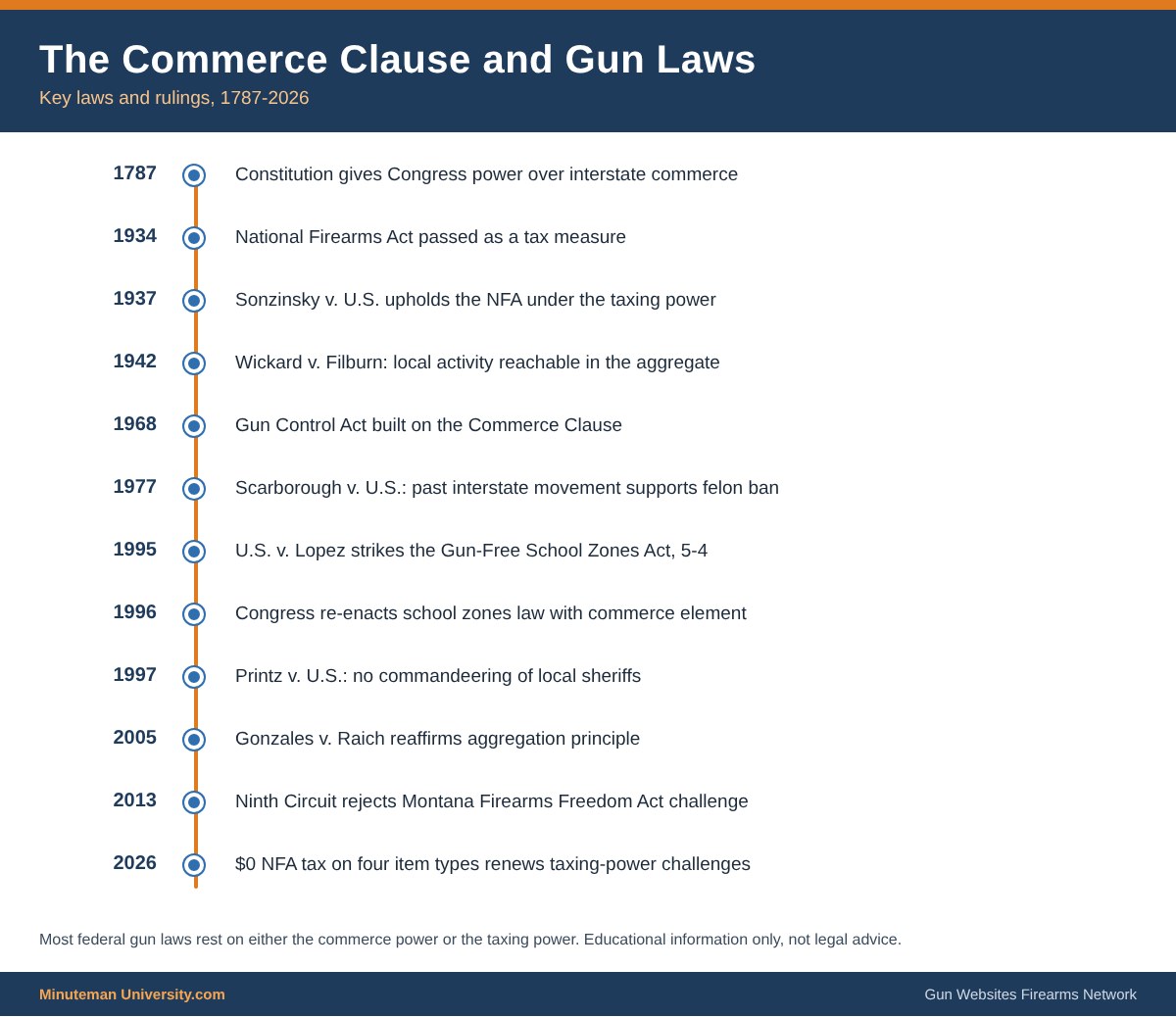
Article I, Section 8 of the Constitution gives Congress power "to regulate Commerce … among the several States." The federal government has no general police power, so most federal gun laws rest on this clause or on the taxing power. Understanding which power a law relies on is the first step in understanding how it can be challenged.
The National Firearms Act of 1934 was written as a tax measure, and the Supreme Court upheld it on that basis in Sonzinsky v. United States (1937). The Gun Control Act of 1968, by contrast, rests on the Commerce Clause: it regulates who may deal in firearms and who may possess guns that have moved in interstate commerce. In Scarborough v. United States (1977), the Court held that a firearm's past movement across state lines is enough to support the federal ban on possession by felons. After Wickard v. Filburn (1942) and Gonzales v. Raich (2005), Congress can also reach purely local activity that, taken in the aggregate, substantially affects an interstate market.
The limits matter just as much. In United States v. Lopez (April 26, 1995), the Court struck down the Gun-Free School Zones Act of 1990 by a 5-4 vote, holding that simple possession of a gun near a school is not economic activity. Congress re-enacted the law in 1996, adding a requirement that the firearm have moved in interstate commerce. In Printz v. United States (1997), the Court held under the Tenth Amendment that Congress cannot order local sheriffs to run Brady Act background checks. States have tested the boundary too: Montana's 2009 Firearms Freedom Act tried to exempt guns made and kept in-state from federal rules, but the Ninth Circuit rejected that challenge in 2013.
Can the federal government be challenged for overreach? Yes. Challenges come as a defense in a criminal case (as in Lopez), as civil suits seeking a declaratory judgment, or as suits brought by states. The issue is live again in 2026: with the NFA tax on suppressors, short-barreled rifles, short-barreled shotguns and AOWs set to $0 since January 1, 2026, challengers argue that registration of those items can no longer rest on the taxing power.
Key Facts
- NFA (1934): taxing power; GCA (1968): Commerce Clause.
- Lopez (1995) was the first time in nearly 60 years the Court found a law exceeded the commerce power.
- Printz (1997) was decided on anti-commandeering grounds, not the Commerce Clause.
- Raich (2005) confirmed the aggregation principle for local, non-commercial activity.
What Gun Owners Should Know
- Federal possession crimes usually require proof of an interstate commerce link, but nearly every commercially made firearm meets it.
- State "firearms freedom" laws do not protect anyone from federal prosecution.
- Watch the NFA litigation of 2025-2026; it turns on which constitutional power supports registration.
Related: Federal Laws, Montana Firearms Freedom Act, National Firearms Act, Strict Scrutiny vs. Intermediate Scrutiny, and NFA updates on NFA Buyers Guide.com.
Sources
- United States v. Lopez, 514 U.S. 549 (1995)
- Printz v. United States, 521 U.S. 898 (1997)
- Scarborough v. United States, 431 U.S. 563 (1977)
- Constitution Annotated: Commerce Clause
- What does the National Government have the power to Regulate?
- Can the Federal Government be sued on grounds of overreach?