The Right to Carry a Concealed Handgun: From Permit Discretion to Shall-Issue, Permitless Carry and Bruen
For much of American history, carrying a concealed handgun was either restricted or left to the discretion of local officials. Vermont was the long-standing exception: a 1903 Vermont Supreme Court decision (State v. Rosenthal) is commonly cited as the reason the state has never required a carry permit. Elsewhere, “may-issue” systems let a sheriff or police chief decide who received a permit, and many applicants had to show a special need.
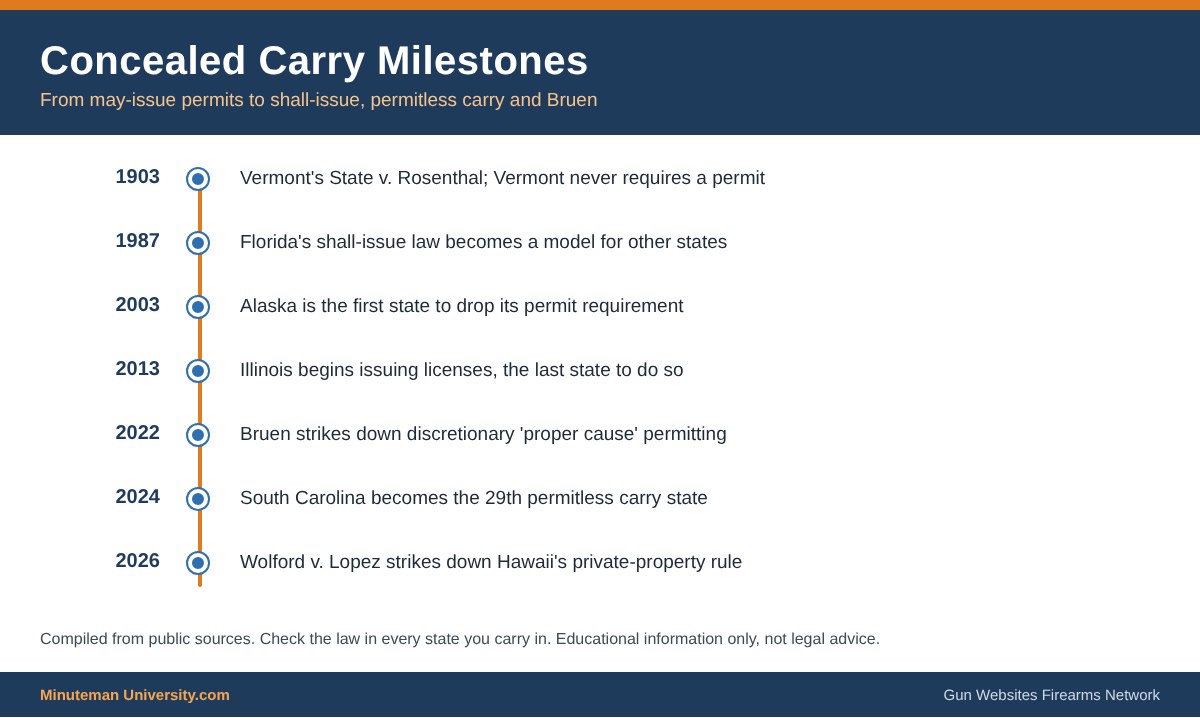
The modern shift began with “shall-issue” laws, which require officials to issue a permit to any applicant who meets objective criteria such as age, a clean record and, in many states, training. Florida’s 1987 law is widely credited with starting the national trend. Illinois became the last state to allow some form of public concealed carry in 2013, after the Seventh Circuit struck down its ban in Moore v. Madigan (2012). The next step was permitless, or “constitutional,” carry: Alaska dropped its permit requirement in 2003, and by 2024 a total of 29 states allowed most law-abiding adults to carry without a permit. Most of those states still issue optional permits, which remain useful for reciprocity and for buying firearms in some states.
On June 23, 2022, the U.S. Supreme Court decided New York State Rifle & Pistol Association v. Bruen (6-3). The Court held that the Second Amendment protects carrying a handgun in public for self-defense and struck down New York’s “proper cause” requirement, which affected similar discretionary rules in California, Hawaii, Maryland, Massachusetts, New Jersey and the District of Columbia. Several of those jurisdictions then adopted longer lists of “sensitive places” and other limits, which led to new litigation. In Wolford v. Lopez (June 25, 2026), the Court struck down Hawaii’s rule barring permit holders from carrying on private property open to the public without the owner’s express consent. Supporters of these state laws argue they protect public safety; challengers argue they recreate the barriers Bruen rejected. Courts continue to sort out where the lines fall.
For the full history and state-by-state dates, see Concealed Carry, Constitutional Carry and the Carrying Guns hub.
Key Facts
- 1903: Vermont’s State v. Rosenthal decision; Vermont has never required a carry permit.
- 1987: Florida’s shall-issue law takes effect and becomes a model for other states.
- 2003: Alaska becomes the first state to drop its concealed carry permit requirement.
- 2013: Illinois begins issuing concealed carry licenses, the last state to do so.
- June 23, 2022: Bruen strikes down discretionary “proper cause” permitting and sets the text, history and tradition test.
- 2024: South Carolina becomes the 29th permitless carry state.
- June 25, 2026: Wolford v. Lopez strikes down Hawaii’s private-property default rule (6-3).
What Gun Owners Should Know
- Permitless carry does not remove prohibited-person rules, age limits or sensitive-place restrictions; check the law in every state you carry in.
- A state permit is still the main way to carry legally in other states through reciprocity.
- Post-Bruen laws in former may-issue states are still being litigated; follow court cases before relying on older guidance.
- Training is required for a permit in many states and is useful everywhere; After Action.net covers training topics.