Recognize when lawful owners are pushed to the edge of the debate, and answer it without stooping to it.
Marginalize Gun Owners: How Lawful Owners Get Pushed to the Edge of the Debate, and How to Respond
Roughly speaking, a group is marginalized when it is treated as outside the mainstream: described through stereotypes, discussed in loaded terms, or quietly denied services that other lawful customers receive. Gun owners and the firearm industry have experienced each of these at different times. Recognizing the pattern is the first step toward answering it calmly and accurately, without adopting the same tactics in return.
The most visible form is language and framing. Terms such as “assault weapon” carry no single technical definition and are used differently in different state laws. In 2022 the AP Stylebook described “assault rifle” and “assault weapon” as highly politicized and advised journalists to describe the firearm’s actual function instead (semi-automatic or automatic). Stereotypes about who owns guns, and coverage that mentions firearms mainly in the context of crime, can leave the public with an incomplete picture of the tens of millions of owners who use them lawfully for hunting, sport and self-defense.
A less visible form is financial and platform access. The 2013 federal initiative known as Operation Choke Point listed “firearms sales” and “ammunition sales” among high-risk merchant categories until the FDIC revised that guidance in 2014; the Justice Department formally ended the operation in 2017. In September 2022 the International Organization for Standardization approved a merchant category code for firearm and ammunition retailers; supporters said it could help flag suspicious purchases, while opponents said it could track lawful buyers. Visa, Mastercard, American Express and Discover paused it on March 9, 2023, and states have since split, with several banning its use and California requiring it. On August 7, 2025, an executive order titled “Guaranteeing Fair Banking for All Americans” directed federal regulators to remove “reputation risk” from bank supervision and review politicized debanking. Online, YouTube prohibits firearm sales links and manufacturing instructions and age-restricts some firearm content, which shapes what gun creators can publish.
Those on the other side of the issue generally see these steps as reasonable risk management or public-safety measures rather than targeting. The constructive response is to engage that argument with facts, precise terms and a respectful tone.
Key Facts
- 2013-2017: Operation Choke Point; the FDIC’s high-risk list included firearms and ammunition sales until July 2014, and DOJ ended the operation on August 17, 2017.
- July 2022: AP Stylebook guidance called “assault weapon” and “assault rifle” highly politicized terms.
- September 2022: ISO approved a merchant category code (MCC 5723) for firearm and ammunition retailers.
- March 9, 2023: The four major card networks paused implementation of the code.
- 2023: Texas, Florida, Montana, Idaho, Mississippi, North Dakota and West Virginia were among states passing laws barring the code’s required use; California passed a law requiring it by May 2025.
- August 7, 2025: Executive order “Guaranteeing Fair Banking for All Americans” signed.
- Ongoing: YouTube’s firearms policy bars sales links and build instructions and age-restricts some content.
How to Respond Constructively
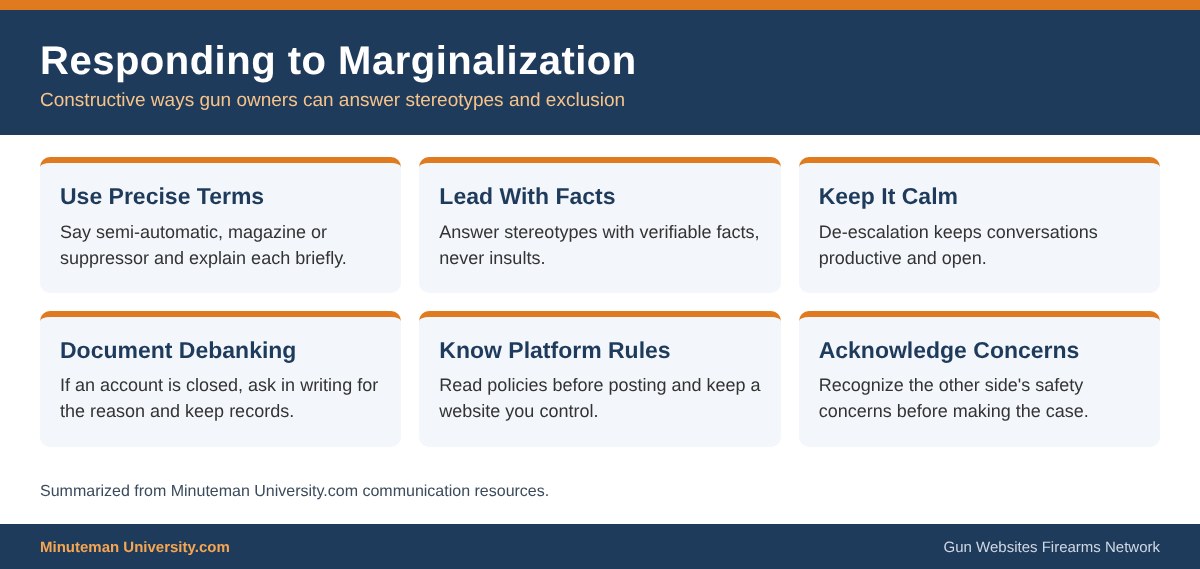
- Use precise terms (semi-automatic, magazine, suppressor) and explain them briefly; see Nomenclature and Jargon.
- Answer stereotypes with verifiable facts, not insults; the Firearm Facts page and Gun Debate Library are a starting point.
- Keep conversations calm; Verbal Judo and Communicating Without Pushing Buttons cover de-escalation.
- If a bank or payment processor closes an account, ask in writing for the stated reason and keep records; check whether your state has a fair-access or MCC law.
- Read platform rules before posting; see Guns on Social Media, and keep a website you control, such as those in the Gun Websites.com network.
- Acknowledge the other side’s safety concerns before making your case; it keeps the discussion open.
Sources
- Payments Dive: Card companies halt gun code plans (March 2023)
- States split over gun merchant category code (Payments Dive via TSG)
- Holland & Knight: Executive Order Briefing, Guaranteeing Fair Banking for All Americans
- YouTube Help: Firearms policy
- TSPR: AP reminds journalists about wording for weapons (2022)