launched by the FBI on November 30, 1998
United States system for determining if prospective firearms or explosives buyers’ name and birth year match those of a person who is not eligible to buy through an FFL
- mandated by the Brady Handgun Violence Prevention Act (Brady Law) of 1993
- launched by the Federal Bureau of Investigation (FBI) in 1998
Background checks are not required under federal law
for intrastate firearm transfers between private parties
About the National Instant Criminal Background Check System
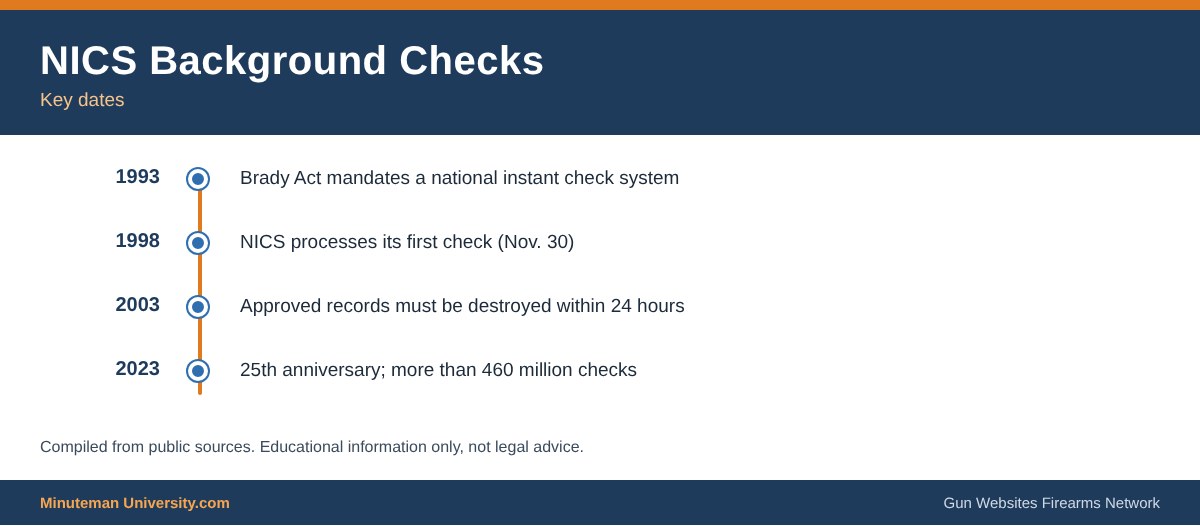
The National Instant Criminal Background Check System, or NICS, is the FBI-run system that licensed firearms dealers contact to determine whether a prospective buyer is prohibited from receiving a firearm under federal or state law. It was required by the permanent provisions of the Brady Handgun Violence Prevention Act of 1993 and processed its first check on November 30, 1998, replacing the interim waiting-period system. When a buyer fills out ATF Form 4473, the dealer submits the buyer’s identifying information and NICS searches federal databases of criminal history, protection orders and other prohibiting records, typically returning a proceed, delay or deny response within minutes.
Some states act as a point of contact and run checks through their own agencies, while others rely on the FBI directly. Federal law does not require background checks for private, intrastate sales between unlicensed individuals, although some states do. By its 25th anniversary in December 2023, the FBI reported that NICS had processed more than 460 million background checks. Under the Tiahrt rider, records of approved transactions must be destroyed within 24 hours, which protects law-abiding buyers from the creation of a federal gun registry.
Key Facts
- November 30, 1993 – Brady Act signed, mandating a national instant check system
- November 30, 1998 – NICS processes its first firearm background check
- 2003 – Appropriations rider requires destruction of approved check records within 24 hours
- December 2023 – FBI marks 25 years and more than 460 million checks